Testosterone blood test: timing, fasting, repeats
A first testosterone test usually happens like this. Someone feels flat for a few months, books a test at whatever time suits, gets one number back, and reads it against the range on the report. If it's low, the conversation about treatment starts from that one number.
One testosterone result is a weak basis for anything. Testosterone is highest in the morning and can be noticeably lower by the afternoon. It drops after a meal, after a bad night, and during an illness. That's why the guidance most doctors follow asks for a morning sample and a repeat test on a different day before calling a level low. The good news is that all of this is under your control.
What a testosterone blood test measures
Most tests report total testosterone: everything in the sample, whether it's bound to proteins or not. A lot of it is held tightly by SHBG, a protein that keeps it out of action, and some is loosely bound to albumin. Only a small part, usually a few percent or less, is free.
Because of that, total testosterone on its own can mislead when SHBG is unusually high or low. Many labs add SHBG and a free testosterone value, either measured or calculated. Our post on free vs total testosterone explains how they relate, and you can work out a calculated free value yourself with our free testosterone calculator.
How to prepare for a testosterone blood test
Test in the morning
Testosterone follows a daily rhythm, highest soon after waking. Most labs and guidelines ask for a sample in the early morning, often before about 10:00. An afternoon result in a younger man can read well below his morning level.
Fast, if you're asked to
A meal, especially a sugary one, lowers testosterone for a few hours. Many labs ask for a fasted morning sample for that reason. Water is fine. Our post on fasting before a blood test covers what else to skip.
Sleep normally the night before
A short night or a night shift can lower testosterone the next morning. If you've slept badly, it's worth moving the appointment. A low number after a bad night may not be your usual level.
Don't test while ill
An infection, a recent operation or a stretch of serious stress can push testosterone down for a while. Wait until you're back to normal.
Skip hard training for a day or two
Very hard or very long sessions can move testosterone and also raise CK and liver enzymes on the same panel.
List everything you take
Opioids, steroid tablets, some antidepressants and anything hormonal can all change the result. So can bodybuilding products, including ones bought as supplements. Your doctor needs to know to read the number.
Use the same lab for the repeat
Testosterone methods differ between labs, and so do their reference ranges. A repeat at another lab mixes a real difference with a method difference.
Why a repeat test matters
Testosterone varies from day to day in the same person, even with everything kept the same. A single low result can be a low day. The usual approach is two separate morning tests, a few weeks apart, before deciding a level is consistently low. If the two disagree a lot, a third helps.
The repeat is also when a few more lines often get added, depending on the first result and on you.
| Test | Why it's often on a first panel |
|---|---|
| SHBG and free testosterone | Shows whether total testosterone tells the whole story |
| LH and FSH | Show whether the testes or the pituitary signal is the issue |
| Prolactin | Can lower testosterone when high |
| Estradiol | Useful as a starting point |
| Haematocrit and haemoglobin | Monitored if treatment starts |
| PSA, at some ages | A starting point if treatment starts |
| Lipids, glucose or HbA1c | Often part of the same check-up |
Which ones you get is your doctor's decision. What's in your control is keeping a copy of each.
Do you need a blood test before starting TRT?
Yes, and more than one. Before treatment, the tests confirm whether testosterone really is low and help find out why. They also become the baseline: once someone is on TRT, every later result is compared with where they started, and those first reports are the only record of it.
This is total testosterone across 13 tests over two years, with what the person was taking shaded:
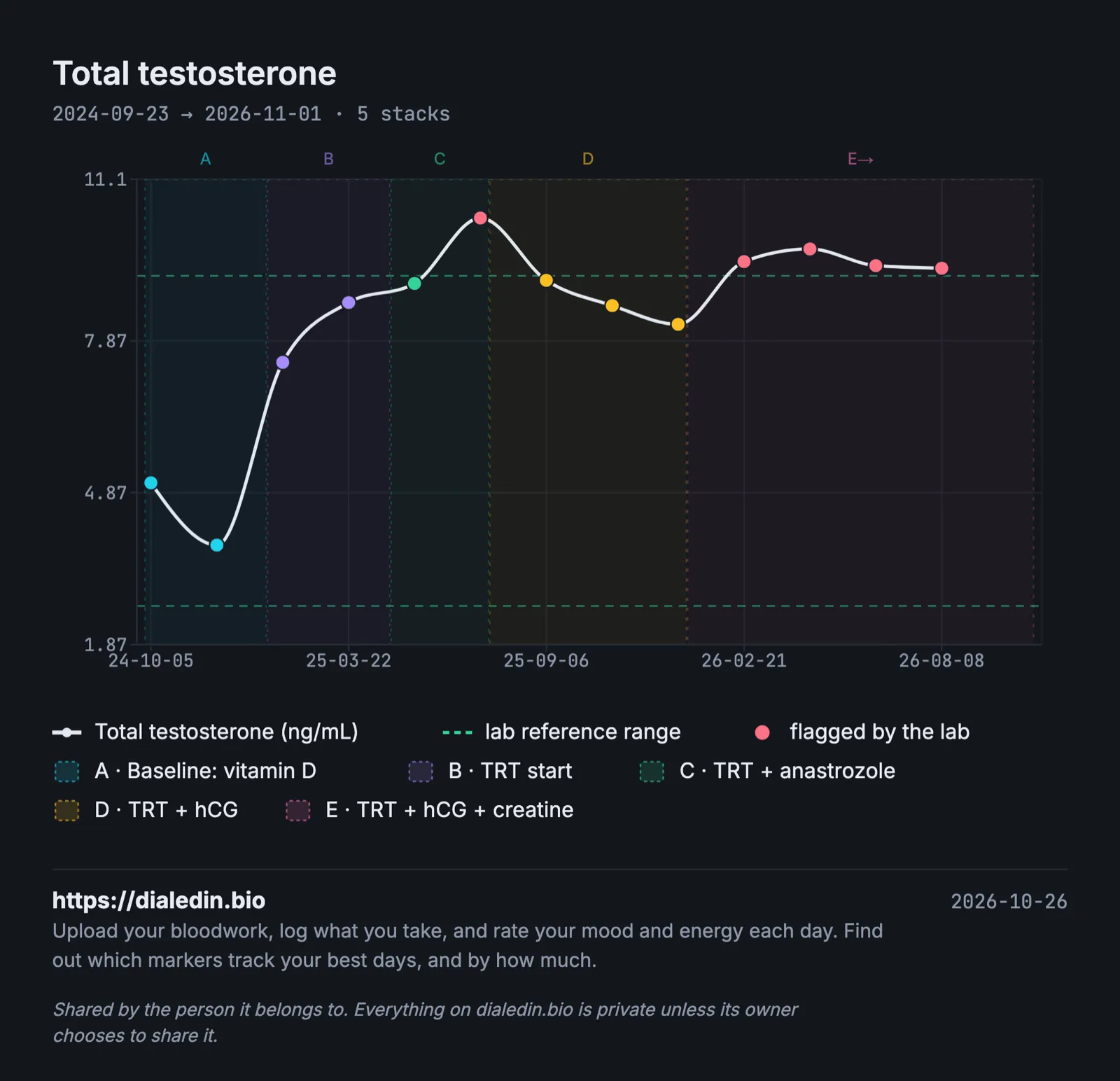
Sample data, not a real person.
The two dots in the first band are the only results from before treatment. Everything after is read against them. Lose those two reports and the later results have nothing to be compared with.
Once treatment starts, when the blood is drawn in the injection or gel cycle matters even more. Our post on TRT blood test timing goes through that.
How often should testosterone be tested?
Without treatment, there's no fixed schedule. It depends on why it was tested and what came back, and your doctor sets it. On treatment, testing is usually more frequent in the first year and then settles to a routine.
Whatever the schedule, keep the conditions the same: same lab, same time of day, same fasting, a normal night's sleep. A result taken that way can be compared with the last one.
A record you can keep by hand
| Date | Lab | Time | Fasted | Total T (ng/dL) | SHBG (nmol/L) | Free T | Notes |
|---|---|---|---|---|---|---|---|
| 2024-10-05 | City Lab | 08:10 | yes | 490 | 38 | 9.6 ng/dL | first test |
| 2024-11-30 | City Lab | 08:05 | yes | 385 | 37 | 7.4 ng/dL | repeat, slept badly |
| 2025-03-22 | City Lab | 08:15 | yes | 860 | 31 | 22 ng/dL | on TRT, mid-cycle |
Note the time, the fasting and anything unusual about the night before. Those three columns explain most of the surprises later. If your reports come in different units, our post on testosterone units has the conversions.
Where dialedin fits
We built dialedin so the baseline reports don't get lost in an inbox, and every later result sits next to them.
You upload a lab PDF and it is read into individual markers, which you check before saving. Every report goes onto one timeline, and the same marker under different lab names stays one line. You can record what you were taking and when, like the shaded bands above, and add an optional daily check-in to see which levels line up with your better days. You can export your history as a PDF for your doctor.
It's free while we're in beta. If your first testosterone results are in a folder somewhere, put them on one timeline now, while you still have them.
This article is general information, not medical advice, and it can't take your own history into account. Talk to your doctor about which tests you need and what your results mean for you.