Estradiol in men: why it's on a TRT panel
Estradiol is the main estrogen, and many men are surprised to find it on their bloodwork at all. On testosterone therapy it often becomes the number men argue about most, on forums and with their prescribers.
The reason it's there is simple chemistry. Men make most of their estradiol from testosterone, using an enzyme called aromatase found in fat, muscle, bone, the brain and the testes. More testosterone in usually means more estradiol out. So when testosterone goes up on TRT, estradiol tends to follow, and how far it follows differs a lot from one man to the next.
What estradiol does in men
Estradiol does real work in men. It's the main hormone keeping bones dense in men as well as women, and it's involved in libido, erections and where the body stores fat. A study that lowered men's own testosterone and then added it back, with or without the ability to turn it into estradiol, found that several effects people credit to testosterone needed estradiol too (Finkelstein et al., 2013).
Both very high and very low estradiol have been linked to symptoms in men, and the level that suits one man may not suit another. What your levels should be is a question for your prescriber. What you can do yourself is make the measurements comparable and keep a record of how you felt.
Why estradiol rises on TRT
How much testosterone turns into estradiol depends on how much aromatase you have, and that varies between men. Body fat holds a lot of it, so men with more body fat tend to make more estradiol from the same testosterone. Age matters, and so do genetics and some medicines.
The form and timing of therapy matter too. On injections, estradiol rises and falls through the cycle along with testosterone. A test taken at the peak and one taken at the trough can differ a lot without anything having changed. Our post on TRT blood test timing covers how to pick a point in the cycle and keep to it.
SHBG binds estradiol as well as testosterone, so a change in SHBG can shift how much of either is free. Our post on high or low SHBG explains what moves it.
The test method matters more than usual
There are two common ways to measure estradiol, and at male levels they can give quite different numbers.
| Method | What it's often called | At male levels |
|---|---|---|
| Immunoassay | "Estradiol", the standard test | Less accurate at low concentrations. Other substances can cross-react and push the reading up |
| LC-MS/MS (mass spectrometry) | "Estradiol, sensitive" or "ultrasensitive" | Built for low levels. Generally the more accurate choice for men |
Standard immunoassays were designed for the much higher levels seen in women, so at male levels they tend to be noisier. If you compare a standard result with a sensitive one, part of the difference is the method. Ask which one your lab uses, and keep to it.
How to track estradiol on TRT
Test at the same point in your injection cycle
This is the biggest source of noise. Write down how many days had passed since the last injection, or how many hours since applying a gel, on every result.
Use the same lab and the same method
Write the method next to the result: standard or sensitive. A switch from one to the other can look like a big change in your levels.
Check the units
Estradiol comes in pg/mL in the US and pmol/L in much of Europe. To convert, multiply pg/mL by 3.671 to get pmol/L, or divide pmol/L by 3.671. 30 pg/mL is about 110 pmol/L. Mixing the two on one chart makes a mess. Our post on testosterone units has the conversions for the rest of the panel.
Look at testosterone and estradiol together
Since one is made from the other, they're easier to read side by side. The testosterone to estradiol ratio calculator puts both into one number. It describes your own results over time, and it has no reference range of its own.
Note weight changes and new medicines
Losing or gaining a lot of weight changes how much aromatase you have. A new medicine, or a change your prescriber makes to your therapy, can move estradiol within weeks. A line next to the result tells you why a step appeared.
Record how you feel, not only the number
Because the level that suits each man varies, the only way to learn yours is to put your results next to how you were doing at the time. Write down mood, sleep, energy and libido on the days around each test, or rate each day briefly.
This is estradiol across 13 tests over two years, with four stacks shaded and a daily check-in shown as coloured dots:
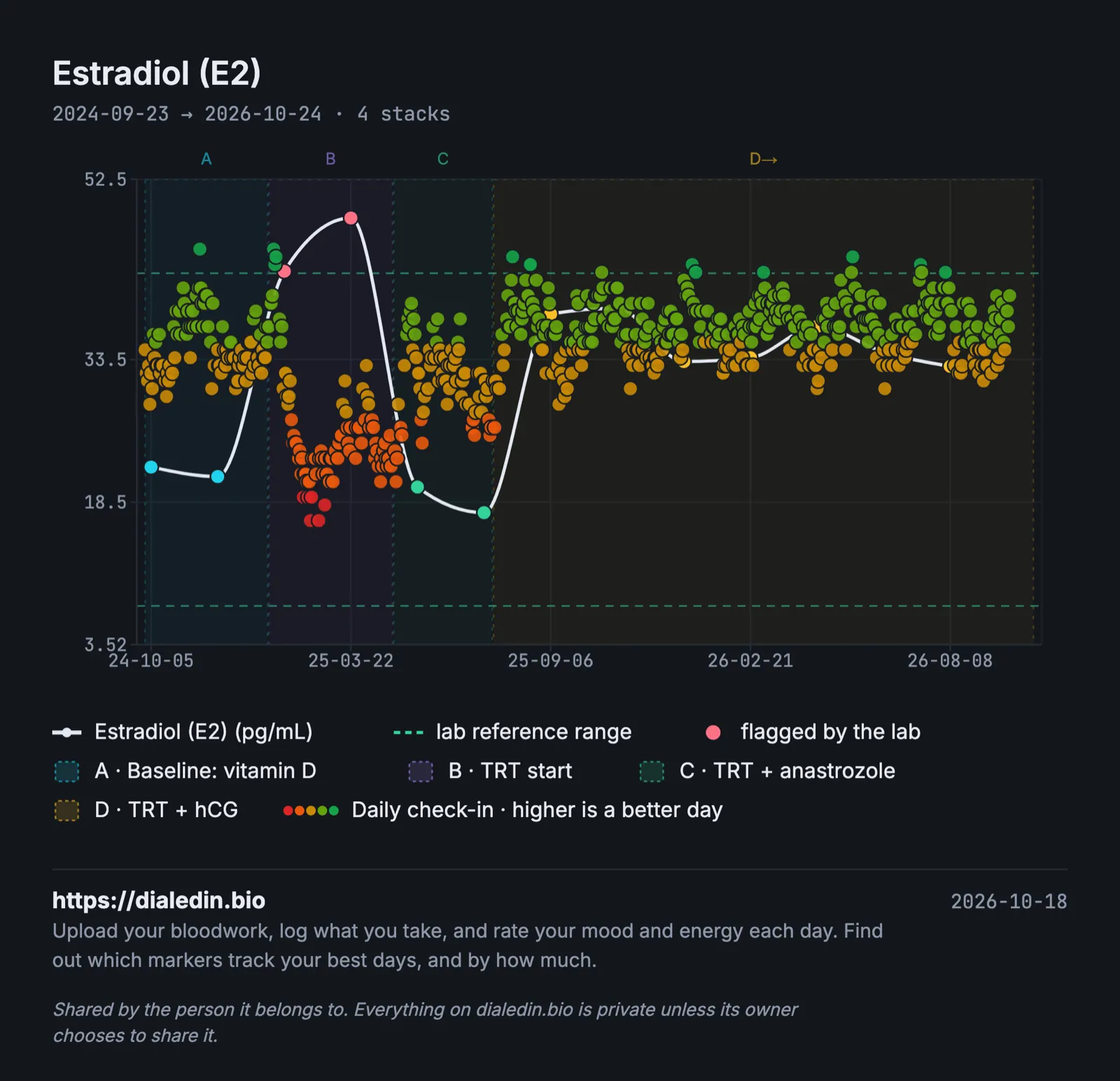
Sample data, not a real person.
The dots are the daily ratings, higher being a better day. In this example the worse days come in the stretches where estradiol was furthest from where it settled, high in one stack and low in the next. That says something about this one person's pattern. It doesn't say what anyone else's level should be.
How often should estradiol be checked on TRT?
Your prescriber decides that, and schedules differ. A common pattern is a baseline before starting, a check a few weeks to a few months after starting or after any change, and then periodic checks with the rest of the TRT panel. Retesting after a change is what tells you what the change did, so keep the conditions the same as the test before.
A simple way to track it by hand
| Date | Days since injection | Total T (ng/dL) | Estradiol (pg/mL) | Method | Weight (kg) | How the week felt (1-5) | Notes |
|---|---|---|---|---|---|---|---|
| 2025-01-10 | (baseline) | 410 | 21 | sensitive | 86 | 3 | |
| 2025-03-21 | 3 | 940 | 48 | sensitive | 87 | 2 | poor sleep, low mood |
| 2025-09-05 | 3 | 780 | 35 | sensitive | 85 | 4 |
A few rows like that, with the same day in the cycle, are worth more than any single result.
Where dialedin fits
We built dialedin to do this without the spreadsheet.
You upload a lab PDF and it is read into individual markers, which you check before saving. Every report goes onto one timeline, and you record what you were taking and when, so each result sits inside the stack it came from. The optional daily check-in is the dots in the chart above: a short rating of how you feel, which lets you see which of your levels line up with your better days. You can also export your history as a PDF to bring to your prescriber.
It's free while we're in beta. If your estradiol results are scattered across clinics and labs, put them on one chart next to how you felt.
This article is general information, not medical advice, and it can't take your own history into account. Talk to your prescriber about your estradiol results and what they mean for you.