TRT blood tests: when to test and what to check
Most men on testosterone therapy get blood drawn whenever the appointment happens to be. One test lands the day after an injection, the next one the morning before, and the two reports get compared as if they measured the same thing.
They didn't. On injections, testosterone climbs in the first days after the shot and falls towards the next one, and the difference between the top and the bottom of that cycle can be bigger than the difference between two protocols. A TRT blood test means little without knowing where in the cycle it was taken. Picking one point in the cycle and sticking to it costs nothing, and it makes your results comparable.
Peak, trough or midpoint?
There are three points people test at, and each one answers a different question.
| When | What it shows | Why people pick it |
|---|---|---|
| Peak, a day or two after an injection | The highest level of the cycle | Shows how high levels go, and often where side effects come from |
| Midpoint, halfway between injections | A middle reading | What the Endocrine Society's guideline suggests for the common injectable forms |
| Trough, just before the next injection | The lowest level of the cycle | Easy to repeat exactly, and shows whether levels hold up to the end |
The Endocrine Society's guideline on testosterone therapy suggests measuring midway between injections for testosterone enanthate and cypionate (Bhasin et al., 2018). Many prescribers and many men use the trough instead, because "the morning of my injection day" is an easy point to hit every time. Either works if you're consistent. Mixing them doesn't.
When to test on gels, pellets and other forms
The cycle depends on what you use, so the timing does too. Your prescriber's instructions come first. These are the usual patterns.
Gels and creams
Levels rise in the hours after applying it and are fairly steady from day to day once you've been on it a week or so. The guideline suggests testing two to eight hours after applying it, once you've used it for at least a week. Have the blood taken from an arm you didn't apply it to. Gel left on the skin can get into the sample and make the result read much too high.
Long-acting injections
Testosterone undecanoate, given every few months, is usually checked just before the next injection.
Pellets
Pellets release testosterone over months, and levels are usually checked towards the end of the interval, before the next insertion.
Everything else
Oral and nasal forms each have their own timing. Ask whoever prescribed it, and write the answer down so every test follows it.
What to ask for on a TRT blood test
Testosterone is one line, and on therapy the others often matter as much. Each of these is worth noticing and raising with your doctor if it moves, and each has harmless explanations too.
- Total testosterone, the headline number. Only comparable at the same point in the cycle.
- SHBG and albumin, so free testosterone can be calculated. Our posts on free vs total testosterone and high or low SHBG cover why that matters.
- Estradiol, made from testosterone, which tends to rise with it. A "sensitive" LC-MS/MS test reads more accurately at male levels than a standard immunoassay.
- Haematocrit and haemoglobin. Testosterone raises red cell production, and the guideline recommends checking haematocrit before starting, a few months in and then about yearly.
- PSA, for men in the age group where it's monitored. How fast it changes matters more than one value.
- Lipids and liver enzymes, which are on most routine panels anyway.
- LH and FSH, if fertility matters to you. On therapy they're usually suppressed.
How to make TRT results comparable
Pick one point in the cycle and write it down every time
Days since the last injection, or hours since the gel went on. That single number explains more of the variation between reports than anything else on this list.
Test in the morning, and fast if lipids or glucose are on the panel
Testosterone has a daily rhythm, and lipids and glucose need a fast to compare. A morning, fasted draw covers both.
Drink normally the day before
Dehydration concentrates the blood and pushes haematocrit up. A dehydrated morning can make haematocrit look worse than it is, and haematocrit is one of the numbers you'll be watching.
Use the same lab, and the same estradiol method
Different labs and methods print different ranges. For estradiol at male levels, the method can matter more than any real change. If you switch, treat the next result as a new starting point.
Keep the schedule steady before a test
If you moved your injection day or missed one, the test describes that unusual week. Note it, or wait a few weeks before testing.
Note illness, bad sleep and anything new
A cold or a new medication can shift results for a while, and so can a week of short nights. One line next to the result saves you reading a trend into it.
Check the units
Labs report testosterone in ng/dL, ng/mL or nmol/L. Put them in one list and the chart is meaningless. Our free calculators convert the common units, and the testosterone to estradiol ratio works with either.
How often to test on TRT
That's your prescriber's schedule, and it depends on what you use and how long you've been on it. A common pattern is a check a few months after starting or changing anything, then less often once things are steady.
Two things help whatever the schedule is. Retest after every change, because the follow-up is how you find out what the change did. And keep the gaps roughly even.
What a steady habit shows
This is one person's haematocrit across 13 tests over two years, with what he was on shaded:
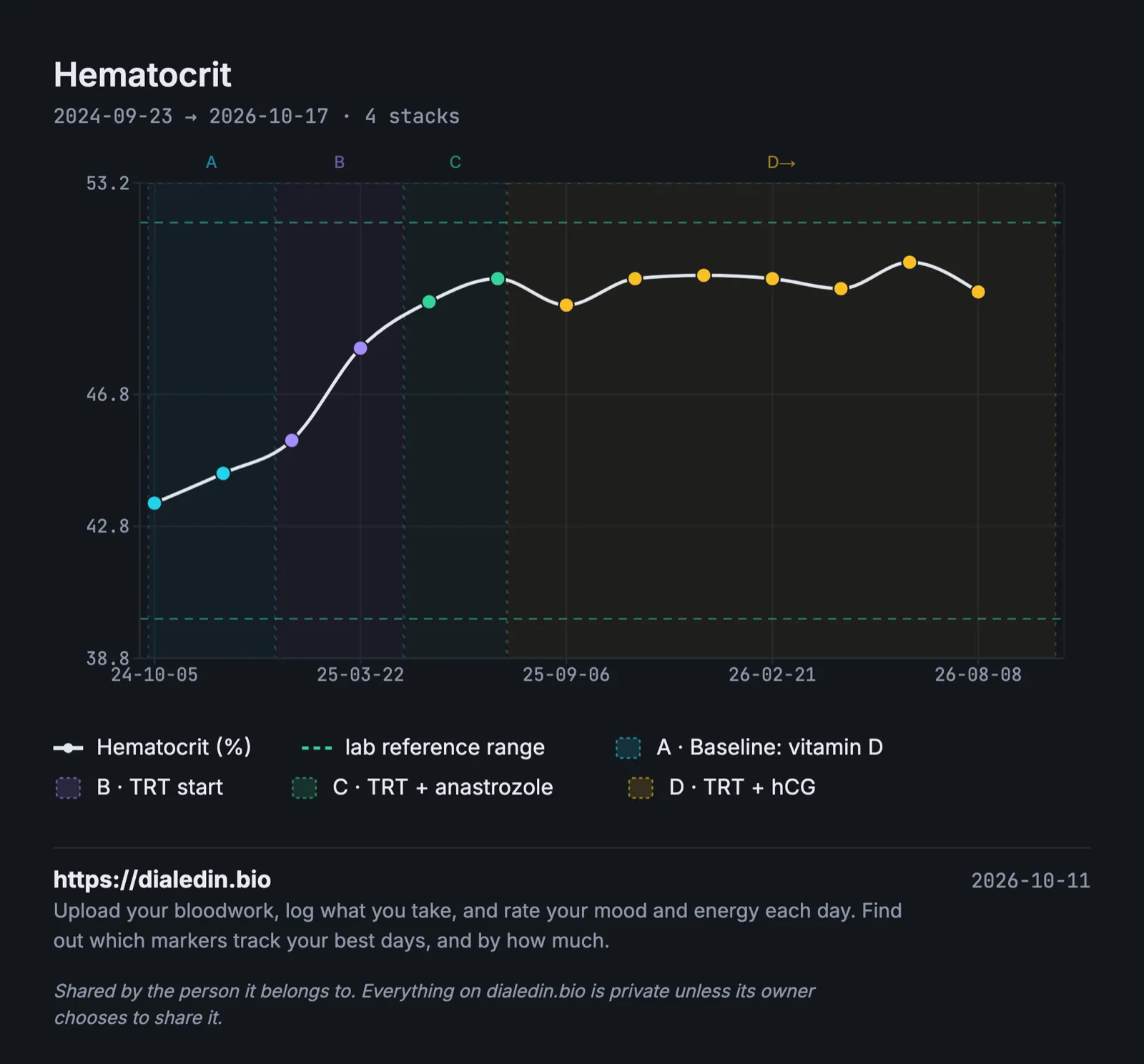
Sample data, not a real person.
Haematocrit rose by about seven points over the first year and then levelled off, all inside the range, so no single report flagged it. When every draw is taken the same way, you can trust a climb like this, and it's the kind of slow change that is much easier to discuss early than to discover late. Our post on tracking testosterone results over time shows the same person's estradiol next to how he felt.
Tracking it in a spreadsheet
The columns that matter most on TRT are the ones that say when and how the blood was taken:
| Date | Lab | Marker | Value | Unit | Days since injection | Time | Fasted | Hydrated | Notes |
|---|---|---|---|---|---|---|---|---|---|
| 2025-06-10 | City Lab | Total testosterone | 22.1 | nmol/L | 7 (trough) | 08:05 | yes | yes | |
| 2025-06-10 | City Lab | Haematocrit | 48.6 | % | 7 (trough) | 08:05 | yes | yes | |
| 2025-09-02 | City Lab | Total testosterone | 30.4 | nmol/L | 2 | 08:30 | yes | no | tested early by mistake |
| 2025-09-02 | City Lab | Haematocrit | 50.1 | % | 2 | 08:30 | yes | no | hot week, little water |
The second test looks like a big jump in testosterone and haematocrit. The notes show it was taken five days earlier in the cycle, on a dehydrated morning.
Where dialedin fits
We built dialedin because keeping those columns straight for years is the part that falls apart.
You upload a lab PDF and it is read into individual markers, which you check before saving. Every report goes onto one timeline, and different lab names for the same marker are merged into one line. You record what you were taking and when, so each result sits next to the stack you were on, and a short daily check-in shows which levels line up with your better days. Before an appointment you can export your history as a PDF for your doctor.
It is free while we are in beta. There is more on the men's hormone side of dialedin, or you can put your results on one timeline now.
This article is general information, not medical advice, and it can't take your own history into account. Talk to your doctor about which tests you need and what your results mean for you.