How to track your testosterone results over time
Most men who get their testosterone checked read each report on its own. Total testosterone goes up or down, estradiol is flagged or it isn't, and the PDF goes into a folder until the next one.
On injections, one fact makes that habit misleading. Your testosterone level climbs in the days after an injection and falls towards the next one, so when the blood was drawn in that cycle can move the result more than any change you made. Two reports taken at different points in the cycle can look like a big change when nothing changed at all. To track testosterone results over time, you need each number together with when it was taken and what you were doing.
Which results to track together
Testosterone is one line on a panel, and it rarely tells the story alone. These are the markers most men end up following, each worth noticing and raising with your doctor if it moves, and each with plenty of harmless explanations.
- Total testosterone is the headline number. It is only comparable between draws taken at the same point after an injection, or the same number of hours after a gel.
- Free testosterone is the small unbound part. It depends on SHBG, and labs report it in two ways that don't agree, calculated and direct. We wrote about calculated vs direct free testosterone separately, and our free testosterone calculator works it out from your own results.
- SHBG changes slowly and shifts free testosterone with it. Weight, thyroid function and some medications all move it.
- Estradiol is made from testosterone, so it often follows it up and down. Methods differ a lot at the low levels men have, and a standard immunoassay can read differently from a "sensitive" LC-MS/MS test.
- Haematocrit and haemoglobin are routinely monitored on testosterone therapy, because testosterone raises red cell production. A slow climb across several draws is easier to talk about than a surprise.
- PSA is judged partly on how fast it changes, which you can only see with the earlier results in hand.
- LH and FSH are usually suppressed on testosterone therapy, since your body reads the outside testosterone and turns down its own signal. They matter more if you use something meant to keep that signal going.
- Cholesterol and the liver enzymes are part of most panels and show whether anything else in your routine is having an effect.
How to make your results comparable
Most of the apparent change between two reports comes from how the blood was taken. These habits remove most of that noise, and they cost nothing.
Test at the same point in your injection cycle
Pick a point and stick to it. Many men test just before an injection, at the lowest level of the cycle, because that point is easy to repeat. Whatever you pick, write down how many days it had been since the last injection. On a gel or cream, write down how many hours since you applied it.
Test in the morning
Testosterone follows a daily rhythm and is highest in the morning. That matters most before therapy, but a consistent time removes one more variable either way.
Use the same lab, and the same estradiol method
Labs use different machines and print different reference ranges. For estradiol the method makes a large difference at male levels. If you switch labs or methods, expect a jump and treat the new result as a new starting point.
Note anything that changed
A new compound, a different injection schedule, a new supplement, a week of bad sleep, a cold. Short sleep and illness can both pull testosterone down for a while. One line next to the result saves you from reading meaning into a number that had an ordinary cause.
Drink normally before the draw
Dehydration concentrates the blood and nudges haematocrit up. If haematocrit is the number you watch, a dehydrated morning can make it look worse than it is.
Tell your doctor about biotin
Biotin in the large amounts found in many hair and nail products can interfere with some hormone tests and make results read too high or too low.
Check the units
One lab reports testosterone in ng/dL, another in nmol/L, and some in ng/mL. Put mixed units in one list and any chart of it is meaningless. Our free calculators convert the common ones.
Rate how you feel, every day, the same way
This is the part almost everyone skips, and it is why most people can't say whether a change helped. Pick a handful of things that matter to you, such as energy, mood, libido and sleep, and rate them on the same short scale every day. A daily rating lets you average a whole stretch of time, so one bad Monday doesn't decide anything. Memory can't do that. Four weeks later, nobody remembers how the second week felt.
How often should you get bloodwork on TRT?
That schedule belongs to you and your prescriber. A common pattern is a check a few months after starting or changing anything, then less often once things are stable. Follow the schedule you were given.
Two things help whatever the schedule is. Retest after every change, because the follow-up is how you find out what the change did. And keep the gaps roughly even, since evenly spaced results are much easier to read than three in one month and then nothing for a year.
What lining up labs with how you feel shows
Here is one person's estradiol across 15 blood tests over two years. The shaded bands are the stacks he was on, and each dot is one day's check-in, greener for a better day.
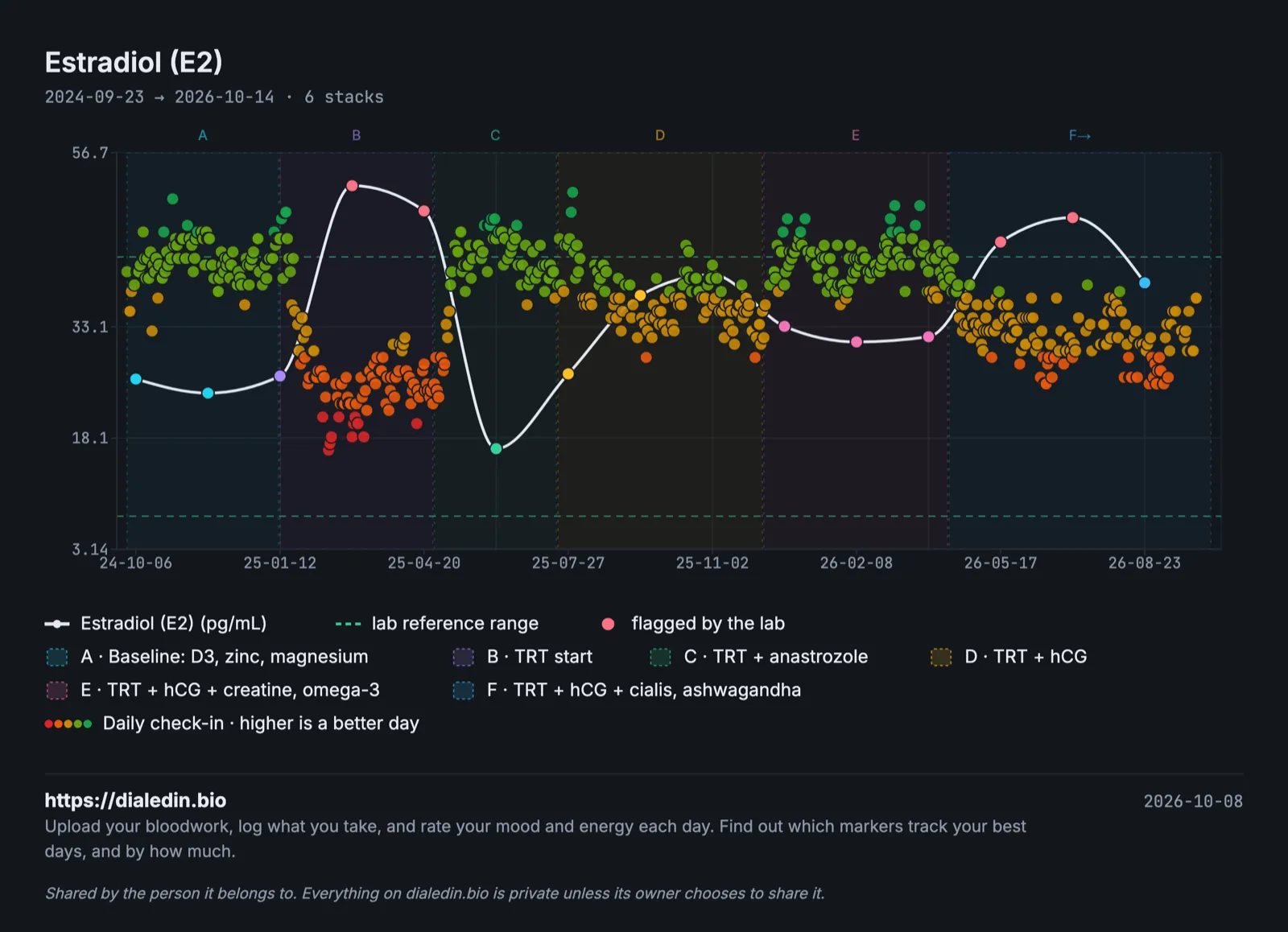
Sample data, not a real person.
His check-ins were at their worst in the months when estradiol sat above the lab's range. One chart proves nothing about anyone else, and it can't say why. It does give him and his doctor something specific to discuss, which "I felt off for a while last spring" never does.
Doing it with a spreadsheet
You can start today with a spreadsheet: one row per marker per test, plus the columns that make results comparable.
| Date | Lab | Marker | Value | Unit | Lab's range | Days since injection | Stack | Avg rating, last 4 weeks | Notes |
|---|---|---|---|---|---|---|---|---|---|
| 2025-03-04 | City Lab | Total testosterone | 18.9 | nmol/L | 8.6-29 | 6 | Stack A | 6.1 | |
| 2025-03-04 | City Lab | Estradiol | 31 | pg/mL | 11-44 | 6 | Stack A | 6.1 | |
| 2025-06-10 | City Lab | Total testosterone | 24.2 | nmol/L | 8.6-29 | 3 | Stack B | 7.0 | tested earlier in the cycle |
| 2025-06-10 | City Lab | Estradiol | 39 | pg/mL | 11-44 | 3 | Stack B | 7.0 | had a cold that week |
Keep the daily ratings on a second sheet and average the four weeks before each draw into the rating column. Keep one unit per marker. It is tedious to fill in by hand, but it works.
Where dialedin fits
We built dialedin because keeping that spreadsheet by hand got old.
You upload a lab PDF and it is read into individual markers, which you check before saving. Every report goes onto one timeline, and different lab names for the same marker are merged so each line stays continuous. You record what you were taking and when, so each result sits next to the stack you were on, and a short daily check-in shows which levels line up with your better days. Sleep and heart rate can come in from your phone, and before an appointment you can export your history as a PDF for your doctor.
It is free while we are in beta. There is more on the men's hormone side of dialedin, or you can put your results on one timeline now.
This article is general information, not medical advice, and it can't take your own history into account. Talk to your doctor about which tests you need and what your results mean for you.