Calculated vs direct free testosterone, explained
If you've had testosterone tested, you may have seen free testosterone on the report, sometimes twice: one line marked calculated, another marked direct, with numbers that don't agree. Most people pick whichever one is flagged and move on.
The two lines come from different methods, and they are not interchangeable. In the 1999 study behind the widely used Vermeulen formula, direct measurements read only a fraction of the true free testosterone, and how big that fraction was depended on each person's SHBG (Vermeulen et al., 1999). If you compare a direct result with a calculated one, or follow the direct one over time while your SHBG changes, part of the trend you see can come from the method itself.
What free testosterone is
Most testosterone in your blood is bound to proteins. A large share is held tightly by SHBG (sex hormone-binding globulin). Some is held loosely by albumin. A small part, usually around 1 to 3% of total testosterone, floats free.
Free testosterone is that small unbound part. Free plus albumin-bound is called bioavailable testosterone, because albumin lets go easily. Testosterone bound to SHBG is held much more tightly.
Calculated vs direct free testosterone: what's the difference?
There are three common ways to get a free testosterone number.
| Method | How the number is produced | What to know |
|---|---|---|
| Equilibrium dialysis | Measured in a specialised lab by separating the free hormone through a membrane | The reference method. Slow and expensive, so few labs offer it |
| Calculated | Worked out from total testosterone, SHBG and albumin with a formula, most often Vermeulen's | Matched equilibrium dialysis closely in Vermeulen's study, except in pregnancy |
| Direct (analog immunoassay) | Measured directly by an automated machine | Read a fraction of the true value in that study, and the fraction moved with SHBG |
The Endocrine Society's guideline on testosterone in men recommends getting free testosterone "using either equilibrium dialysis or estimating it using an accurate formula" (Bhasin et al., 2018). The direct method isn't one of the two.
We have a glossary page for each version: calculated free testosterone and direct free testosterone.
Why SHBG changes the answer
Because SHBG holds most of the bound testosterone, the same total testosterone can mean very different free levels. These rows come from our free testosterone calculator, with total testosterone fixed at 600 ng/dL and albumin at 4.3 g/dL:
| SHBG | Free T (calculated) | Free fraction |
|---|---|---|
| 15 nmol/L | 179 pg/mL | 2.98% |
| 30 nmol/L | 134 pg/mL | 2.23% |
| 45 nmol/L | 105 pg/mL | 1.75% |
| 60 nmol/L | 85 pg/mL | 1.42% |
Same total, and free testosterone is about twice as high at the lowest SHBG as at the highest.
SHBG itself moves. It tends to rise with age, with an overactive thyroid, with liver disease and with some medications, such as certain anti-seizure drugs and oral estrogen. It tends to fall with excess weight, insulin resistance, an underactive thyroid, and testosterone or anabolic steroid use. So a change in SHBG between two tests changes free testosterone even when total testosterone stays put.
This is total testosterone and SHBG for one person over two years of tests, including the start of testosterone therapy:
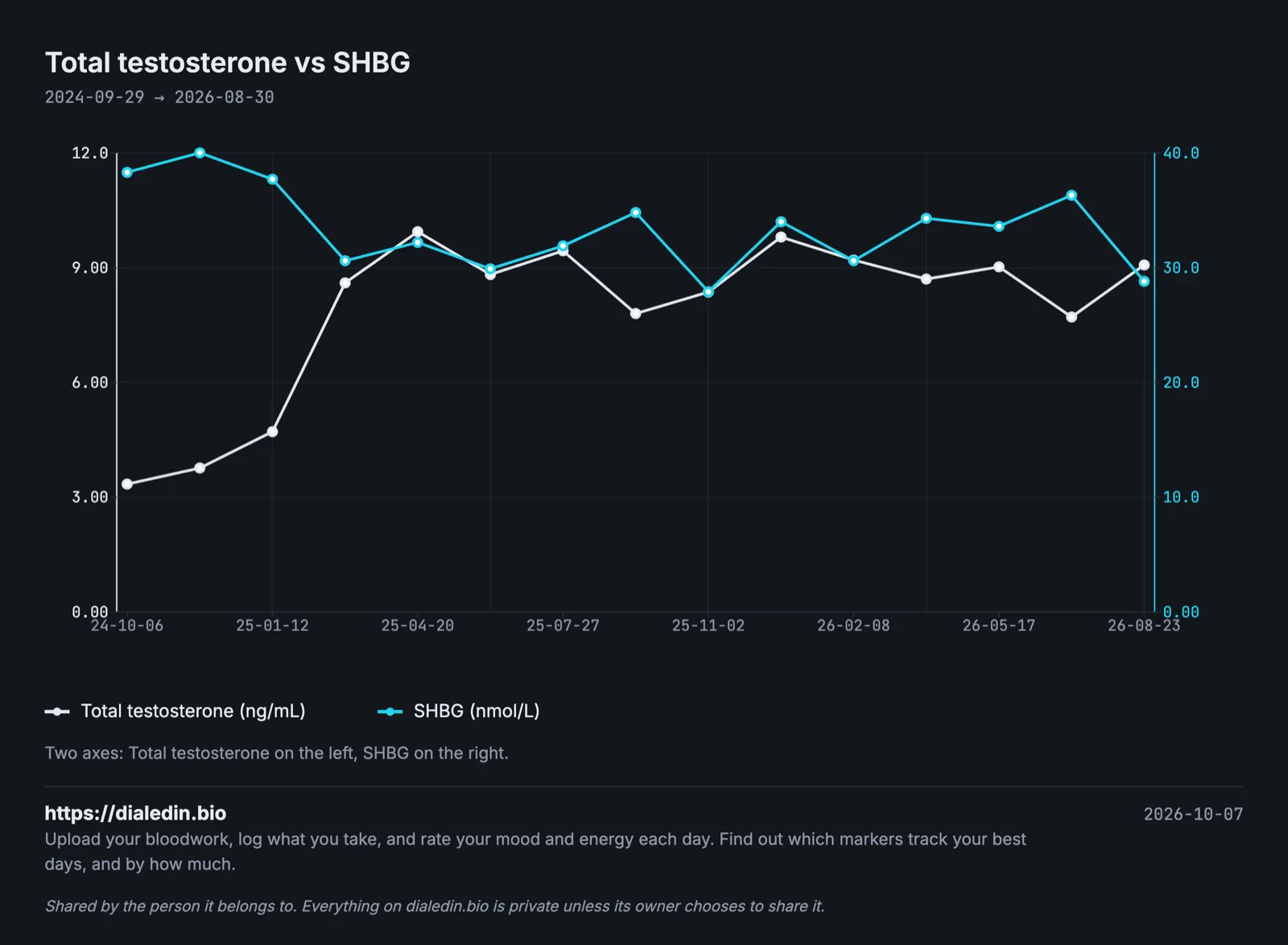
Sample data from our demo, not a real person.
SHBG drops when therapy starts and then shifts by several nmol/L between tests. Each of those shifts moves free testosterone, which is why the calculated value needs the SHBG from the same blood draw.
How to compare free testosterone results over time
Follow the calculated value
If your report shows both, track the calculated one. If it only shows direct, ask whether the lab can report SHBG and albumin too, then work out the calculated value yourself with the calculator. Albumin is often part of a standard metabolic panel already.
Use total testosterone, SHBG and albumin from the same draw
The formula assumes all three describe the same blood. Pairing this month's total testosterone with an SHBG from six months ago gives a number that describes neither day.
Don't mix methods
A direct result and a calculated result from different tests can't be compared, even from the same lab. If your lab switches method, the line will jump, so start a new baseline from that point.
Stick to one formula
Vermeulen's is widely used, and it's the one our calculator uses. Other published formulas exist, and they give somewhat different numbers for the same inputs. A change of formula between tests looks like a change in you.
Check the units
Free testosterone is reported in pg/mL, ng/dL or pmol/L, depending on the lab. 1 ng/dL is 10 pg/mL, and the calculator shows pmol/L next to pg/mL (134 pg/mL is about 465 pmol/L). Reference ranges are printed in the lab's own units, so compare a result only with the range from the same report.
Test in the morning, fasted, and repeat before reading much into it
The same guideline recommends measuring total testosterone in the morning while fasting, and repeating it to confirm a low result. Testosterone is highest in the morning and varies from day to day, so one test is a starting point.
Know what the free androgen index is
Some reports, especially for women, show a free androgen index (FAI): total testosterone divided by SHBG, times 100. It's quick to compute (we have a free androgen index calculator), but in Vermeulen's comparison its relationship to true free testosterone also changed with SHBG, so it isn't a substitute for a calculated value.
When is free testosterone worth checking?
The Endocrine Society guideline suggests looking at free testosterone when total testosterone is near the lower limit of normal, or when something is likely to change SHBG, such as the conditions above. Outside those cases, total testosterone is usually the first number doctors look at.
Whether you need it, and how often, is a question for your doctor. If you're already tracking free testosterone, the most useful habit is to record SHBG every time and to keep the lab and the method the same.
A simple way to track it yourself
You don't need special software. One row per test, with the inputs next to the result, is enough to tell a real change from a change in SHBG:
| Date | Total T (ng/dL) | SHBG (nmol/L) | Albumin (g/dL) | Calculated free T (pg/mL) | Method | Time |
|---|---|---|---|---|---|---|
| 2025-03-04 | 620 | 31 | 4.4 | 135 | calculated | 08:10 |
| 2025-06-10 | 640 | 26 | 4.3 | 155 | calculated | 08:05 |
| 2025-09-15 | 590 | 34 | 4.5 | 119 | calculated | 08:20 |
Total testosterone barely moved across those three tests, while free testosterone went from 119 to 155 pg/mL, almost entirely because of SHBG. Without the SHBG column, that would look like a much bigger change than it was.
Where dialedin fits
We built dialedin because tracking this by hand across several lab reports gets old quickly.
You upload a lab PDF and it is read into individual markers, which you check before saving. Calculated and direct free testosterone stay separate lines, so they never get mixed on one chart, and SHBG, total testosterone and albumin sit on the same timeline. You can chart any two markers together, as in the chart above, and record what you were taking and when. The free testosterone calculator is free and needs no account.
It is free while we are in beta. If your results are spread across several reports, put them on one timeline and see how free testosterone and SHBG move together.
This article is general information, not medical advice, and it can't take your own history into account. Talk to your doctor about which tests you need and what your results mean for you.