Free vs total testosterone: which one to follow
When people talk about their testosterone, they nearly always mean total testosterone, the big number at the top of the hormone section. It's the one that gets flagged, quoted on forums and compared with friends.
Most of that number isn't available to your body. Only around 1 to 3% of it circulates free, and the rest is bound to proteins, mostly SHBG. Two men can have total testosterone results 400 ng/dL apart and almost the same amount free. The two numbers answer different questions, and the gap between them is often the most useful thing on the report.
What total and free testosterone measure
Total testosterone is everything in the sample: bound tightly to SHBG, bound loosely to albumin, and free. It's measured directly and it's the standard first test.
Free testosterone is the unbound part. Labs either calculate it from total testosterone, SHBG and albumin, or measure it directly. The calculated version is the one that holds up. The direct immunoassay reads low by an amount that shifts with SHBG, which we cover in calculated vs direct free testosterone. Some reports also print free testosterone as a percentage of total, or a bioavailable figure that adds the albumin-bound part.
When free and total testosterone disagree
The two disagree whenever SHBG is unusually high or low. These rows come from our free testosterone calculator, with albumin fixed at 4.3 g/dL:
| Total testosterone | SHBG | Free testosterone (calculated) |
|---|---|---|
| 400 ng/dL | 15 nmol/L | 114 pg/mL |
| 800 ng/dL | 60 nmol/L | 120 pg/mL |
| 400 ng/dL | 60 nmol/L | 53 pg/mL |
| 800 ng/dL | 15 nmol/L | 247 pg/mL |
The first two rows have twice as much total testosterone on the second line, and nearly the same free testosterone. The last two have the same totals as the first two and free testosterone values about four and a half times apart.
That's the whole reason free testosterone exists as a test. High SHBG is common in older men and with an overactive thyroid. Low SHBG is common with excess weight and insulin resistance. Our post on high or low SHBG goes through what moves it.
Which one doctors look at
Total testosterone comes first. The Endocrine Society's guideline on testosterone in men uses a fasting, early-morning total testosterone, confirmed with a repeat test, as the starting point, and suggests adding free testosterone when total is near the lower limit of normal or when SHBG is likely to be off (Bhasin et al., 2018). For free testosterone it recommends equilibrium dialysis or an accurate formula, which in practice means the calculated value.
So the honest answer to "which one matters" is both, read together. Total tells you how much is there. Free, worked out with the SHBG from the same draw, tells you how much of it is unbound. When SHBG is ordinary, the two tell the same story. When it isn't, free testosterone is the one that changes the reading.
The free androgen index is a third, rougher option: total testosterone divided by SHBG. It's used mostly for women, and it is less reliable at the testosterone levels men have.
How to track free and total testosterone so they compare
Always get total, SHBG and albumin from the same draw
A free testosterone value is only as good as the SHBG it was worked out from. SHBG from last month and total testosterone from today give you a number that describes neither day.
Follow the calculated free testosterone
If your report prints a direct free testosterone, ignore it for tracking and calculate your own from total, SHBG and albumin. Use the same formula every time. Our calculator uses Vermeulen's, the one most labs use.
Test early in the morning, and fasted
Testosterone is highest in the morning and drops through the day, and a meal can lower it for a while. Before any therapy, a morning, fasted draw is the standard. Once on therapy, the point in your injection or application cycle matters more than the clock, which we cover in when to get blood drawn on TRT.
Repeat a low result before reading much into it
One low testosterone result is often followed by a second one weeks later, because illness, poor sleep or a hard week can pull a single result down. If two morning results agree, they mean much more than one.
Watch the units
Total testosterone comes in ng/dL, ng/mL or nmol/L. Free testosterone comes in pg/mL, ng/dL or pmol/L, and 1 ng/dL is 10 pg/mL. Mixing them in one chart makes it useless. Our free calculators convert the common units.
Stay with one lab and one method
Total testosterone results can differ between methods, and some labs measure it by mass spectrometry and others by immunoassay. Switching changes the number for reasons that have nothing to do with you.
How often to check them
That depends on why you're testing, so the schedule is one to agree with your doctor. If you're being assessed for low testosterone, expect at least two morning tests. On therapy, prescribers usually check a few months after starting or changing anything, then less often once things are steady.
Whatever the schedule, ask for SHBG each time you get total testosterone, and try to keep the gaps between tests roughly even.
What it looks like over two years
This is one person's total testosterone and calculated free testosterone across 13 tests, including the start of testosterone therapy:
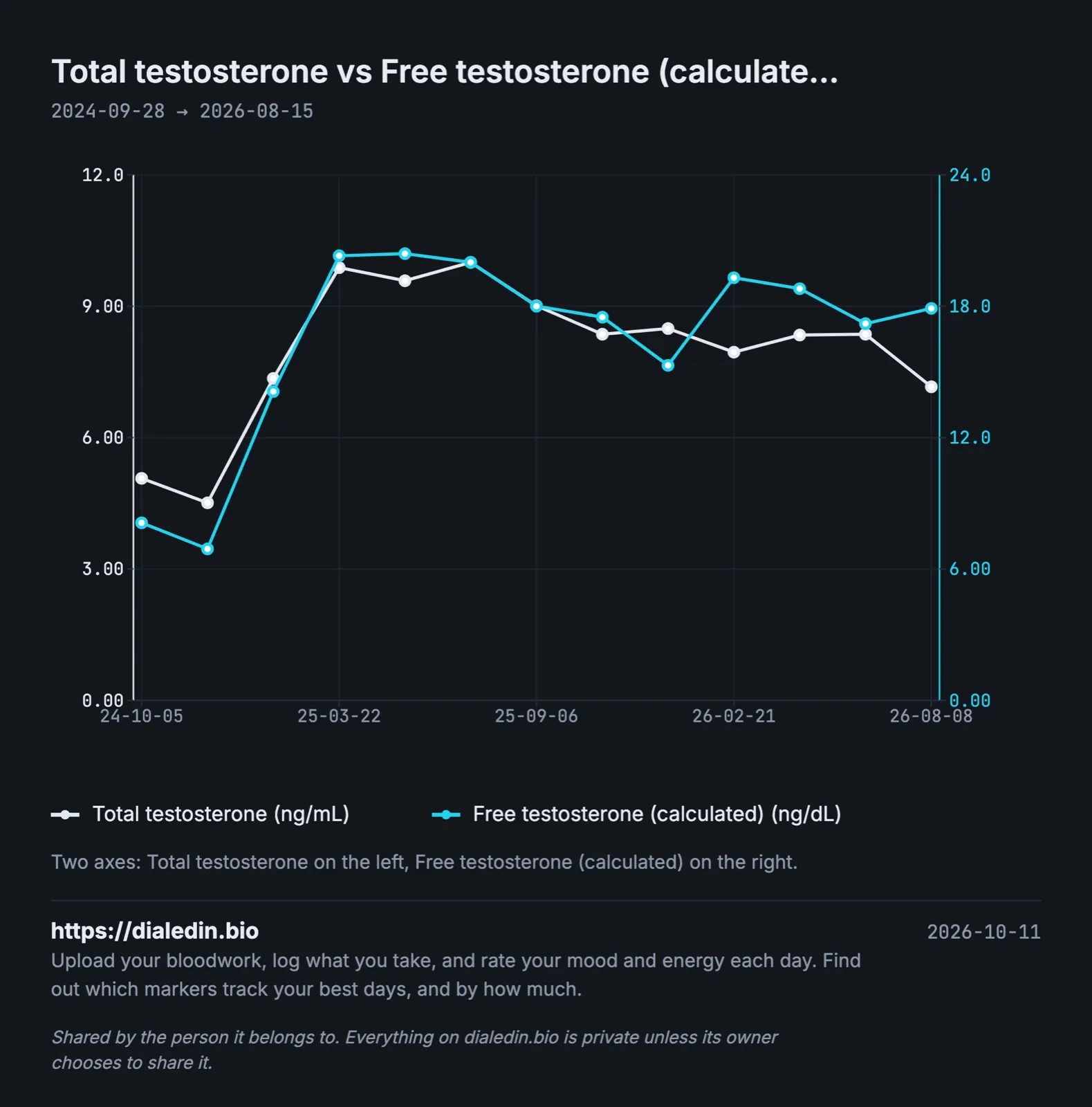
Sample data, not a real person.
For most of these tests the two lines move together, because his SHBG stayed within a few nmol/L of where it settled. While SHBG is steady, total testosterone is a fair guide to free. Tracking both is how you catch the draws where they split, which a chart of total testosterone alone can't show.
Tracking it in a spreadsheet
You don't need anything special to start. One row per test, with every number the calculation needs:
| Date | Lab | Total T | Unit | SHBG (nmol/L) | Albumin (g/dL) | Free T, calculated | Time of draw | Fasted | Notes |
|---|---|---|---|---|---|---|---|---|---|
| 2025-01-20 | City Lab | 400 | ng/dL | 60 | 4.3 | 53 pg/mL | 08:05 | yes | |
| 2025-02-17 | City Lab | 380 | ng/dL | 58 | 4.3 | 52 pg/mL | 08:10 | yes | repeat test |
Two morning results that agree, with SHBG next to them, are something specific to take to an appointment. Keep one unit per column, and calculate free testosterone the same way every time.
Where dialedin fits
We built dialedin because doing those calculations by hand for every report got old.
You upload a lab PDF and it is read into individual markers, which you check before saving. Total testosterone, SHBG and the rest go onto one timeline, and different lab names for the same marker are merged into one line. You can overlay total and free testosterone on the same chart, record what you were taking and when, and log a short daily check-in to see which levels line up with your better days. Before an appointment you can export your history as a PDF for your doctor.
It is free while we are in beta. There is more on the men's hormone side of dialedin, or you can put your results on one timeline now.
This article is general information, not medical advice, and it can't take your own history into account. Talk to your doctor about which tests you need and what your results mean for you.