High or low SHBG? What it means for testosterone
Most people skip the SHBG line on a hormone panel. It isn't the number anyone asked about, and unless it's flagged it looks like background.
It's the number that tells you how to read the testosterone result above it. SHBG (sex hormone-binding globulin) is a protein made in the liver that grips testosterone tightly, so whatever SHBG holds isn't available to your tissues. With a high SHBG, a normal-looking total testosterone can come with a fairly low free testosterone. With a low SHBG, a modest total can come with plenty free. If your SHBG is high or low, the total testosterone number on its own can mislead you.
What SHBG does
Most testosterone in the blood is bound to something. SHBG holds a large share of it tightly. Albumin holds some loosely, and a small part floats free. Free testosterone plus the albumin-bound part is called bioavailable testosterone.
SHBG also binds DHT and estradiol, which is one reason it shows up on both men's and women's panels. Women usually have higher SHBG than men, so the reference ranges differ by sex.
To see how much it matters, here is total testosterone fixed at 400 ng/dL, with albumin at 4.3 g/dL, run through our free testosterone calculator:
| SHBG | Free testosterone (calculated) | Free fraction |
|---|---|---|
| 15 nmol/L | 114 pg/mL | 2.86% |
| 30 nmol/L | 84 pg/mL | 2.11% |
| 45 nmol/L | 66 pg/mL | 1.64% |
| 60 nmol/L | 53 pg/mL | 1.34% |
The total is the same on every row. Free testosterone at the lowest SHBG is a bit more than twice what it is at the highest.
What can make SHBG high
A high SHBG is common and often has an ordinary explanation. These are the usual ones a doctor will think about, and any of them is worth mentioning if your result is flagged.
- Age. SHBG tends to drift up as men get older, which is part of why free testosterone often falls faster with age than total does.
- An overactive thyroid. Thyroid hormone raises SHBG, so a high SHBG sometimes leads to a TSH test.
- Oral estrogen, including many combined contraceptive pills and oral HRT. Patches and gels usually move it much less.
- Liver disease, since the liver is where SHBG is made.
- Some medications, certain anti-seizure drugs among them.
- Being underweight, eating very little for a long stretch, or losing a lot of weight.
What can make SHBG low
Low SHBG is just as common, and the list is close to the mirror image.
- Excess weight, especially around the middle.
- Insulin resistance and type 2 diabetes. A low SHBG often sits alongside a rising fasting insulin, which we cover in the post on insulin resistance tests.
- An underactive thyroid.
- Testosterone therapy and anabolic steroids. Outside androgens lower SHBG, which is why it often drops after someone starts TRT.
- Glucocorticoids such as prednisone, taken for long periods.
- In women, polycystic ovary syndrome (PCOS), where a low SHBG is one reason free testosterone can be raised while total looks normal.
How SHBG behaves over time
SHBG changes slowly. It moves over weeks and months, with weight, thyroid function and medication, and it doesn't swing much from morning to evening the way testosterone does. That makes it one of the easier hormone markers to track, and a steady trend in it means more than a single odd value.
This is one person's SHBG and calculated free testosterone across two years of tests, with the stretches he was on shaded:
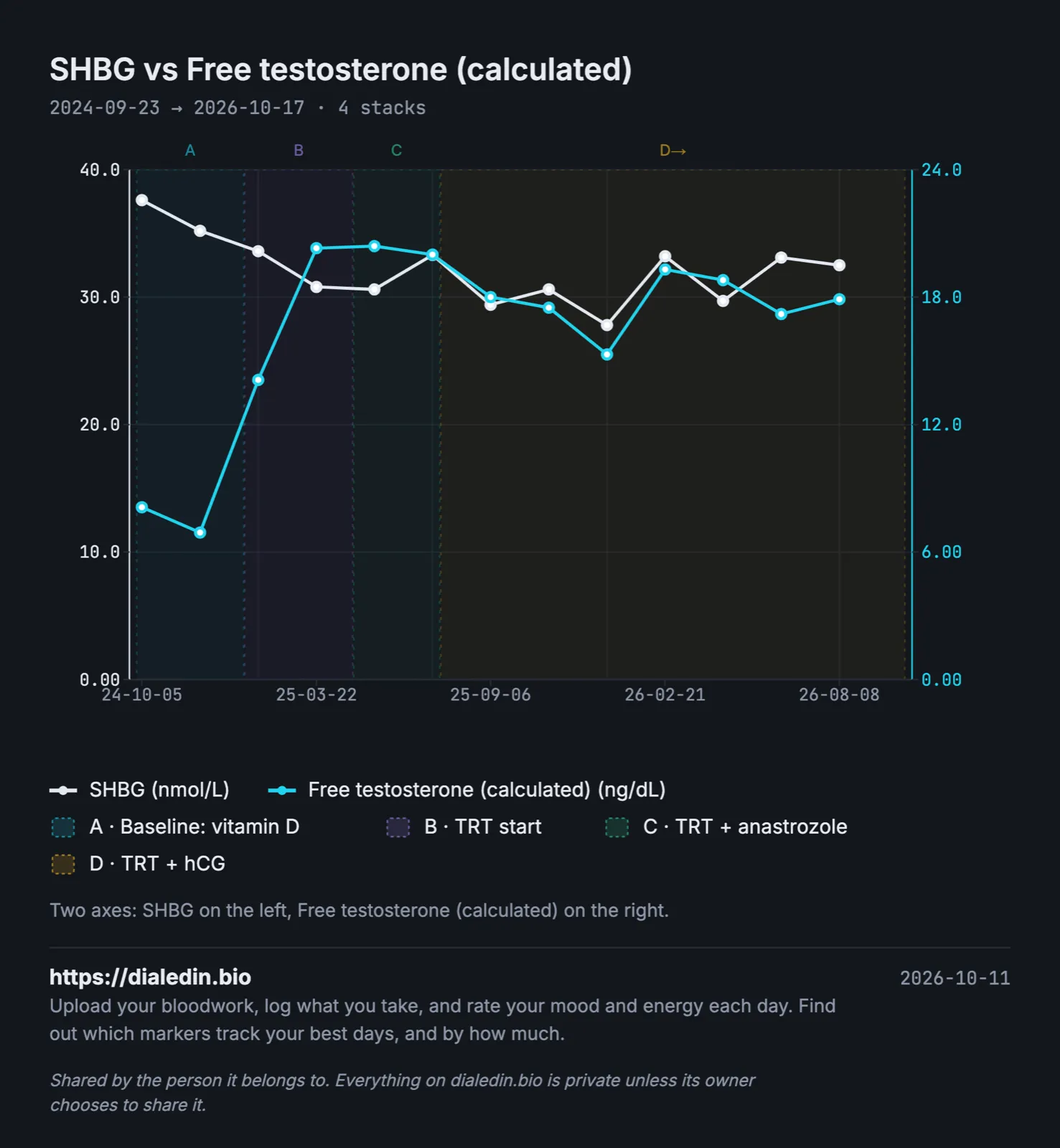
Sample data, not a real person.
SHBG fell by about a fifth when therapy started and then kept moving by a few nmol/L from one test to the next. Every one of those moves feeds into the free testosterone number, which is why free testosterone should always be worked out from the SHBG in the same blood draw.
How to track SHBG so the results compare
Get SHBG on every hormone panel
If you're following testosterone, ask for SHBG and albumin every time. Without them a free testosterone value can't be calculated, and you can't tell a change in total testosterone from a change in how much of it is bound.
Use the same lab
SHBG assays are fairly consistent, but labs still print different ranges and can read a few nmol/L apart. When you switch labs, treat the first result as a new starting point.
Calculate free testosterone yourself from the same draw
Some reports print a free testosterone that was measured directly by an immunoassay, and those readings follow SHBG in ways they shouldn't. We explain why in calculated vs direct free testosterone. Putting total testosterone, SHBG and albumin from one draw into the calculator gives you a number that compares from test to test.
Note weight, thyroid and medication changes
Because SHBG follows weight and thyroid function, write your weight next to each result and note any new medication, especially oral estrogen, thyroid medication or steroids. A drop in SHBG after losing a lot of weight, or a rise after starting the pill, then has an obvious explanation.
Give a change time to show
Since SHBG moves slowly, a test two weeks after a change will show little. Retesting after a couple of months gives the change a chance to show up.
Treat supplement claims with care
You'll find supplements sold to "lower SHBG", with boron the current favourite. The evidence is mostly small, short studies. If you try one anyway, a result from before and one from a couple of months after, at the same lab and the same time of day, will tell you what it did for you.
When is SHBG worth checking?
The Endocrine Society's guideline on testosterone in men suggests measuring free testosterone when total testosterone is near the lower limit of normal, or when something that changes SHBG is likely, such as obesity, older age, thyroid disease or some medications (Bhasin et al., 2018). That calculation needs SHBG. For women, SHBG is usually requested alongside testosterone when irregular periods, acne or excess hair growth raise the question of PCOS.
Whether you need it is your doctor's call. If you already get testosterone checked regularly, adding SHBG costs little and makes the testosterone result far easier to read.
Tracking it in a spreadsheet
You can keep this yourself. One row per test, with SHBG next to the numbers it affects:
| Date | Lab | Total T | Unit | SHBG (nmol/L) | Albumin (g/dL) | Free T, calculated | Weight | Notes |
|---|---|---|---|---|---|---|---|---|
| 2025-02-03 | City Lab | 410 | ng/dL | 44 | 4.4 | 68 pg/mL | 92 kg | |
| 2025-05-12 | City Lab | 425 | ng/dL | 38 | 4.3 | 79 pg/mL | 88 kg | lost weight since Feb |
| 2025-09-01 | City Lab | 418 | ng/dL | 35 | 4.4 | 80 pg/mL | 86 kg |
Total testosterone barely moves across those three rows. Free testosterone rises by almost a fifth, because SHBG fell as weight came down. Without the SHBG column you'd have said nothing changed.
Where dialedin fits
We built dialedin because keeping those rows by hand, and redoing the calculation for each one, got tedious.
You upload a lab PDF and it is read into individual markers, which you check before saving. SHBG, total testosterone and everything else from each report land on one timeline, and different lab names for the same marker are merged so each line stays continuous. You can chart SHBG against testosterone on the same chart, record what you were taking and when, and add a short daily check-in to see which levels line up with your better days. Before an appointment you can export your history as a PDF for your doctor.
It is free while we are in beta. If your SHBG results are scattered across old PDFs, put them on one timeline and see how they've moved.
This article is general information, not medical advice, and it can't take your own history into account. Talk to your doctor about which tests you need and what your results mean for you.