PSA on TRT: why it's checked and how to track it
PSA is usually the line men on testosterone therapy look at last, and the one that worries them most when it moves. A result goes from 0.6 to 0.9 and suddenly the question is whether TRT is doing something to the prostate.
A small rise after starting therapy is common and expected. The prostate depends on testosterone, and in men who started with low levels, PSA often climbs a little in the first months of treatment and then levels off. One PSA result says little on its own. How it changes between comparable tests says much more, and most of the work of tracking PSA is making the tests comparable.
What PSA is
PSA, prostate-specific antigen, is a protein made by the prostate, both by normal tissue and by tissue that isn't. A small amount gets into the blood, and that's what the test measures. It's reported in ng/mL, which is the same number as µg/L.
PSA goes up for many reasons, most of them not cancer. An enlarged prostate, which is very common with age, raises it. So does inflammation or infection of the prostate or urinary tract. So, for a day or two, do ejaculation, a long bike ride and some prostate procedures. That's why a single raised result usually leads to a repeat test before anything else.
Some labs also report free PSA, the part not bound to proteins in the blood, and the free to total PSA ratio. Doctors sometimes use the ratio to help decide what a raised total PSA means.
Why PSA is checked on TRT
Testosterone acts on the prostate, and a rise in PSA is one of the few prostate signs a blood test can show. So it's part of the monitoring.
The Endocrine Society's guideline on testosterone therapy suggests that men in the age group where prostate screening is discussed, and who choose to be screened, have PSA checked before starting therapy, again 3 to 12 months in, and after that on the usual screening schedule (Bhasin et al., 2018). Settle with your prescriber whether that group includes you, and what counts as a rise worth acting on.
The baseline matters most. Without a result from before therapy, a later PSA can't be read as a change.
What else moves PSA
Each of these can move a result without anything being wrong. Tell whoever orders the test about any that apply.
- Finasteride and dutasteride, often taken for hair loss or an enlarged prostate, lower PSA a lot, roughly by half after some months. Doctors adjust for this when they read the result, so they need to know.
- Ejaculation in the day or two before the test can raise PSA a little.
- Cycling, especially long rides, can raise it for a day or two.
- A urinary tract infection or prostatitis can raise it a lot, for weeks.
- A prostate biopsy or a catheter raises it, sometimes for weeks.
- Different labs and methods give somewhat different results for the same blood.
How to make PSA results comparable
Get a baseline before you start TRT
If you haven't started yet, ask for PSA on your first panel. If you already started without one, your earliest result on therapy becomes the reference point. Note that it was taken on TRT.
Skip ejaculation and long bike rides for two days before
Both give a small, temporary rise. Two days is the usual advice, and doing the same thing before every test removes the question.
Don't test during a urinary infection
If you have symptoms of an infection, tell your doctor and test after it has cleared. A result taken during an infection describes the infection.
Use the same lab
PSA methods differ between labs by enough to matter at small changes. Changing labs between two tests makes it hard to tell a real change from a different machine.
Note finasteride, dutasteride and any change to them
Starting or stopping one of them changes PSA by much more than TRT usually does. The date you started belongs next to your results.
Test at the same point in your cycle
PSA doesn't swing much through an injection cycle, but the testosterone and estradiol on the same panel do. Keeping one point in the cycle keeps the whole report comparable, including hematocrit, the other line most watched on TRT. Our post on TRT blood test timing explains how to pick it.
This is PSA across seven tests over two years, with the stacks shaded:
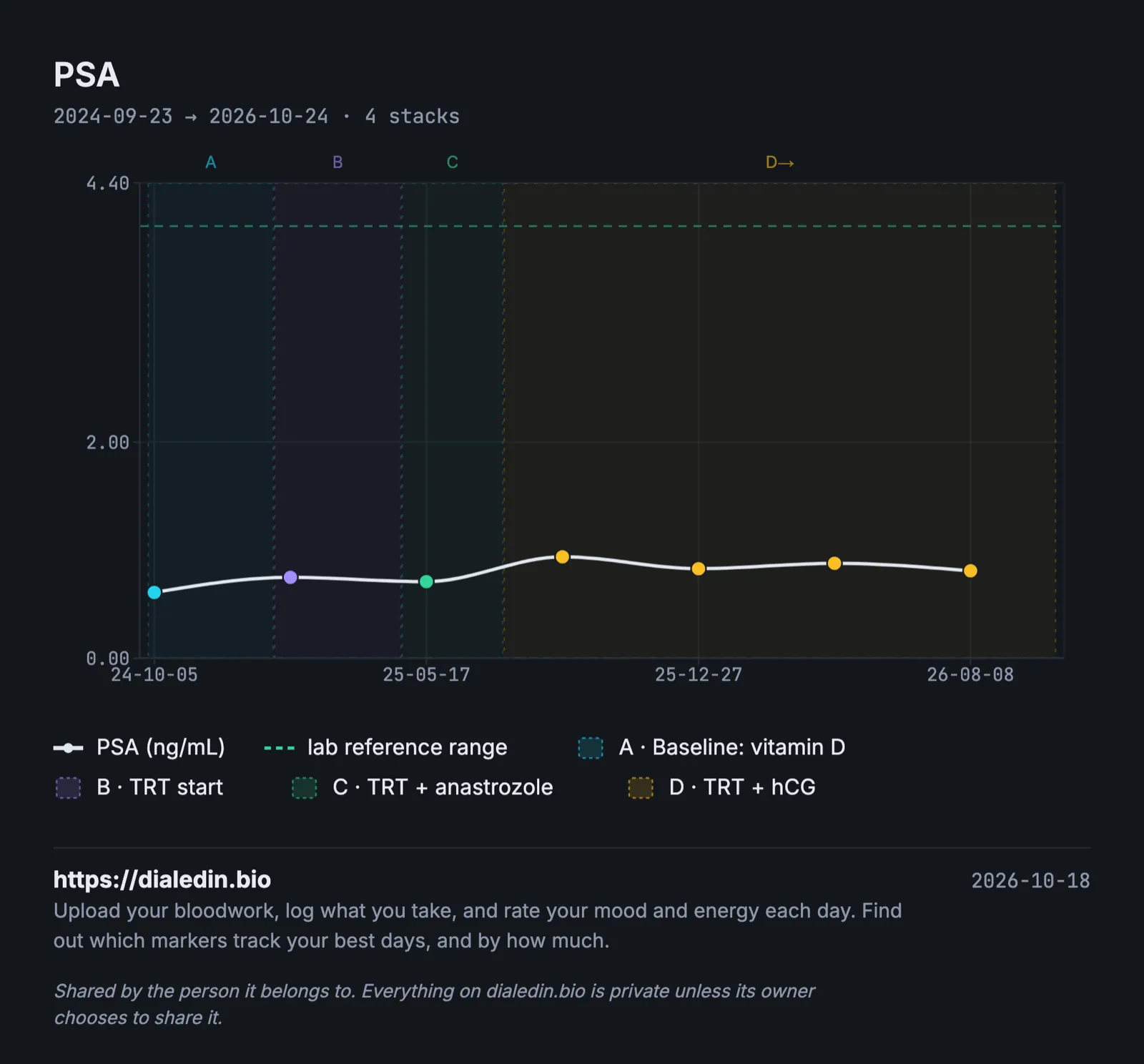
Sample data, not a real person.
The step is small, it comes in the first months of therapy, and then the line goes flat. That's the common pattern. Seeing it needs the baseline and several results from the same lab.
How often should PSA be checked on TRT?
Your prescriber sets that. The guideline above gives the usual shape: before starting, once within the first year, then on the screening schedule for your age. A raised result usually means a repeat test under good conditions before anything else, because so many harmless things push PSA up for a while.
Keep the spacing regular. Several results a year apart, taken the same way, show the direction far better than two taken close together.
Tracking PSA by hand
| Date | Lab | PSA (ng/mL) | On TRT since | Days since injection | Finasteride | Two clear days | Notes |
|---|---|---|---|---|---|---|---|
| 2024-10-05 | City Lab | 0.62 | (baseline) | no | yes | ||
| 2025-03-02 | City Lab | 0.78 | 2025-01 | 3 | no | yes | |
| 2025-11-08 | City Lab | 0.84 | 2025-01 | 3 | no | yes |
"Two clear days" means no ejaculation or long rides in the two days before. The columns that look fussy are the ones that let your doctor trust the trend.
Where dialedin fits
We built dialedin because a PSA trend needs several years of results in one place, and those years are usually spread across clinics.
You upload a lab PDF and it is read into individual markers, which you check before saving. Every report goes onto one timeline, and the same marker under different lab names stays one line. You record what you were taking and when, so each PSA result sits inside the stack it came from, as in the chart above. If you want, daily check-ins show which levels line up with your better days, and you can export your history as a PDF to bring to an appointment.
It's free while we're in beta. If you're on TRT and your PSA results are scattered, put them on one chart next to when you started.
This article is general information, not medical advice, and it can't take your own history into account. Talk to your doctor about whether PSA testing is right for you and what your results mean.