High hematocrit on TRT: what moves it
Most men starting testosterone therapy hear about hematocrit for the first time a few months in, when it comes back higher than the baseline and someone mentions it. It then becomes the line on the report everyone checks first.
A rise in hematocrit on TRT is expected. Testosterone increases red blood cell production in almost everyone who takes it, so the question is how far it climbs, how fast, and how much of a given result is the therapy and how much is the morning the blood was drawn. A surprising share of a single reading comes from things you can control: hydration, the time since your last cigarette, even whether you'd been standing in a queue.
What hematocrit measures
Hematocrit (haematocrit in British spelling) is the share of your blood's volume taken up by red blood cells, given as a percentage. Hemoglobin, the oxygen-carrying protein inside those cells, usually moves with it, at roughly a third of the hematocrit value in g/dL. The red blood cell count is the third line that goes with them.
On most modern analyzers hematocrit isn't measured directly. The machine counts red cells and measures their average size (MCV), and multiplies the two. The older method spins a tube of blood and reads the packed cells off a scale, which is still used in some clinics. The two can differ by a point or so, which is one reason a result from a different lab can jump.
Why TRT raises hematocrit
Testosterone pushes the bone marrow to make more red cells, partly by raising erythropoietin, the hormone that drives red cell production, and partly by making more iron available to build them. The effect is real in nearly every man on therapy, and it tends to follow a pattern.
Most of the rise comes in the first months, then levels off. Injections usually raise hematocrit more than gels, because they produce higher peaks. Older men tend to see a larger rise than younger men. And the higher the testosterone levels, the bigger the effect usually is.
That's why the Endocrine Society's guideline on testosterone therapy recommends checking hematocrit before starting, again a few months in, and then about once a year (Bhasin et al., 2018). What counts as too high for you, and what to do about it, is a conversation for your prescriber.
What else pushes hematocrit up
Several things raise hematocrit with or without testosterone. They stack, so a man on TRT who also smokes and has untreated sleep apnoea can see a much bigger number than one who doesn't. Each is worth mentioning to your doctor.
- Dehydration. Less plasma means the same red cells take up a bigger share. This one changes from day to day.
- Smoking. Carbon monoxide in the blood makes the body build more red cells.
- Sleep apnoea. Repeated drops in oxygen overnight push red cell production up.
- Living at high altitude, for the same reason.
- Lung conditions that lower oxygen levels.
- Other medicines and conditions, which your doctor will know to ask about.
How to make hematocrit results comparable
Hematocrit is easy to move by a point or two on the morning of the test. That's enough to make a stable trend look like a climb, so it's worth taking the same care each time.
Drink normally the day before and the morning of the test
A dehydrated morning concentrates the blood and nudges hematocrit up. If the draw is early and fasted, water is usually still allowed: check with the lab. A hot day, a hard workout or a night of drinking the evening before can all show up in the result.
Sit down for a while before the draw
Standing moves fluid out of the blood vessels and concentrates the blood, and lying down does the opposite. A few quiet minutes in the waiting room makes one draw closer to the next. A tourniquet left on for a long time can also push the number up.
Test at the same point in your injection cycle
Hematocrit doesn't swing much over a week, but the testosterone and estradiol on the same panel do. Testing at the same point in the cycle keeps the whole report comparable. Our post on TRT blood test timing covers how to pick that point.
Use the same lab when you can
Analyzers and methods differ, and so do the reference ranges printed next to the result. A jump right after a lab switch may not mean anything.
Write down donations, illness and travel
A blood donation lowers hematocrit for weeks. So does a heavy bleed. A trip to the mountains raises it. A note next to the result explains a step in the line before you worry about it.
Keep ferritin on the panel
Blood donation, which some men on TRT are offered, lowers ferritin along with hematocrit, and low iron then limits how many new red cells you can make. Our post on reading an iron panel explains the lines to watch.
This is hematocrit across 13 tests over two years, for a man who started TRT in the second stack:
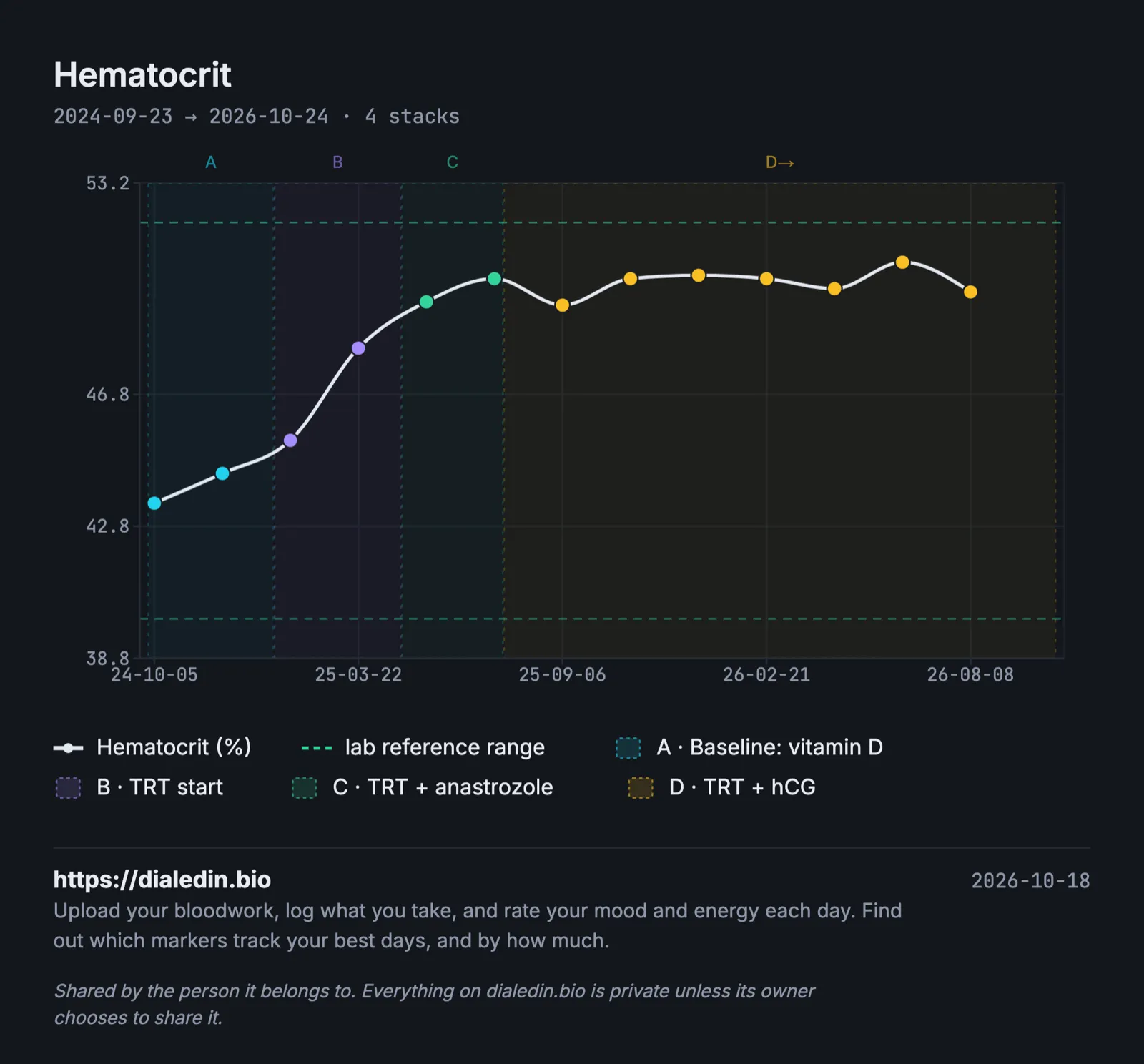
Sample data, not a real person.
Each result is inside the range. The chart shows the shape the guideline is looking for: a climb in the first months of therapy, then a plateau. It also shows when it started, which a single report can't.
How often should hematocrit be checked on TRT?
Your prescriber sets the schedule, and the guideline above is the usual starting point: before therapy, a few months in, then roughly yearly once it's stable. Retest after any change, such as a new form of testosterone, a new injection schedule or any other change your prescriber makes, because that's when hematocrit is most likely to move.
Keep the gaps steady and the conditions the same. Four comparable results a year apart say much more than a cluster of three in one month.
Tracking it by hand
A spreadsheet works. Keep hematocrit and hemoglobin on the same row, and keep columns for the things that move them.
| Date | Lab | Hematocrit (%) | Hemoglobin (g/dL) | Days since injection | Hydrated, seated | Notes |
|---|---|---|---|---|---|---|
| 2025-01-08 | City Lab | 43.6 | 15.0 | (baseline) | yes | |
| 2025-04-15 | City Lab | 47.9 | 16.3 | 3 | yes | |
| 2025-07-22 | City Lab | 49.8 | 16.8 | 3 | no, ran there | hot day |
The last row explains itself because someone wrote it down.
Where dialedin fits
We built dialedin because the spreadsheet above was getting long.
You upload a lab PDF and it is read into individual markers, which you check before saving. Every report goes onto one timeline, and different lab names for the same marker merge into one line. You record what you were taking and when, so each hematocrit result sits on the chart inside the stack it came from, as in the image above. Optional daily check-ins show which levels line up with your better days, and before an appointment you can export your history as a PDF.
It's free while we're in beta. If your TRT bloodwork is spread across clinics and labs, put it on one timeline and see how hematocrit has moved since you started.
This article is general information, not medical advice, and it can't take your own history into account. Talk to your prescriber about how often your hematocrit should be checked and what your results mean for you.