Ferritin vs iron: how to read an iron panel
An iron panel usually comes back as four or five lines: ferritin, iron, transferrin or TIBC, and transferrin saturation. Most people look at the one called "iron", see it's in range, and assume their iron is fine.
Serum iron is the least reliable line on the panel. It changes from hour to hour, is higher in the morning than in the afternoon, and goes up for a while after a meal or an iron tablet. Ferritin, the protein that stores iron, moves slowly and usually tells you more about how much iron you actually have. So when people ask about ferritin vs iron, the short answer is that they measure different things, and ferritin is normally the one to follow over time.
What each line on an iron panel measures
Iron in the body sits in three places: in red blood cells, in storage (mostly in the liver), and in transit in the blood, carried by a protein called transferrin. Each test looks at one of them.
| Test | What it measures | What moves it |
|---|---|---|
| Ferritin | Stored iron | Falls as stores run down. Rises with inflammation, infection, liver problems and alcohol, whatever the stores are |
| Serum iron | Iron in transit in the blood right now | Time of day, recent meals, iron supplements, illness |
| Transferrin or TIBC | How much iron the blood could carry | Tends to rise when stores are low, fall with inflammation. Oral estrogen and pregnancy raise it |
| Transferrin saturation | The share of transferrin carrying iron | Calculated from iron and TIBC, so it inherits iron's day-to-day swings |
| Haemoglobin | Iron already built into red cells | Usually the last of these to fall |
Transferrin saturation is iron divided by TIBC, times 100. If your report doesn't print it, you can work it out from the other two, as long as they came from the same sample.
Why ferritin and iron can disagree
Because they measure different pools, they often point in different directions, and the pattern across the panel says more than any single line. These are the common combinations doctors look at. Each has more than one explanation, so a pattern is worth raising with your doctor, not reading as an answer.
- Ferritin low, iron low, TIBC high, saturation low. The textbook picture of stores running out. Ferritin is usually the first to show it.
- Ferritin normal or high, iron low, TIBC low. Common during inflammation or infection: the body holds iron back and ferritin rises as part of the immune response. Stores can be low underneath a normal ferritin.
- Ferritin high, saturation high. Worth raising, because a high saturation can mean iron is building up in the body. Inflammation alone usually lowers it.
- Ferritin falling across several tests while everything else is in range. Stores going down before anything else has changed.
The second pattern is why a CRP or hs-CRP is often ordered with ferritin. If inflammation is up, a normal ferritin means less.
Who tends to watch ferritin
Ferritin drops for ordinary reasons, and it usually drops long before haemoglobin does, which is why it's on so many panels.
Heavy periods are the most common cause in women, and periods often get heavier in perimenopause. Our post on tracking hormones through perimenopause covers that side. Regular blood donation lowers ferritin, and some men on testosterone therapy donate because of their haematocrit. Endurance training, a vegetarian diet and some stomach and gut conditions can lower it too. Ferritin is also often checked alongside a thyroid panel, because tiredness and hair loss bring people to both.
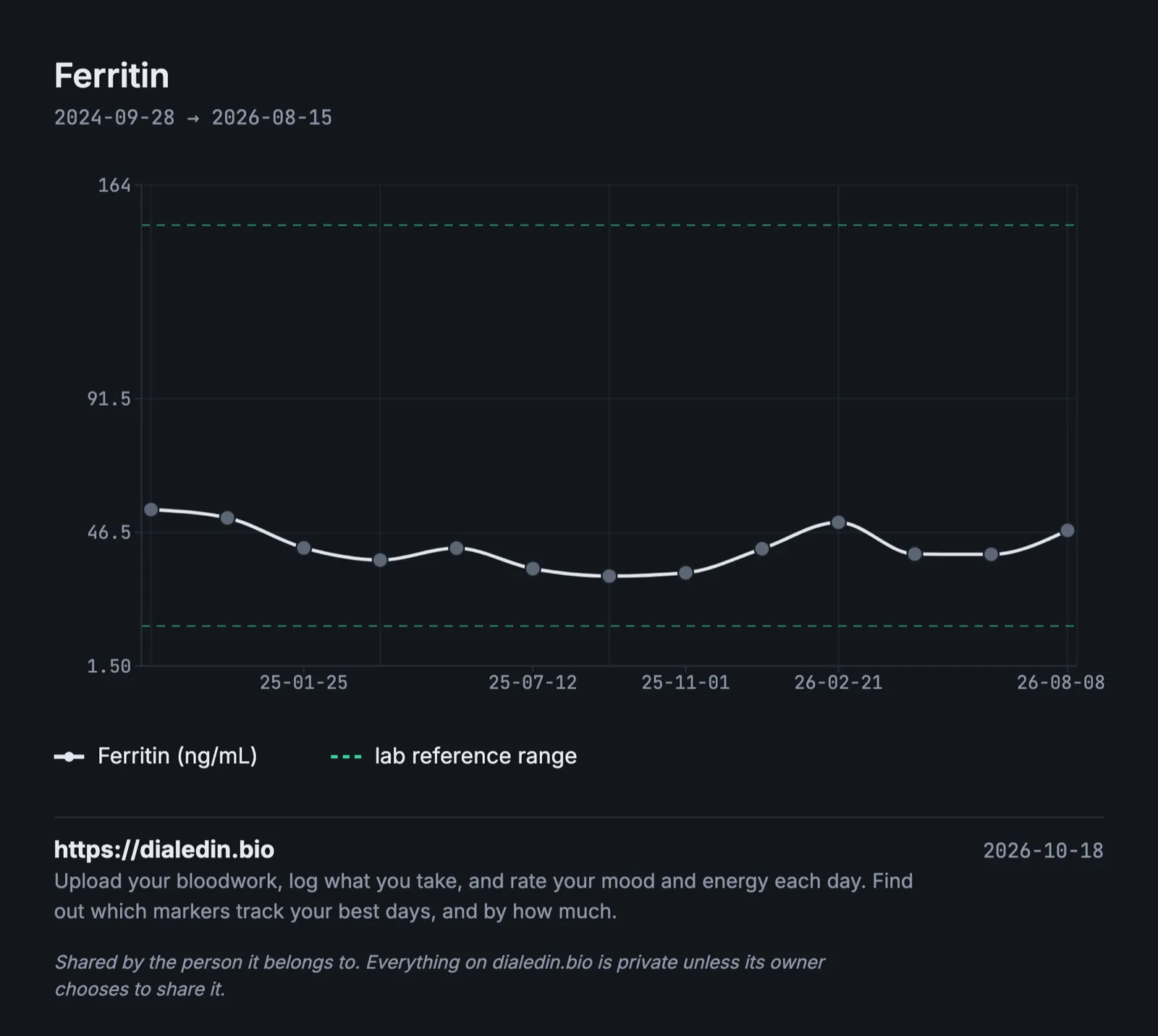
Here is ferritin across 13 tests over two years:
Sample data, not a real person.
Every result is inside the range, so no report would have flagged it. On one chart, a year of falling stores is easy to see.
How to make iron results comparable
Iron is one of the noisier panels, and most of the noise comes from how the blood was taken. These habits remove most of it.
Test in the morning, fasted
Serum iron is higher in the morning and changes after you eat. Most labs ask for a morning, fasted sample for an iron panel. If one test was at 8am fasted and the next at 4pm after lunch, the iron and saturation lines can't be compared.
Pause iron supplements before the test, if your doctor agrees
An iron tablet raises serum iron for hours, so a test taken soon after one shows the tablet, not your usual level. Many labs ask you to skip iron for a day beforehand. Check with whoever ordered the test, and write down what you did.
Don't test during or just after an illness
A cold, flu or any infection can push ferritin up and iron down for a few weeks. The panel then describes the illness. If you were ill, note it, or wait and retest.
Note heavy training and blood donation
A hard race or a donation shortly before a test changes the picture. Donation in particular lowers ferritin for months. Put the date next to the result.
Watch the units
Ferritin is reported in ng/mL or µg/L, and those are the same number. Serum iron comes in µg/dL or µmol/L, which are not, so convert before you put two labs on one chart.
Use the same lab when you can
Ferritin methods and ranges vary between labs, and the lower limit in particular differs a lot. A jump after switching labs may be the method.
How often should ferritin be checked?
That depends on why it's being checked, so it's a schedule for your doctor to set. A few anchors hold for most people.
Get a baseline while you feel well, so later results have something to compare with. If you start iron, a recheck after a couple of months is common, because ferritin takes weeks to respond. If you're in a group where ferritin tends to drift, such as heavy periods, regular donation or a plant-based diet, ask whether a yearly check makes sense.
Keep the conditions the same each time: same lab, morning, fasted, no iron tablet that morning, not ill. A series taken that way can show a trend that one test never will.
Tracking an iron panel by hand
You can start with a spreadsheet. Put the whole panel on one row so the pattern stays visible, and keep a column for anything that might have moved it.
| Date | Lab | Ferritin (ng/mL) | Iron (µg/dL) | TIBC (µg/dL) | Saturation (%) | Haemoglobin (g/dL) | Fasted, time | Notes |
|---|---|---|---|---|---|---|---|---|
| 2025-02-11 | City Lab | 52 | 88 | 320 | 28 | 13.6 | yes, 08:00 | |
| 2025-06-03 | City Lab | 38 | 71 | 355 | 20 | 13.4 | yes, 08:10 | heavy month |
| 2025-10-14 | City Lab | 31 | 64 | 372 | 17 | 13.3 | yes, 08:05 |
Ferritin is the column to chart first. The others help explain it.
Where dialedin fits
We built dialedin because keeping that table by hand gets old quickly.
You upload a lab PDF and it is read into individual markers, which you check before saving. Every report goes onto one timeline, and when two labs name the same marker differently, it stays one line. You can record what you were taking and when, such as an iron supplement, so each result sits next to it. Optional daily check-ins show whether your energy lines up with any of it, and you can export your history as a PDF for your doctor.
It's free while we're in beta. If your ferritin results are spread across several reports, put them on one chart and see which way they're going.
This article is general information, not medical advice, and it can't take your own history into account. Talk to your doctor about which iron tests you need and what your results mean for you.