Thyroid panel explained: TSH, T4, T3 and antibodies
A thyroid panel can be one line or eight. Ask one doctor and you get a TSH. Ask a private lab for a "full thyroid panel" and you get TSH, free T4, free T3, total T3, reverse T3, two kinds of antibodies, and sometimes T3 uptake and a T7 for good measure. Most people read the flags and stop there.
The lines aren't independent. TSH comes from the pituitary gland in your head and tells the thyroid how hard to work, so it usually moves in the opposite direction to the hormones the thyroid makes. Because of that feedback, TSH often changes first and by the most, and a thyroid panel makes much more sense read as a set, in the order the hormones are made and used, than flag by flag.
What each test on a thyroid panel measures
| Test | What it is | What it's used for |
|---|---|---|
| TSH | Thyroid-stimulating hormone, from the pituitary | The usual first test. It rises when thyroid output is low and falls when it's high |
| Free T4 | The unbound part of thyroxine, the main hormone the thyroid makes | Read with TSH to see whether output matches the signal |
| Free T3 | The unbound part of triiodothyronine, the active form | Most T3 is made from T4 in other tissues, not in the thyroid |
| Total T4 and total T3 | Bound plus free hormone | Older tests, affected by binding proteins (oral estrogen and pregnancy raise them) |
| Reverse T3 | An inactive form made from T4 | Rises during illness, fasting and stress. Not part of routine testing |
| TPO antibodies | Antibodies against thyroid peroxidase, an enzyme in the thyroid | The usual sign of autoimmune thyroiditis (Hashimoto's) |
| Thyroglobulin antibodies | Antibodies against thyroglobulin, the protein T4 is stored on | Another autoimmune marker, sometimes positive when TPO isn't |
| T3 uptake and T7 | Indirect estimates of free hormone | Mostly replaced by direct free T4 tests |
How the results usually move together
These are the common patterns. Each one has more than one explanation, and none of them is a diagnosis. They're the reason doctors read the lines together.
- TSH high and free T4 low is the pattern of an underactive thyroid.
- TSH high and free T4 still in range is often called subclinical. It's common, and it's often rechecked before anything is decided.
- TSH low and free T4 or free T3 high is the pattern of an overactive thyroid.
- TSH low with free T4 low is much less common. It can come from the pituitary, and it also turns up in people who are seriously ill.
- TPO antibodies positive with everything else in range means autoimmune thyroiditis may be present without having affected output yet. Many people with positive antibodies keep normal levels for years.
- Reverse T3 high with free T3 on the low side is what usually happens during illness, a hard diet or a long fast. It tends to settle on its own.
The free T3 to free T4 ratio is another way to look at the same two numbers. It describes your own results and has no reference range of its own.
How to track a thyroid panel over time
The thyroid changes slowly, and most of the apparent change between two panels comes from how they were taken. These habits remove most of that noise.
Test at the same time of day
TSH is highest overnight and early in the morning and lower in the afternoon. A morning result and a mid-afternoon one can differ noticeably for no other reason.
On thyroid medication, take it the same way before every test
Taking levothyroxine an hour before the draw can lift free T4 on that day's result. Many doctors ask you to have blood taken before that day's tablet. Whichever way you do it, do it the same way every time and write it down.
Stop biotin before the test, as your lab advises
Biotin in the large amounts found in many hair and nail supplements interferes with many thyroid tests and can make results look like an overactive thyroid. Labs usually ask you to stop it for a couple of days beforehand.
Use the same lab
Free T4 and free T3 methods differ between labs, and so do the ranges printed next to them. Antibody results in particular aren't comparable between methods. A new lab means a new starting point.
Don't chase antibody numbers
TPO antibody levels go up and down for reasons that aren't well understood, and a move from one positive value to another rarely changes anything. Whether they're positive matters more than the exact number.
Give a change about six weeks to show
TSH takes weeks to settle after a change in medication or thyroid function, which is why follow-up tests are usually spaced six to eight weeks apart. A test after two weeks mostly shows the middle of the change.
Write down illness and big diet changes
Because reverse T3 and free T3 shift during illness and heavy calorie restriction, a note next to the result saves you reading a temporary change as a trend.
How often should thyroid tests be done?
That depends on whether you're on treatment, so it's a schedule for your doctor to set. On a new or changed thyroid medication, a check after six to eight weeks is common, then less often once results are steady. Without treatment, many people only have TSH checked when there's a reason to.
If your antibodies are positive and your levels are normal, ask your doctor how often to recheck TSH. That's the result most likely to change first.
What a slow change looks like
This is one person's free T4 across 13 tests over two years:
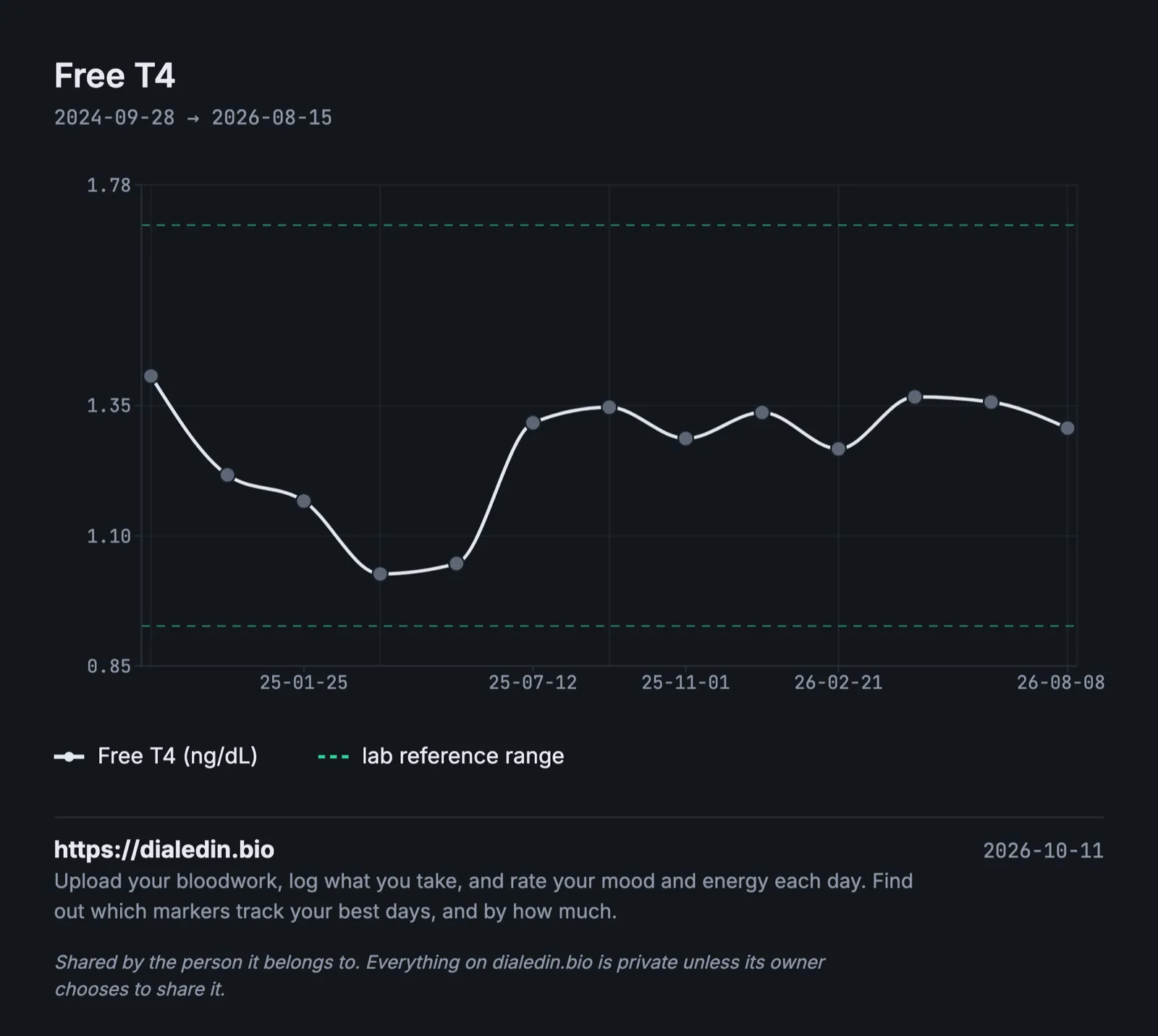
Sample data, not a real person.
Free T4 lost more than a quarter of its value over the first year without leaving the range, so no single report flagged it. Lined up, the slide is plain, and so is the recovery after treatment started in mid-2025.
Her TPO antibodies over the same two years:
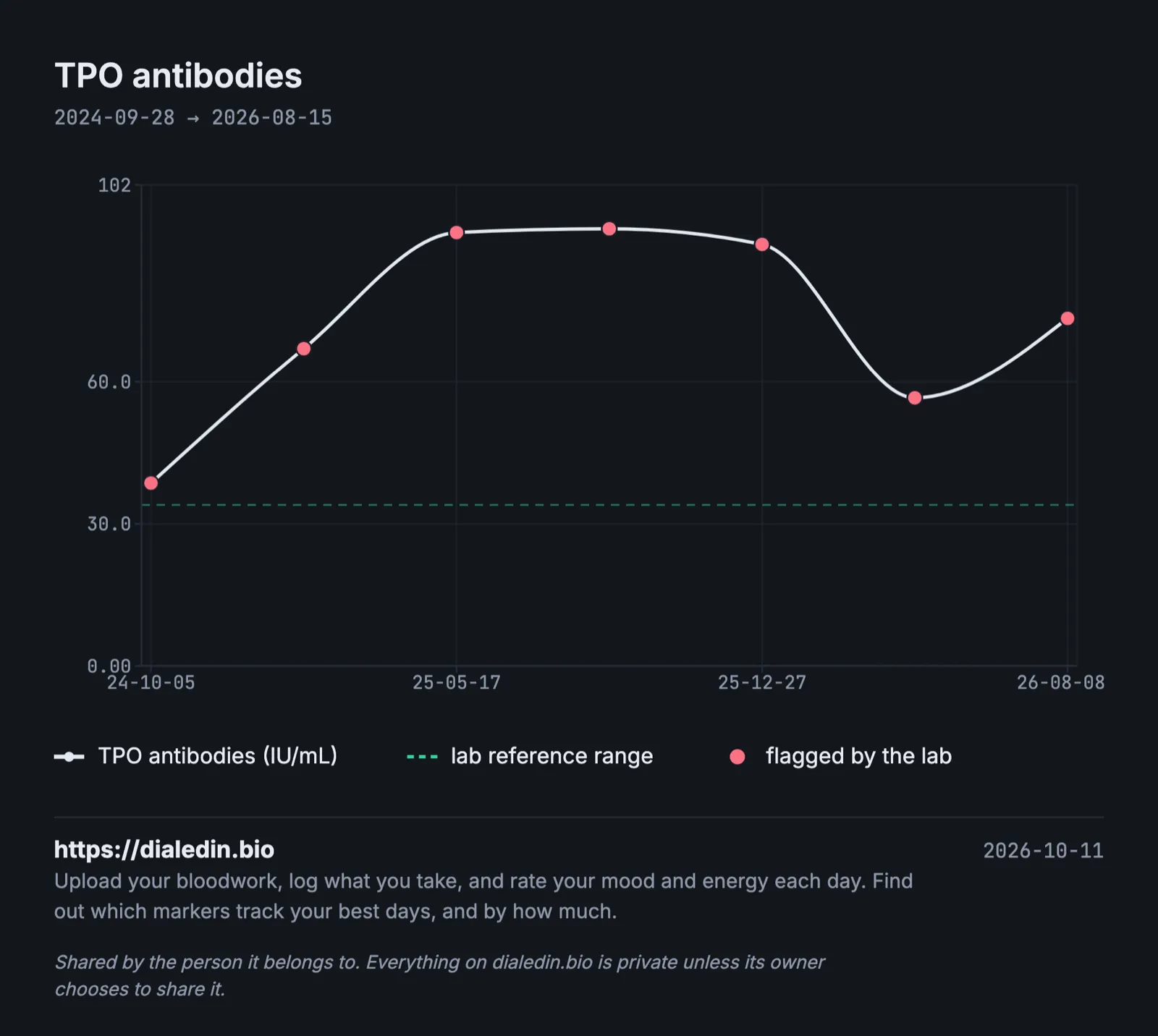
Sample data, not a real person.
Every result is flagged, and the number moves around a lot. What tells you something is that it stays positive. Whether the latest one is 72 or 90 tells you very little.
Tracking it in a spreadsheet
One row per test date, one column per thyroid marker, plus the notes that make results comparable:
| Date | Lab | TSH (mIU/L) | Free T4 (ng/dL) | Free T3 (pg/mL) | TPO Ab (IU/mL) | Time | Medication before draw? | Notes |
|---|---|---|---|---|---|---|---|---|
| 2025-02-03 | City Lab | 2.6 | 1.21 | 3.0 | 66 | 08:15 | none | |
| 2025-04-01 | City Lab | 3.1 | 1.15 | 2.9 | 08:10 | none | ||
| 2025-08-12 | City Lab | 1.9 | 1.31 | 3.1 | 88 | 08:20 | no, taken after | 8 weeks on medication |
Keep one unit per column, and leave a cell empty when the test wasn't done. Our earlier post on tracking thyroid tests when TSH is normal but you're still tired adds a daily symptom rating to the same sheet.
Where dialedin fits
We built dialedin because a thyroid history spread over a dozen PDFs is hard to read.
You upload a lab PDF and it is read into individual markers, which you check before saving. TSH, free T4, free T3 and antibodies go onto one timeline, and different lab names for the same marker are merged into one line. You can record what you were taking and when, so each result sits next to the medication you were on, and a short daily check-in shows which levels line up with your better days. Before an appointment you can export your history as a PDF for your doctor.
It is free while we are in beta. There is more on the thyroid side of dialedin, or you can put your results on one timeline now.
This article is general information, not medical advice, and it can't take your own history into account. Talk to your doctor about which tests you need and what your results mean for you.