Normal TSH but still tired? Track your thyroid tests
The usual thyroid story goes like this. You feel tired, foggy and cold, you get a blood test, TSH comes back inside the range, and you're told your thyroid is fine. A year later the same thing happens, with a slightly different number.
What that misses is how narrow your own thyroid range is. In a Danish study that tested 16 healthy men every month for a year, each man's results stayed within a band about half as wide as the range for the whole group (Andersen et al., 2002). The authors' conclusion was that a result inside the lab's limits is not necessarily normal for the person it belongs to. So a TSH that moves from near the bottom of the range to near the top can be a large change for you, with no flag anywhere on the report. You only see it if you track your thyroid tests over time.
Which thyroid results to keep
These are the markers that show up on most thyroid panels, plus a few that often travel with them. Each is worth noticing and raising with your doctor if it moves, and none means anything on its own.
- TSH is the pituitary's signal to the thyroid. It reacts strongly to small changes in thyroid hormone, which makes it the earliest marker to move and also a noisy one.
- Free T4 is the main hormone the thyroid makes. If you take levothyroxine, this is the hormone you are taking.
- Free T3 is the active form, mostly converted from T4 in the body. Our FT3/FT4 ratio calculator puts the two side by side.
- TPO antibodies are the usual marker of Hashimoto's, the most common cause of an underactive thyroid. They can be raised for years before TSH changes.
- Ferritin and vitamin B12 are often checked alongside, because low iron and low B12 cause the same tiredness, and B12 problems are more common in people with autoimmune thyroid disease.
- Cholesterol tends to rise when the thyroid is underactive, so a lipid result next to your thyroid results adds context.
How to make thyroid results comparable
Thyroid tests are sensitive to how and when they are done. These habits remove most of the difference that has nothing to do with your thyroid.
Test at the same time of day
TSH follows a daily rhythm. It is highest overnight and in the early morning and lower in the afternoon, so a morning result and an afternoon result can differ for that reason alone. Most people find an early morning appointment easiest to repeat.
Take your thyroid medication the same way on test days
Levothyroxine taken shortly before a blood test raises free T4 for a few hours. Some doctors ask you to take it after the draw, others don't mind. Ask yours, and then do the same thing every time.
Stop biotin before the test, as your lab advises
Biotin in the large amounts found in many hair, skin and nail products interferes with many thyroid tests. It can make results look like an overactive thyroid when nothing is wrong. Labs usually ask you to stop it for a few days beforehand.
Use the same lab
Thyroid tests are run on different machines with different reference ranges, and free T4 and free T3 in particular vary between methods. If you switch labs, expect a step and don't read much into it.
Give a change time to show
TSH takes weeks to settle after a change in thyroid medication, so a test taken too soon after one shows a level still on its way somewhere. Your doctor will tell you how long to wait.
Write down brand changes and what you take with it
Switching between levothyroxine brands or formulations can shift your levels, even when the strength on the box is the same. Calcium, iron, some antacids and coffee taken close to levothyroxine reduce how much you absorb. One line next to a result explains a lot later.
Rate your symptoms every day, on the same scale
Fatigue, brain fog, cold intolerance, aches: pick what affects you and rate it daily. A few weeks of ratings around each blood test show whether how you feel moves with your results or doesn't. Both answers are useful to bring to your doctor.
How often should thyroid levels be checked?
That depends on whether you are on treatment and how stable things are, so the schedule is for your doctor to set. After a change it is usually sooner, and once things are stable a yearly check is common.
Two things help whatever the schedule. Get a baseline while you feel well, if you can, because it shows where your own normal sits within the lab's range. And keep the conditions the same every time: same lab, same time of day, same routine with your medication.
What a slow TSH drift looks like
This is a made-up person's TSH across two years of blood tests, with the stacks shaded and a dot for each day's thyroid check-in, greener for a better day.
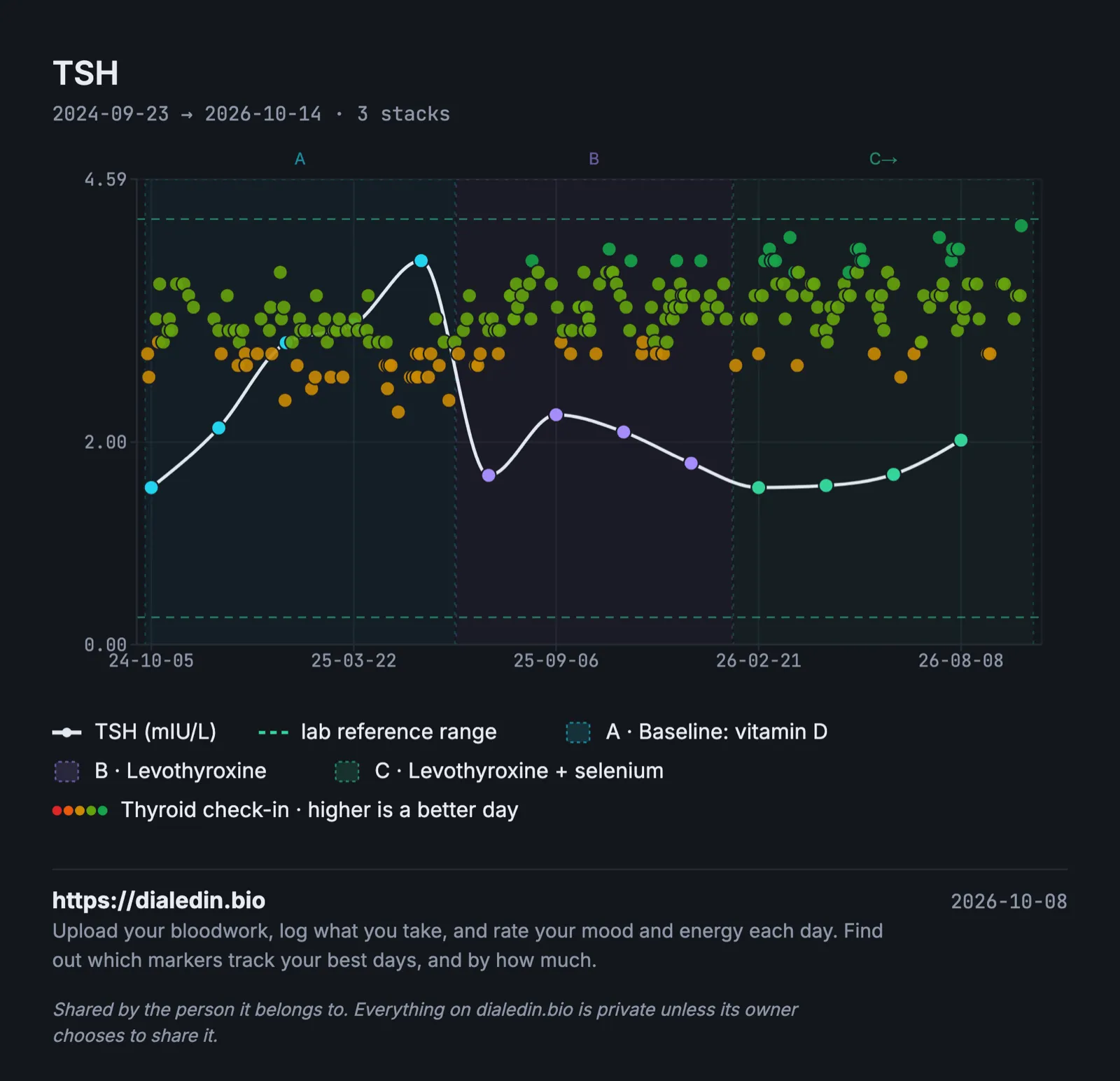
Sample data for a made-up person, not a real patient.
No result on this chart is flagged. Each report on its own reads as normal. Lined up, TSH more than doubles over nine months, and the worse days sit in the same stretch.
Doing it with a spreadsheet
You don't need an app to start. One row per marker per test, plus the columns that make thyroid results comparable:
| Date | Lab | Marker | Value | Unit | Lab's range | Time | Levothyroxine before test? | Avg fatigue rating, last 4 weeks | Notes |
|---|---|---|---|---|---|---|---|---|---|
| 2025-03-04 | City Lab | TSH | 2.1 | mIU/L | 0.27-4.2 | 08:10 | not taking | 3.2 | |
| 2025-03-04 | City Lab | Free T4 | 1.22 | ng/dL | 0.93-1.7 | 08:10 | not taking | 3.2 | |
| 2025-09-02 | City Lab | TSH | 3.4 | mIU/L | 0.27-4.2 | 08:05 | not taking | 2.4 | stopped biotin 3 days before |
| 2025-09-02 | City Lab | Free T4 | 1.04 | ng/dL | 0.93-1.7 | 08:05 | not taking | 2.4 |
Keep daily ratings on a second sheet and copy the four-week average into the main one. Keep one unit per marker, since free T4 comes in ng/dL or pmol/L depending on the lab. It is slow by hand, but it works.
Where dialedin fits
We built dialedin to do that bookkeeping for you.
You upload a lab PDF and it is read into individual markers, which you check before saving. Every report goes onto one timeline, and different lab names for the same marker are merged into one line. You record what you take and when, including a change in brand, so each result sits next to what you were on. A short daily thyroid check-in covers fatigue, brain fog, cold intolerance and aches, and shows which of your levels line up with your better days. You can also export your history as a PDF to bring to an appointment.
It is free while we are in beta. There is more on thyroid tracking in dialedin, or you can put your results on one timeline now.
This article is general information, not medical advice, and it can't take your own history into account. Talk to your doctor about which tests you need and what your results mean for you.