Tracking your hormone levels through perimenopause
A lot of women in their forties ask for an FSH test hoping for a straight answer: am I in perimenopause or not? The result comes back, sometimes flagged and sometimes not, and it settles very little.
The reason is how perimenopause works. In the years before the last period, the ovaries respond less predictably, and FSH and estradiol can swing widely from one month to the next and even within a single cycle. One test can look premenopausal and the next one, a few weeks later, postmenopausal. That is why the UK's NICE guideline diagnoses perimenopause in women over 45 from symptoms and changes in periods, without a blood test (NICE NG23). If you want to track your hormone levels through perimenopause, the lab results are one part of the record, and the symptoms and the cycle are the rest.
Which results are worth keeping
Blood tests still have a place. They help rule other things out, they give a baseline, and on HRT they sometimes help answer why symptoms haven't settled. These are the ones that tend to come up. Each is worth noticing and raising with your doctor if it changes, and none of them diagnoses anything on its own.
- FSH tends to rise over perimenopause, but with big swings along the way. A run of results shows the direction better than any single one.
- Estradiol swings even more, high some months and low in others. On HRT, the level also depends on when you last changed a patch or applied a gel.
- LH usually moves with FSH and is often reported next to it.
- Progesterone is mainly useful to show whether ovulation happened, and only when it is taken at the right point in the cycle, about a week before the next period is due.
- TSH is worth having on file, because thyroid problems share many symptoms with perimenopause: tiredness, low mood, changes in periods, feeling too hot or too cold.
- Ferritin, your stored iron, can fall if periods get heavier, which is common in perimenopause. It usually drops before haemoglobin does.
- Cholesterol and blood sugar markers are worth following, because LDL cholesterol tends to rise around menopause.
How to time and compare your tests
Hormone results in perimenopause are noisy enough already. These habits remove the noise you can control.
Write down your cycle day for every test
Estradiol, progesterone, FSH and LH all depend on where you are in your cycle. A result without a cycle day is hard to read later. If periods are irregular, write down the date of the last one instead.
Test on the same cycle day when you can
FSH and estradiol are usually measured early in the cycle, in the first few days after a period starts. Progesterone is measured later. Comparing an early-cycle result with a late-cycle one mostly measures the cycle.
On HRT, note when you last changed or applied it
With a patch, write down how many days the current patch had been on. With a gel or spray, note the time you applied it, and don't have blood drawn from the arm you put it on: gel on the skin near the needle can make estradiol read far too high.
Note anything hormonal you take
Hormonal contraception, including a hormonal coil, changes FSH and LH and can make them hard to read. Some supplements matter too. Biotin in the large amounts found in many hair and nail products can interfere with hormone and thyroid tests.
Use the same lab
Estradiol methods differ between labs, especially at low levels. If you switch labs, expect a jump and treat the new result as a new starting point.
Keep a daily symptom diary
This is the record that carries the most weight. Hot flushes and night sweats, sleep, mood and brain fog, rated on the same short scale every day, with your period marked when it comes. A diary like this shows patterns that a few blood tests a year can't: symptoms that cluster before a period, sleep that gets worse in one part of the cycle, a change that started with a new medication. It is also what most doctors ask for. "Six weeks of ratings" is easier to act on than "it's been bad lately".
How often should hormones be tested in perimenopause?
There is no standard schedule. It depends on your symptoms, your age and whether you are on treatment, so it is something to agree with your doctor.
Many doctors adjust HRT by how you feel and check hormone levels only in particular cases, such as symptoms that don't settle. So don't expect regular hormone tests, and don't worry if you aren't offered them. What helps whatever the schedule is a baseline while you feel well and a daily symptom record that runs the whole time. When a test does happen, the diary shows what was going on around it.
What a few years of results and ratings look like
This is a made-up person's estradiol across two years of blood tests, with the stacks shaded and one dot per day's hormone check-in, greener for a better day.
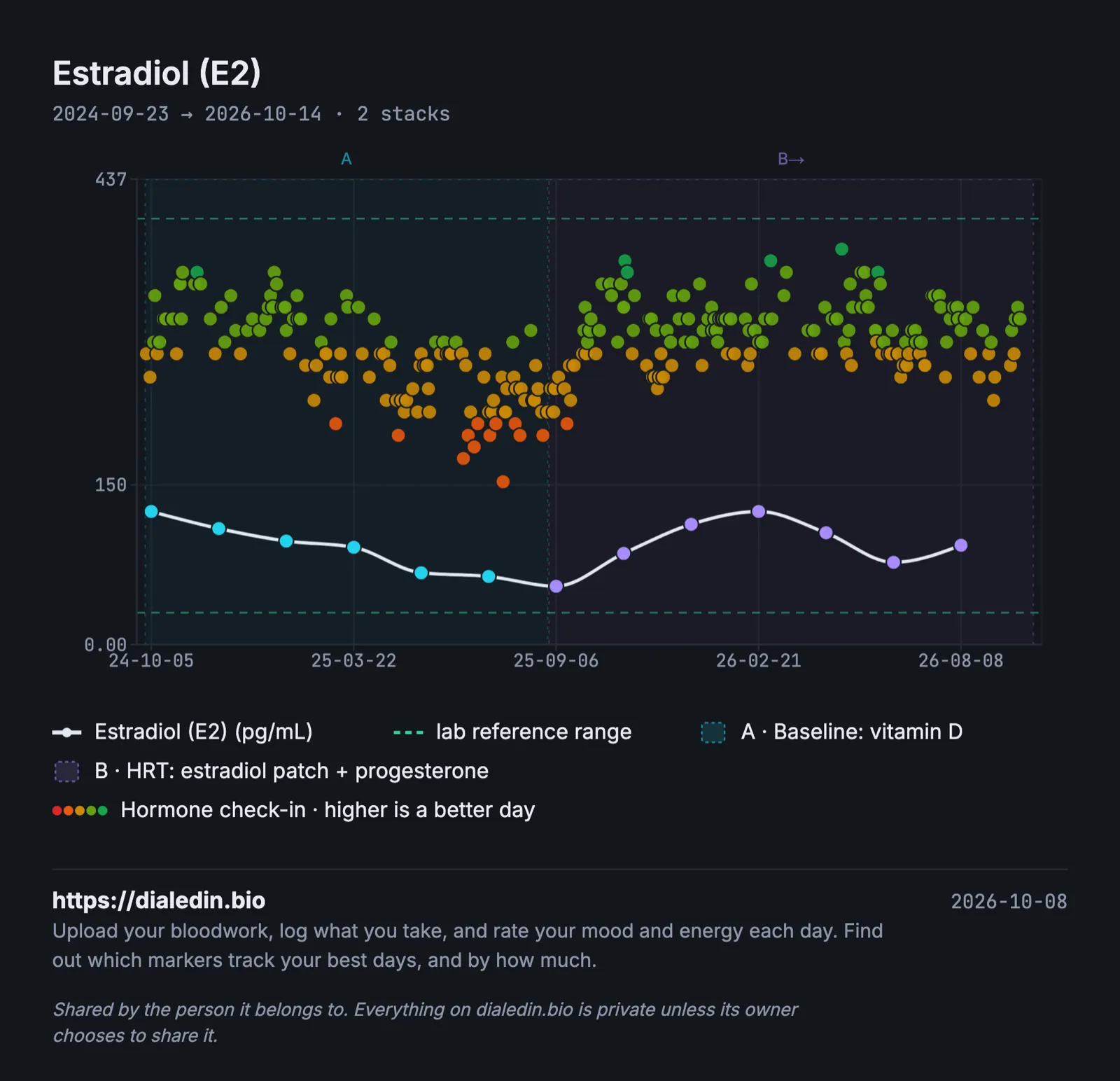
Sample data for a made-up person, not a real patient.
Every result is inside the lab's range, the dashed lines, so no single report would have flagged anything. With the ratings on the same chart, the slide in estradiol and the run of bad days line up, which is the kind of pattern worth taking to an appointment.
Doing it with a spreadsheet and a diary
You can start today without any app. Keep two sheets. The first is your lab results, one row per marker per test:
| Date | Lab | Marker | Value | Unit | Lab's range | Cycle day | HRT note | Notes |
|---|---|---|---|---|---|---|---|---|
| 2025-03-04 | City Lab | FSH | 14.2 | mIU/mL | (by phase) | 3 | none | |
| 2025-03-04 | City Lab | Estradiol | 88 | pg/mL | (by phase) | 3 | none | |
| 2025-09-16 | City Lab | Estradiol | 104 | pg/mL | (by phase) | n/a | patch on 2 days | periods irregular, last one 2025-08-20 |
The second is the daily diary: date, period yes or no, and your ratings for hot flushes, sleep, mood and brain fog on a 1 to 5 scale. Five minutes a week to copy the averages next to each test is enough to see whether they move together.
Where dialedin fits
We built dialedin so that record doesn't have to live in two spreadsheets.
You upload a lab PDF and it is read into individual markers, which you check before saving. Every report goes onto one timeline, and different lab names for the same marker are merged into one line. You record what you take and when, so each result sits next to the treatment you were on. A short daily hormone check-in covers hot flushes, mood, sleep, brain fog and cycle day, and shows which of your levels line up with your better days. Sleep and heart rate can come in from your phone, and you can export your history as a PDF for your doctor.
It is free while we are in beta. There is more on hormone tracking for women, or you can start your own timeline now.
This article is general information, not medical advice, and it can't take your own history into account. Talk to your doctor about which tests you need and what your results mean for you.