Prolactin blood test: why results bounce around
A prolactin result marked high is one of the more alarming flags to find on a report. Search it and the first pages are about pituitary tumours.
Prolactin is also one of the easiest hormones to push up by accident. Stress raises it, including the stress of having blood taken. So do sleep, hard exercise, a big meal and a long list of common medications. Many mildly raised prolactin results come down on a repeat test with nothing done in between, which is why a single high result is usually checked again before anyone reads much into it.
What prolactin is and why it gets tested
Prolactin is a hormone made by the pituitary gland. Its best-known job is milk production after childbirth, and levels rise a lot during pregnancy and breastfeeding. It does other things too: when it's high, it damps down the signals that drive the testes and ovaries.
That last effect is why it turns up on hormone panels. A doctor may order it to look into:
- irregular or missing periods,
- milky nipple discharge when not breastfeeding,
- fertility problems,
- low testosterone, or low libido and erectile problems in men,
- headaches or vision changes, when a pituitary problem is a possibility.
High prolactin lowers LH and FSH, and through them testosterone or estradiol. So a low testosterone with a low or normal LH is one of the situations where prolactin is usually checked.
What can raise prolactin
Most of these are ordinary. They're the reason a raised result is followed by questions about the morning of the test, and each is worth mentioning to your doctor if your result is flagged.
- Stress, including anxiety about the blood draw itself, or a difficult draw with several attempts.
- Sleep. Prolactin rises during sleep, so a test very soon after waking can read higher.
- Hard exercise shortly before the test.
- Eating, especially a protein-heavy meal, shortly before.
- Nipple stimulation, including from a tight sports bra or a chest workout.
- Pregnancy and breastfeeding.
- Medications. Many antipsychotics, some antidepressants, some anti-sickness drugs such as metoclopramide, and some blood pressure drugs raise it.
- An underactive thyroid. A high prolactin often leads to a TSH test for this reason.
- Kidney disease, which slows how fast prolactin is cleared.
Macroprolactin
Some people carry much of their prolactin as macroprolactin, a large complex of prolactin bound to an antibody. It's mostly inactive in the body, but many lab tests count it. The result is a high prolactin on paper in someone with no symptoms. Labs can screen for it, often by treating the sample with a chemical called PEG and measuring again. If you have a high result and no symptoms, ask whether a macroprolactin check was done.
How prolactin behaves over time
Even in someone with nothing going on, prolactin moves a lot from one test to the next. This is one person's prolactin across 13 tests over two years:
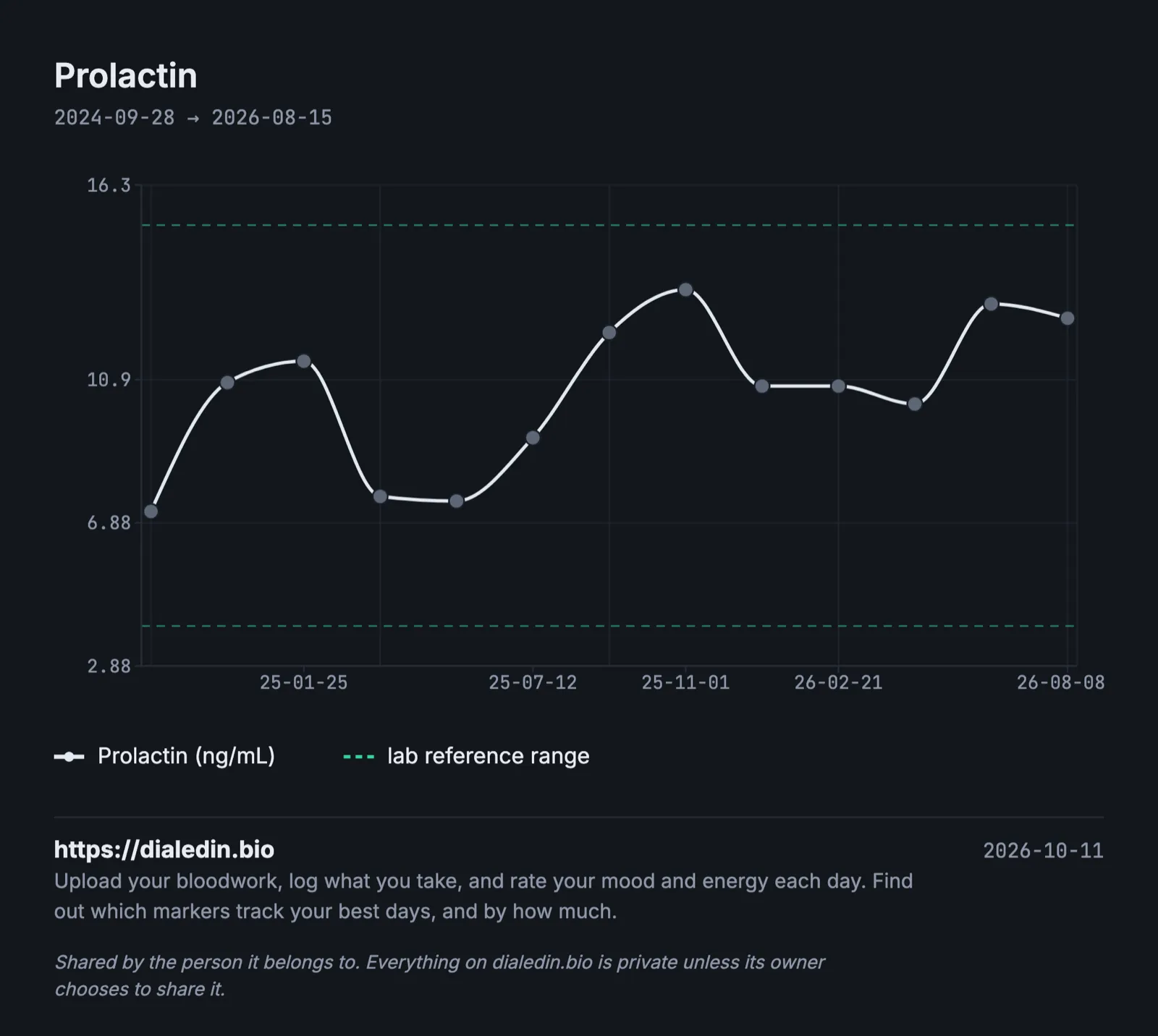
Sample data, not a real person.
Every result is in range, and the values still swing from about 7 to about 13.5 with no trend. A single result near the top of the range, read on its own, can look like a rise. Read against the others, it's one more point in the usual scatter. That scatter is also why a mildly raised result is much less informative than a run of consistently high ones.
How to get a prolactin result you can trust
Sit quietly for a while before the draw
Arriving rushed and stressed raises prolactin. Many labs ask you to rest for a few minutes before blood is taken. If your result was mildly raised, it's reasonable to ask whether the repeat can be done after a longer rest.
Don't test right after waking
Because prolactin rises during sleep, a draw a couple of hours after you wake up is more comparable than one taken straight from bed. Whatever time you pick, keep it the same.
Skip exercise and a big meal beforehand
A workout or a large breakfast before the lab can both nudge it up. If you train in the morning, have the blood taken first.
Write down every medication
Bring a list to the appointment, including anything taken occasionally. Many prolactin-raising drugs aren't obviously hormonal, such as anti-sickness tablets or some antidepressants.
Write down how the draw went
If it took several attempts, or you felt faint or anxious, put a note next to the result. That's exactly the kind of draw that can read high.
Use the same lab
Prolactin assays differ, and so does how much macroprolactin each one picks up. Results from two labs can disagree by more than a real change would.
How often should prolactin be checked?
There's no routine schedule. Prolactin is usually tested when there's a reason, then repeated if the first result was raised. If it's being monitored for a known condition, follow the schedule your doctor gave you. If you're on a medication known to raise it, ask whether it's worth checking at all, since a raised result may then be expected.
Tracking it in a spreadsheet
Prolactin is the marker where the notes column matters most:
| Date | Lab | Prolactin (ng/mL) | Unit | Lab's range | Time | Hours awake | Rested before draw | Exercise or meal before | Notes |
|---|---|---|---|---|---|---|---|---|---|
| 2025-02-10 | City Lab | 21.4 | ng/mL | 4-15.2 | 07:10 | 0.5 | no | no | rushed, two attempts |
| 2025-03-03 | City Lab | 11.8 | ng/mL | 4-15.2 | 09:30 | 2.5 | 20 min | no | repeat test |
Two rows like these, side by side, explain a flagged result better than any single number. Some labs report prolactin in mIU/L instead of ng/mL. One ng/mL is roughly 21 mIU/L, though the exact factor depends on the standard the assay was calibrated to, so it's easiest to keep each lab's results in the unit it reports.
Where dialedin fits
We built dialedin because a hormone like prolactin is only readable next to its own history.
You upload a lab PDF and it is read into individual markers, which you check before saving. Prolactin, LH, FSH, testosterone or estradiol go onto one timeline, and different lab names for the same marker are merged into one line. You can record what you were taking and when, and add a short daily check-in to see which levels line up with your better days. Before an appointment you can export your history as a PDF for your doctor.
It is free while we are in beta. If you have a flagged prolactin and a few older results somewhere, put them on one timeline and see how the new one compares.
This article is general information, not medical advice, and it can't take your own history into account. Talk to your doctor about which tests you need and what your results mean for you.