Fasting before a blood test: which tests need it
Most people get the fasting instruction as one line on a booking confirmation: "nothing to eat after midnight". Some follow it to the letter, some have a coffee with milk on the way, and nobody writes down which it was.
Only a handful of tests change much after a meal. Glucose, insulin and triglycerides are the big ones, and testosterone dips after eating too. Thyroid tests, HbA1c, most hormones and most of a blood count barely move. So the real question is less "do I need to fast?" and more "which lines on this request does a meal change?", plus doing the same thing every time so your results can be compared.
Which blood tests need fasting?
The usual reason for fasting is that food changes the result within hours. This table covers the tests people most often ask about.
| Test | Fasting usually asked for? | Why |
|---|---|---|
| Glucose | Yes | Rises after any meal with carbohydrate |
| Insulin, HOMA-IR | Yes | Insulin rises with food; HOMA-IR is defined on fasting values |
| Triglycerides and lipid panels | Often | Triglycerides rise for several hours after fat; many labs now accept non-fasting lipids |
| Total testosterone | Often, for men | A meal, especially a sugary one, lowers it for a few hours |
| Iron and transferrin saturation | Sometimes | Serum iron moves with meals and time of day |
| HbA1c | No | Reflects the last two to three months |
| TSH, free T4, free T3 | No | Time of day and medication timing matter more |
| Prolactin | No | Rest, stress and the time since waking matter more |
| Cortisol | No | The clock decides most of it |
| Blood count, vitamin D, B12, ferritin | No | Meals make little difference |
Lipid panels are the one people find confusing. Many guidelines in Europe and the US now accept a non-fasting lipid panel for routine checks, because total cholesterol, HDL and LDL barely change after a normal meal. Triglycerides do change, and an LDL that is calculated from triglycerides changes with them. If your lab asks for fasting, it's usually for that reason.
How long should you fast before a blood test?
When fasting is asked for, it normally means eight to twelve hours with no food. Most people manage that by booking an early morning appointment and skipping breakfast.
Longer is not better. A fast of a day or more changes other results: bilirubin rises, glucose can drop, and some hormones shift. If you fasted much longer than usual for some other reason, mention it to whoever reads the results.
Water, coffee and medicines while fasting
Plain water is fine and helps. Being a bit dehydrated concentrates the blood, which nudges up results like haematocrit and albumin, and makes the vein harder to find.
Coffee is the one people argue about. Black coffee has almost no calories, but caffeine can raise glucose and cortisol a little in some people. Milk and sugar are food. The simplest rule is water only until after the draw, then breakfast.
Keep taking your usual medicines unless whoever ordered the test told you otherwise. The exceptions are specific, and your doctor or lab will say. Thyroid tablets are the classic one: many people are asked to take levothyroxine after the draw on test day, which our post on levothyroxine and blood tests goes through. Supplements are another: biotin in large amounts can upset several hormone and thyroid tests, so ask about stopping it beforehand.
What one breakfast can do to a result
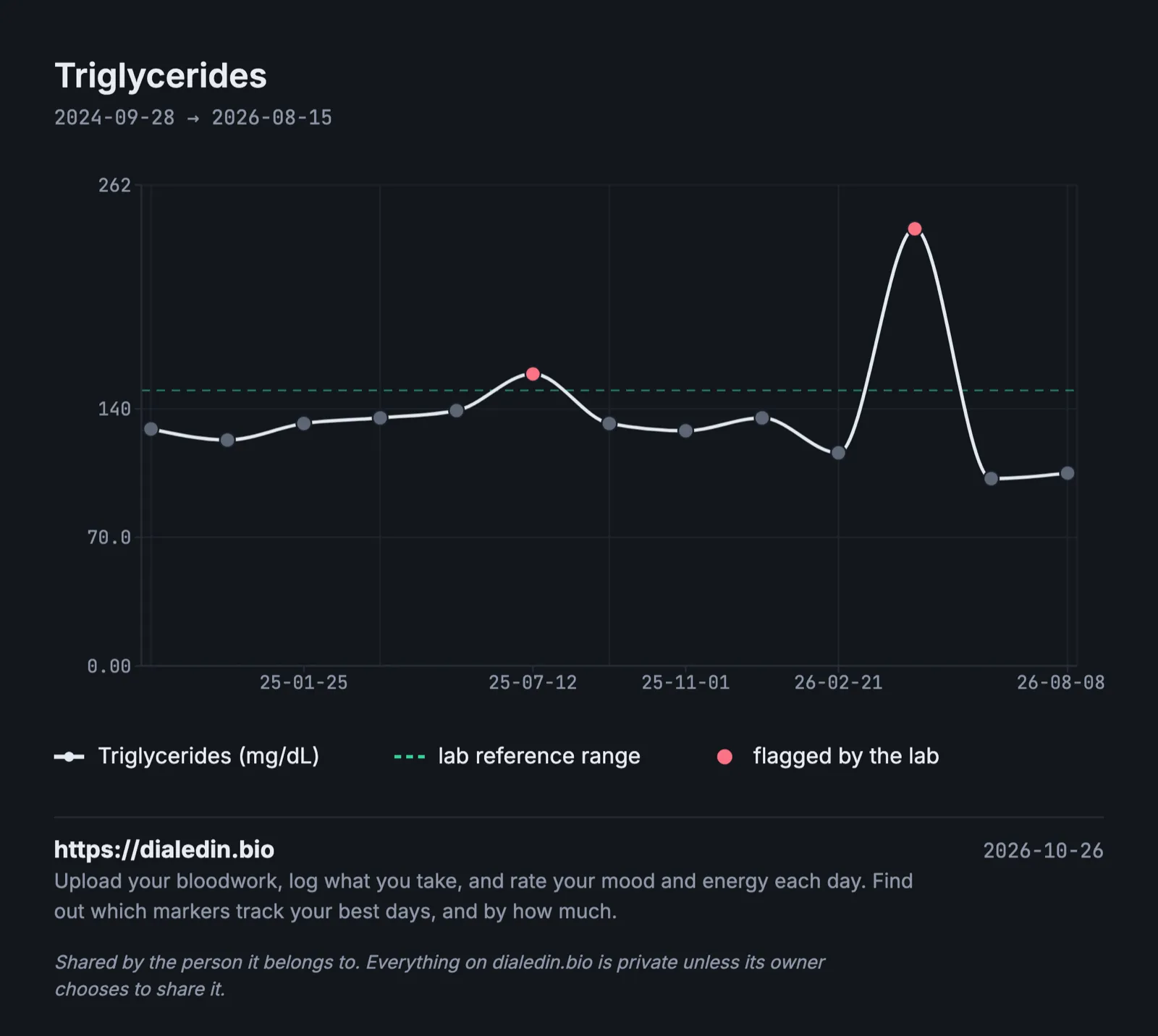
This is triglycerides across 13 blood tests over two years:
Sample data, not a real person.
The flagged spike was a draw taken after breakfast. Nothing else changed: the next test, fasted again, is back where the line was heading. Without a note saying "ate first", that one result could easily start a conversation about cholesterol medication.
How to fast the same way every time
The fasting rule matters less than keeping it constant. A result is only useful next to your earlier ones, and they only compare if they were taken the same way.
Book the same time of day
An early slot makes fasting easy and also keeps the time of day steady. Testosterone, cortisol and TSH all follow a daily rhythm, so a 08:00 result and a 15:00 result differ even with the same fast.
Keep the evening before ordinary
A big late dinner, a lot of alcohol or an unusually heavy meal can still show in triglycerides the next morning, even after ten hours. A normal evening gives a normal result.
Drink water
A glass or two before you leave is enough. It also makes the draw quicker.
Skip hard training the day before
Heavy exercise raises CK and liver enzymes like AST and ALT, and can nudge creatinine. Our post on ALT and AST after the gym explains why.
Write down what you did
A note saying "fasted 11 hours, water only, 08:10" takes ten seconds. A note saying "had a latte" explains a surprising glucose or triglyceride result months later, when you no longer remember.
Ask when the request mixes tests
If one request has fasting and non-fasting tests on it, fast. Nothing on the non-fasting list gets worse for it.
Do you need to fast for a thyroid blood test?
Usually not. TSH, free T4 and free T3 aren't changed much by a normal breakfast, and labs rarely ask for fasting on a thyroid panel alone. What does matter is the time of day (TSH is higher in the early morning) and, if you take thyroid medication, when you took it. Our thyroid panel explained post has the full routine.
If the same request also includes glucose or lipids, fast for those.
Do you need to fast for a testosterone test?
Fasting is often asked for, particularly for men. Total testosterone falls for a few hours after eating, and the guidance most labs follow asks for a morning sample, often fasted. The bigger effect is the time of day, since testosterone is highest in the morning. Our post on the testosterone blood test covers timing in more detail.
A record you can keep by hand
| Date | Time | Fasted (hours) | Drank | Glucose (mg/dL) | Triglycerides (mg/dL) | Notes |
|---|---|---|---|---|---|---|
| 2026-02-21 | 08:05 | 11 | water | 91 | 118 | |
| 2026-04-18 | 08:20 | 0 | latte | 104 | 238 | ate breakfast first |
| 2026-06-13 | 08:10 | 12 | water | 88 | 101 |
The fasting and "drank" columns are the ones that explain a surprise. Keep them even when they say the same thing every time.
Where dialedin fits
We built dialedin so results like that one breakfast spike don't get read without their context.
You upload a lab PDF and it is read into individual markers, which you check before saving. Every report goes onto one timeline, so a single odd result stands out against the line around it, and the same marker under different lab names stays one line. You can record what you were taking and when, and add an optional daily check-in to see which levels line up with your better days. Before an appointment you can export your history as a PDF.
It's free while we're in beta. If your results are spread across reports, put them on one timeline and see which ones were really different.
This article is general information, not medical advice, and it can't take your own history into account. Follow the preparation your doctor or lab gives you, and ask them if you're unsure.