Levothyroxine and blood tests: timing the tablet
If you take levothyroxine, you've probably had this question on the morning of a blood test: take the tablet as usual, or wait until after? Most people do whatever they did last time, and many never think about it at all.
It makes a difference to one line on the report. Levothyroxine is T4, and after a tablet free T4 in the blood rises for a few hours before settling. A test drawn two hours after the tablet can show a higher free T4 than one drawn before it, with nothing else changed. TSH, the line most doctors adjust treatment by, moves slowly and isn't much affected by that morning's tablet. So the timing matters most when free T4 is being compared from one test to the next.
What the tablet does to each result
| Result | Effect of a tablet a few hours before the draw |
|---|---|
| Free T4 | Often higher than before the tablet, for several hours |
| TSH | Little short-term change; it reflects the last several weeks |
| Free T3 | Small change, since most T3 is made from T4 in tissues over time |
Many labs and doctors suggest taking levothyroxine after the blood draw on test days, so free T4 shows your usual level between tablets. Some prefer a fixed number of hours after the tablet. Ask whoever orders the test, and then do the same every time. A free T4 from "before the tablet" and one from "two hours after" are two different measurements.
What else changes thyroid results on levothyroxine
How much levothyroxine you absorb depends on what's in your stomach with it, which shows up in your results weeks later:
- Food and coffee taken with or soon after the tablet lower absorption. The usual instruction is an empty stomach and a wait before breakfast.
- Calcium, iron, magnesium and antacids bind it in the gut and should be kept hours apart.
- Medicines that reduce stomach acid, such as omeprazole, can lower absorption.
- Switching brands or between tablets and liquid can change levels a little.
- Estrogen, including the pill and oral HRT, raises the protein that carries T4, which can change what you need over time.
Biotin, common in hair and nail supplements in large amounts, interferes with many thyroid tests in the lab itself. It can make TSH look low and free T4 look high. Labs often suggest stopping it a few days before.
What a steady routine looks like on a chart
This is free T4 across 13 tests over two years, with the stacks shaded:
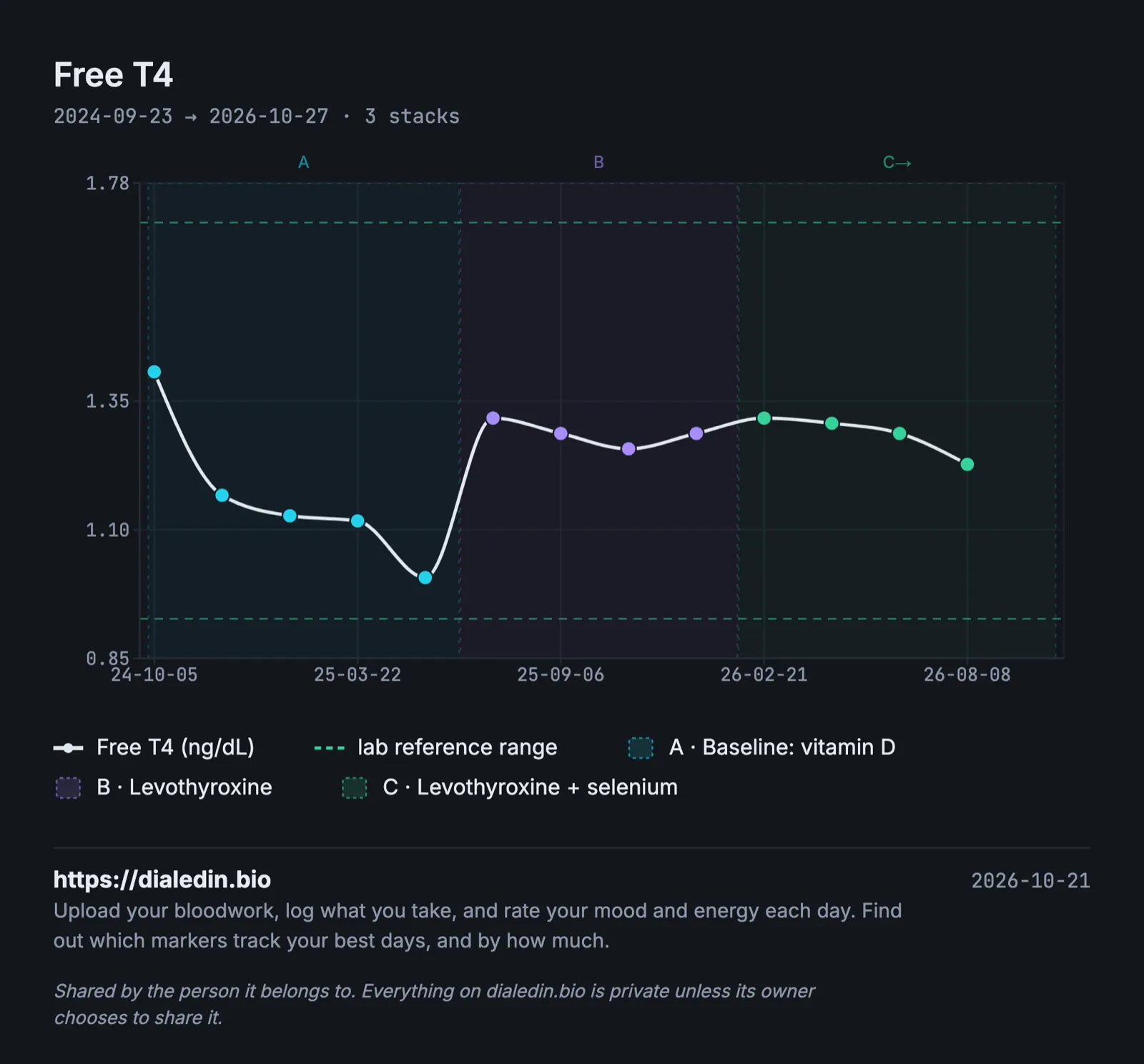
Sample data, not a real person.
Once treatment started, every test was drawn before the morning tablet, and the results sit in a band about a tenth of a unit wide. That's what a fixed routine buys you. If some of those draws had been taken after the tablet, the line would jump around and it'd be hard to tell a change in treatment from a change in timing.
How to keep thyroid tests comparable on levothyroxine
Pick a tablet routine for test days and keep it
Before the draw, or a set number of hours after, as your doctor prefers. Write it down so you remember next time.
Book tests for the same time of morning
TSH has a daily rhythm and is higher in the early morning. An 8am draw and a midday draw aren't quite the same.
Wait six to eight weeks after any change
A new strength, a new brand or a new way of taking it takes weeks to show fully in TSH. A test sooner shows a level that's still moving.
Keep the same lab
Free T4 methods and reference ranges differ between labs. Copy the range from each report.
Stop biotin first, if your doctor agrees
A few days is the usual advice. Note that you did.
Note anything that changes absorption
A new iron or calcium supplement, a new stomach medicine, coffee with the tablet, starting the pill or HRT. One line next to the result explains a lot.
How often are thyroid tests repeated on levothyroxine?
Your doctor sets that. A check about six to eight weeks after starting or changing treatment is common, then less often, often yearly, once results are steady. Our post on tracking thyroid blood tests covers the full routine, and the one on the thyroid panel explains what each line shows. If antibodies are part of your history, the post on TPO antibodies covers what to follow, and the one on reverse T3 explains why that line rises on levothyroxine.
A record you can keep by hand
| Date | Lab | Time of draw | Tablet taken | TSH (mIU/L) | Free T4 (ng/dL) | Notes |
|---|---|---|---|---|---|---|
| 2025-09-07 | City Lab | 08:10 | after the draw | 2.1 | 1.29 | started June |
| 2025-11-02 | City Lab | 08:15 | after the draw | 1.9 | 1.26 | |
| 2026-02-22 | City Lab | 08:05 | after the draw | 1.8 | 1.32 | selenium since February |
"Tablet taken" is the column most people never write down, and the one that makes free T4 readable.
Where dialedin fits
We built dialedin so a thyroid history keeps its context.
You upload a lab PDF and it's read into individual markers, which you check before saving. Every report goes onto one timeline, and the same marker under different lab names stays one line. You record what you take and when, so each result sits inside the stretch of treatment it came from. Optional daily check-ins show whether your energy lines up with your results, and you can export your history as a PDF for your doctor.
It's free while we're in beta. If you're on levothyroxine, put your thyroid results on one chart next to when treatment started.
This article is general information, not medical advice, and it can't take your own history into account. Talk to your doctor about how to take levothyroxine and how to time your blood tests.