TPO antibodies: what to track after a positive test
A lot of people find out about TPO antibodies the same way. A doctor or a private lab adds them to a thyroid panel, the TSH comes back normal, and the antibody line comes back flagged, sometimes several times above the range. Then comes the question of what to do with that.
The antibody result answers a different question from the rest of the panel. TPO antibodies show whether the immune system is reacting to the thyroid. TSH and free T4 show how well the thyroid is working right now. A positive antibody test with a normal TSH is common, and many people stay in that state for years. What usually tells you whether anything is changing is TSH, tracked over time, more than the antibody number.
What TPO antibodies are
Thyroid peroxidase is an enzyme inside the thyroid that it uses to make its hormones. TPO antibodies are antibodies the immune system has made against that enzyme. Their presence is the usual sign of autoimmune thyroiditis, also called Hashimoto's thyroiditis, the most common cause of an underactive thyroid in places where diet has enough iodine. They're also often raised in Graves' disease, an autoimmune cause of an overactive thyroid.
They also turn up in plenty of people whose thyroid works normally, more often in women and more often with age. A positive result is therefore a reason to keep an eye on the thyroid, and not a diagnosis on its own.
Thyroglobulin antibodies are the other common thyroid antibody. They're sometimes positive when TPO antibodies aren't, so some labs run both.
What a positive result can and can't tell you
What it can tell you: people with TPO antibodies are more likely to develop an underactive thyroid over the following years than people without them, and the chance is higher when TSH is already towards the top of the range. That's why a positive result usually leads to regular TSH checks.
What it can't tell you:
- How well your thyroid works today. That's TSH and free T4.
- Whether you'll ever need treatment. Many people with antibodies never do.
- Much from small changes in the number. Antibody levels go up and down between tests, and a fall from 300 to 200 doesn't mean the thyroid got better.
Because of that, many doctors measure antibodies once to answer "is this autoimmune?" and then follow TSH and free T4, without repeating the antibody test often.
If you're pregnant or planning a pregnancy, tell your doctor about a positive result. Thyroid tests are usually watched more closely then.
How antibodies and TSH can move apart
This is TPO antibodies and TSH from the same person across two years:
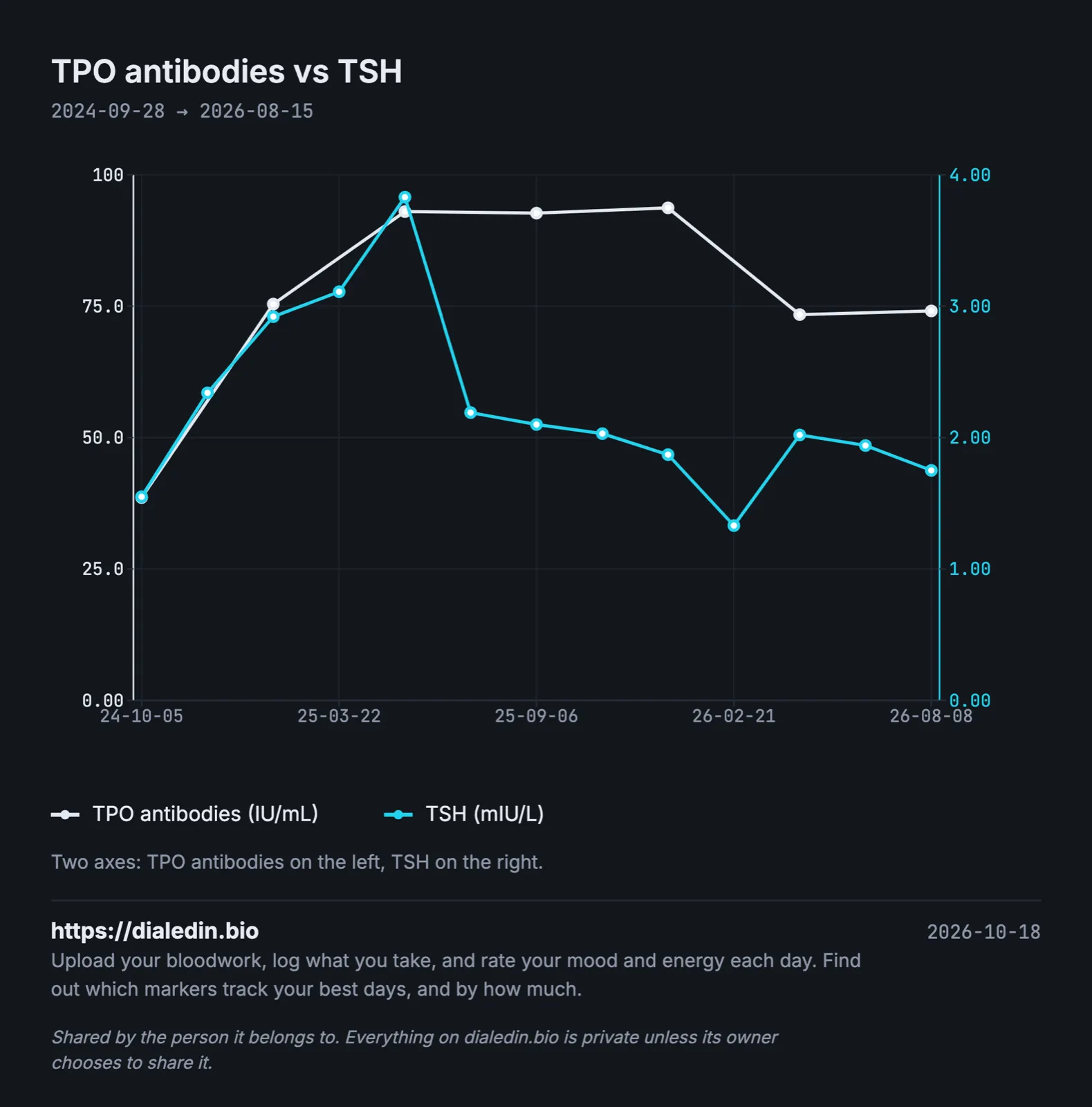
Sample data, not a real person.
Treatment brought TSH back down within a few months. The antibodies stayed high for most of a year afterwards. If you only watched the antibody line, you'd think nothing had changed. TSH is the line that shows how the thyroid responded.
How to track thyroid tests when antibodies are positive
Follow TSH and free T4 on a steady schedule
These are the results that change decisions. Get them from the same lab, at roughly the same time of day, every time. Our post on tracking thyroid blood tests has the full routine.
Use the same lab for antibodies, if you repeat them
Antibody tests differ a lot between labs, and so do their reference ranges. One lab's upper limit can be several times another's. A result of 60 at one lab and 40 at another doesn't mean the level fell. Compare antibody results only within one lab and one method.
Note the range next to every antibody result
Because the cut-offs vary so much, the range printed on the report is part of the result. Copy it into your records with the number.
Stop biotin before thyroid tests, if your doctor agrees
Biotin, common in hair and nail supplements in large amounts, interferes with many lab tests that use a particular chemical step, and thyroid tests are among them. It can make TSH look low and free T4 look high. Labs often suggest stopping it a few days before. Ask whoever ordered the test.
Write down symptoms, illness and new medicines
Tiredness, feeling cold, weight changes and low mood can come with a thyroid that's slowing down, and they also come from a hundred other things. A short note on how you've been helps your doctor read the next TSH. So does a note about any new medicine, since several affect thyroid tests.
Keep the thyroid panel together
TSH, free T4, free T3 and antibodies make more sense as a set. Our thyroid panel explained post goes through what each line measures and which ones move together, and the one on reverse T3 covers the line people most often add.
How often should thyroid tests be repeated?
With positive antibodies and a normal TSH, many doctors suggest checking TSH about once a year, or sooner if symptoms appear. On thyroid medication, a check six to eight weeks after starting or changing it is common, then less often once results are steady. Your doctor sets the schedule. What helps you is keeping the conditions the same, so each new result can be compared with the last.
A record you can keep by hand
| Date | Lab | TSH (mIU/L) | Free T4 (ng/dL) | TPO antibodies | Lab's TPO range | Time | Notes |
|---|---|---|---|---|---|---|---|
| 2024-10-07 | City Lab | 1.6 | 1.27 | 38 IU/mL | under 34 | 08:15 | first antibody test |
| 2025-04-14 | City Lab | 3.1 | 1.09 | 08:10 | more tired than usual | ||
| 2025-10-20 | City Lab | 2.0 | 1.31 | 92 IU/mL | under 34 | 08:20 | on levothyroxine since June |
The antibody column has gaps, and that's fine. The TSH column is the one that should be complete.
Where dialedin fits
We built dialedin so a thyroid history like that doesn't need a spreadsheet.
You upload a lab PDF and it is read into individual markers, which you check before saving. Every report goes onto one timeline, and the same marker under different lab names stays one line. You can put two markers on one chart, like the antibodies and TSH above, and record what you were taking and when. Optional daily check-ins show whether your energy and mood line up with your results, and you can export your history as a PDF to take to your doctor.
It's free while we're in beta. If your thyroid results are spread across reports, put them on one timeline and see what TSH has been doing.
This article is general information, not medical advice, and it can't take your own history into account. Talk to your doctor about your antibody result and how often your thyroid should be checked.