Reverse T3: what it can and can't tell you
Reverse T3 is the line people add to a thyroid panel after reading about it online. It usually comes from a private lab, often labelled "Reverse T3, LC/MS/MS", and it comes with a lot of claims attached: that a high result explains tiredness when TSH is normal, or that it shows the body "blocking" its own thyroid hormone.
The test itself is real and well understood. Reverse T3 is an inactive form of T3, made from T4 by removing one iodine atom from a different place. The body makes more of it during illness, fasting, heavy dieting and stress, and after some medicines, and it changes within days. That makes one result easy to over-read. Often a reverse T3 result describes the last week or two of your life more than how your thyroid works.
What reverse T3 is
The thyroid makes mostly T4, which is a storage form. Tissues around the body convert T4 into one of two things by removing one of its four iodine atoms:
- T3, the active hormone, when the iodine comes off the outer ring of the molecule.
- Reverse T3 (rT3), when it comes off the inner ring. Reverse T3 has the same atoms as T3 in a different arrangement, and it does very little.
Different enzymes do each conversion, and the body shifts the balance between them. Making more reverse T3 and less T3 is one of the ways it slows things down when energy is short, such as during an illness or a long fast.
What raises and lowers reverse T3
These are the common causes. Several have nothing to do with the thyroid gland.
| Higher reverse T3 | Lower reverse T3 |
|---|---|
| Acute or long-term illness, surgery, injury | An underactive thyroid (less T4 to convert) |
| Fasting and large calorie deficits | Recovery after an illness or a diet ends |
| Some medicines, including amiodarone, steroids such as prednisone, and propranolol | |
| More T4 available, including T4 taken as levothyroxine |
The last row on the left surprises people. Levothyroxine is T4, so taking it gives the body more T4 to convert both ways. A higher reverse T3 on levothyroxine is expected.
Why it's hard to read
Because so many things move it quickly, reverse T3 is a noisy marker for anyone who wants to learn about their thyroid from it. The American Thyroid Association's guideline on treating hypothyroidism doesn't recommend measuring it to guide treatment (Jonklaas et al., 2014). TSH and free T4 are what that guideline relies on.
Where reverse T3 is useful is in explaining a pattern. A low free T3 with a high reverse T3 during an illness or a hard diet is the typical picture of the body saving energy, and it tends to settle when the illness or the diet ends. Our thyroid panel explained post covers how the other lines fit around it.
This is reverse T3 next to TSH from the same person over two years:
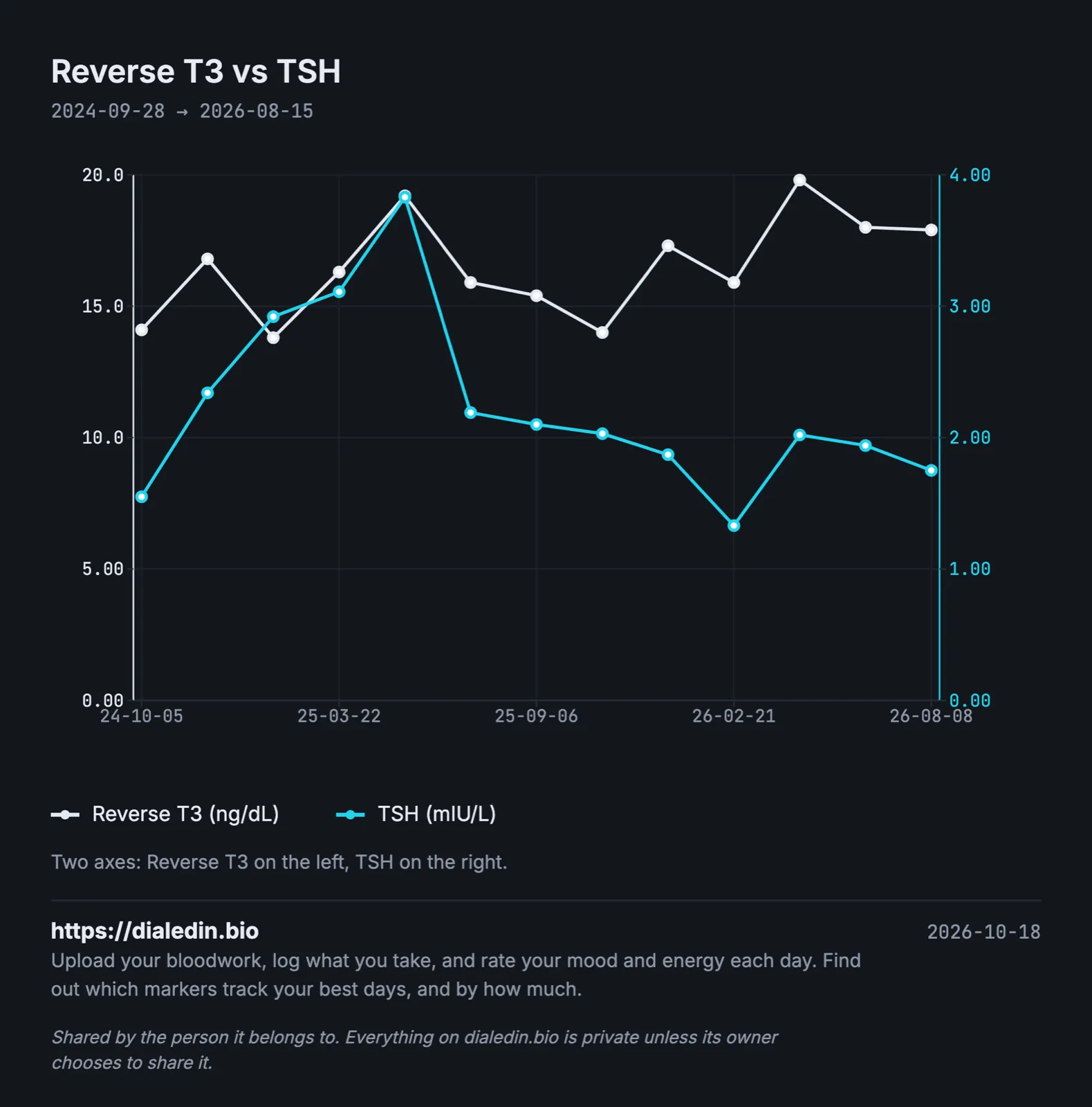
Sample data, not a real person.
TSH tells a clear story: a slow climb, then a drop once treatment starts. Reverse T3 moves by a similar share from one test to the next, but up and down without a direction. Read on its own, any one of those reverse T3 results could look like news.
The ratios people calculate
Some people divide free T3 by reverse T3 and track the ratio. It isn't a standard clinical test, it has no agreed reference range, and its value depends entirely on the units you divide. Free T3 in pg/mL divided by reverse T3 in ng/dL gives a completely different number from the same results in pmol/L. If you calculate it anyway, use the same units every time and treat it as a description of your own results, never a score.
The free T3 to free T4 ratio is the same idea applied to the two standard tests. It also has no reference range of its own.
If you do test reverse T3, make it comparable
Test when you're well and eating normally
Illness and dieting are the two biggest causes of a high result. A test during a cold, after surgery or in the middle of a hard cut tells you about that week. If you want a baseline, take it in an ordinary week.
Keep the same lab and method
Many labs measure reverse T3 by LC-MS/MS, a mass spectrometry method, and some use older immunoassays. They don't always agree, and the reference ranges differ. Note the method next to each result.
Watch the units
In the US reverse T3 is usually in ng/dL. Elsewhere it may be ng/L or pmol/L. 1 ng/dL is 10 ng/L, or about 15.4 pmol/L. A chart that mixes them jumps by a factor of ten or more.
Write down medicines and dieting
Levothyroxine, steroids, beta blockers and amiodarone all move it. So does how much you were eating. One line next to the result explains most surprises.
Time thyroid medicine the same way each time
If you take levothyroxine, ask whoever ordered the test whether to take it before or after the draw, and do the same every time. T4 levels after a tablet differ from those before it.
Stop biotin first, if your doctor agrees
Biotin in large amounts interferes with many immunoassays, including thyroid tests. Labs often suggest stopping it a few days before.
How often is it worth testing?
For most people, not often. TSH and free T4 are what doctors follow for thyroid function, on the schedule they set. Our post on tracking thyroid blood tests covers that routine, and if your antibodies came back positive, the one on TPO antibodies covers what to follow. Reverse T3 is mostly useful as a one-off, to help explain a low free T3, and its result is worth discussing with your doctor next to what was going on that week.
Recording reverse T3 by hand
| Date | Lab | TSH (mIU/L) | Free T4 (ng/dL) | Free T3 (pg/mL) | Reverse T3 | Unit | Method | Notes |
|---|---|---|---|---|---|---|---|---|
| 2025-02-10 | City Lab | 2.9 | 1.12 | 2.9 | 13.8 | ng/dL | LC-MS/MS | ordinary week |
| 2025-05-19 | City Lab | 3.8 | 1.02 | 2.6 | 19.1 | ng/dL | LC-MS/MS | flu the week before |
Without the note on the second row, the jump in reverse T3 looks like a thyroid change.
Where dialedin fits
We built dialedin so the context next to each result doesn't get lost.
You upload a lab PDF and it is read into individual markers, which you check before saving. Every report goes onto one timeline, and the same marker under different lab names stays one line. You can put two markers on one chart, like reverse T3 and TSH above, and mark what you were taking and when, such as starting levothyroxine. Optional daily check-ins show whether your energy lines up with any of it, and you can export your history as a PDF for your doctor.
It's free while we're in beta. If your thyroid results are spread across labs, put them on one timeline and see which ones actually moved.
This article is general information, not medical advice, and it can't take your own history into account. Talk to your doctor about which thyroid tests you need and what your results mean for you.