High ALT and AST after the gym: what moves them
A lot of people who lift find out about AST the same way. A routine panel comes back with AST and maybe ALT flagged high, the report calls them liver enzymes, and they spend a week wondering about their liver.
The name is misleading. AST and ALT are enzymes found inside cells, and when cells are damaged or stressed some of it leaks into the blood. The liver has a lot of both, but muscle has plenty of AST and some ALT. A hard training session, especially one with movements you're not used to, damages muscle fibres enough to raise them for days. Blood drawn the morning after leg day can look like a liver problem when the liver hasn't changed.
What AST and ALT are
ALT, alanine aminotransferase, is mostly in the liver. A rise in ALT usually points there first, though muscle carries some.
AST, aspartate aminotransferase, is in the liver, skeletal muscle, the heart, red blood cells and the kidneys. A rise in AST alone, or more AST than ALT, often has a cause outside the liver.
Both are routine lines on a liver panel, along with GGT, ALP and bilirubin.
What raises AST and ALT besides the liver
| Cause | What tends to happen |
|---|---|
| Hard training, new exercises, long runs | AST up more than ALT, for several days. CK goes up a lot |
| A muscle injury or a fall | Same pattern as training |
| Blood that broke down in the tube (haemolysis) | AST up, because red cells contain it |
| An intramuscular injection | Small, local rise |
| Some thyroid problems | Can raise them a little |
On the liver side, the common causes are alcohol, fatty liver, many medicines (paracetamol in large amounts, some antibiotics, statins in a minority, oral anabolic steroids), herbal and bodybuilding supplements, and viral hepatitis. Telling these apart is your doctor's job.
How doctors tell muscle from liver
Two other tests help.
CK, creatine kinase, is the muscle enzyme. After heavy training it can rise many times above its range and peak a day or few after the session. If CK is very high alongside AST and ALT, muscle is the likely source. Our glossary has a page on CK.
GGT is a liver enzyme that muscle hardly has. If AST and ALT are up but GGT is normal, that also points away from the liver.
The ratio of AST to ALT is a third clue. After muscle damage AST usually rises more than ALT, at least at first, because muscle holds more of it.
This is AST and ALT from one person who trains regularly, over two years:
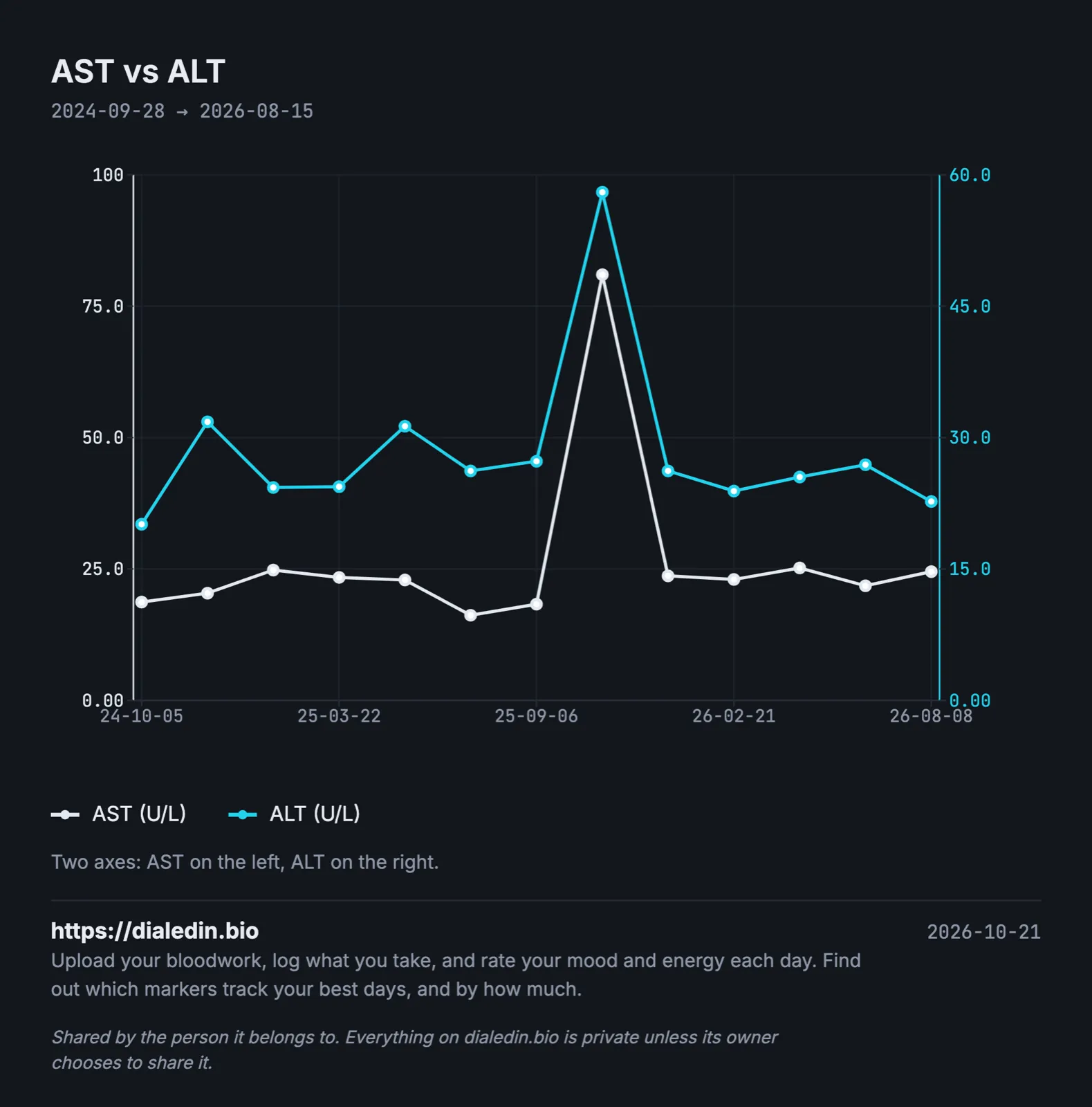
Sample data, not a real person.
The November test was the morning after a heavy leg session. Both lines come back to normal by the next test, without anything else changing. On its own that report would look alarming. Next to the other twelve it looks like one hard workout.
How to get liver results you can compare
Don't train hard in the days before the test
Two or three quiet days is the usual advice. After an unusually hard session, or one with exercises you're new to, the enzymes can stay up for about a week. If you train every day, keep the session before each test light and similar.
Tell the doctor about your training
"I deadlifted heavily two days ago" changes how a high AST is read. If they're unsure, they may add CK or repeat the test after a rest.
Skip alcohol for a couple of days before
Alcohol raises GGT and can raise AST and ALT, and it muddies exactly the comparison the doctor wants to make.
List every medicine and supplement
Including painkillers taken that week, creatine, pre-workouts and herbal products. Several common ones affect liver tests. Our post on creatine and creatinine covers what creatine does to the kidney lines on the same panel.
Mention injections
An intramuscular injection in the days before can nudge AST and CK.
Use the same lab
Reference ranges for AST and ALT differ between labs and between men and women. Copy the range printed on each report.
When is a raised result repeated?
Your doctor decides, and it depends on how high it is, what else is on the panel and your history. After a high AST or ALT in someone who trains, a common step is a repeat test after about a week without hard exercise, often with CK and GGT added. A result that comes back normal after rest usually points at the training. One that stays high gets looked at further.
For a routine panel, regular is better than frequent. Several tests taken under the same conditions show your own normal, and a one-off stands out against it. Our post on why regular bloodwork matters covers that idea more broadly.
A record you can keep by hand
| Date | Lab | AST (U/L) | ALT (U/L) | GGT (U/L) | CK (U/L) | Last hard session | Notes |
|---|---|---|---|---|---|---|---|
| 2025-09-07 | City Lab | 18 | 27 | 19 | 4 days before | ||
| 2025-11-02 | City Lab | 81 | 58 | 18 | the day before, legs | ||
| 2025-12-28 | City Lab | 24 | 26 | 20 | 3 days before |
The training column is the one a doctor will ask about. Having it written down saves a repeat visit.
Where dialedin fits
We built dialedin so a one-off result can be seen next to everything else you've had tested.
You upload a lab PDF and it's read into individual markers, which you check before saving. Every report goes onto one timeline, and the same marker under different lab names stays one line. You record what you take and when, so supplements and medicines sit next to your liver results. Optional daily check-ins show how you felt, and you can export your history as a PDF for your doctor.
It's free while we're in beta. If a flagged AST has you worried, put your results on one timeline and see how it compares with the rest.
This article is general information, not medical advice, and it can't take your own history into account. Talk to your doctor about raised liver enzymes, even if you think training explains them.