Creatine and creatinine: why the kidney number rises
Plenty of people who start creatine find out about it from a blood test months later. The creatinine line is higher than last time, the eGFR line is lower, and sometimes the report flags it.
The two words are related for a reason. Creatinine is what creatine turns into. Your muscles store creatine and break a small, steady share of it down into creatinine every day, which the kidneys filter out. Take more creatine and there's more to break down, so blood creatinine often goes up a little even when the kidneys are working exactly as before. Because eGFR is calculated from creatinine, it goes down by the same logic.
What creatinine and eGFR measure
Creatinine is a waste product of muscle. It's made at a fairly constant rate that depends mostly on how much muscle you have, and it leaves the body almost entirely through the kidneys. If the kidneys filter less, creatinine builds up in the blood. That's why it's on nearly every routine panel.
eGFR is an estimate of how much blood the kidneys filter per minute. Labs don't measure it. They calculate it from your creatinine, your age and your sex, using a published equation (the current one in the US is CKD-EPI 2021, Inker et al., 2021). So anything that raises creatinine without touching the kidneys lowers eGFR on paper.
What raises creatinine besides the kidneys
These are the common ones. Each can move a result while kidney function stays the same.
| What | Why it moves creatinine |
|---|---|
| Creatine supplements | More creatine in muscle, more broken down into creatinine |
| More muscle | More muscle makes more creatinine every day |
| Hard training in the day or two before | Muscle breakdown releases more |
| A large meal of cooked meat the evening before | Cooking turns some of the meat's creatine into creatinine, which you absorb |
| Not drinking much before the test | The blood is more concentrated |
| Some medicines, such as trimethoprim and cimetidine | They slow how fast the kidneys clear creatinine without changing filtration |
The reverse also holds. Someone with little muscle can have a low creatinine and an eGFR that looks better than their kidneys are.
What creatine does to the chart
This is creatinine across 15 tests over two years, with the supplement stacks shaded:
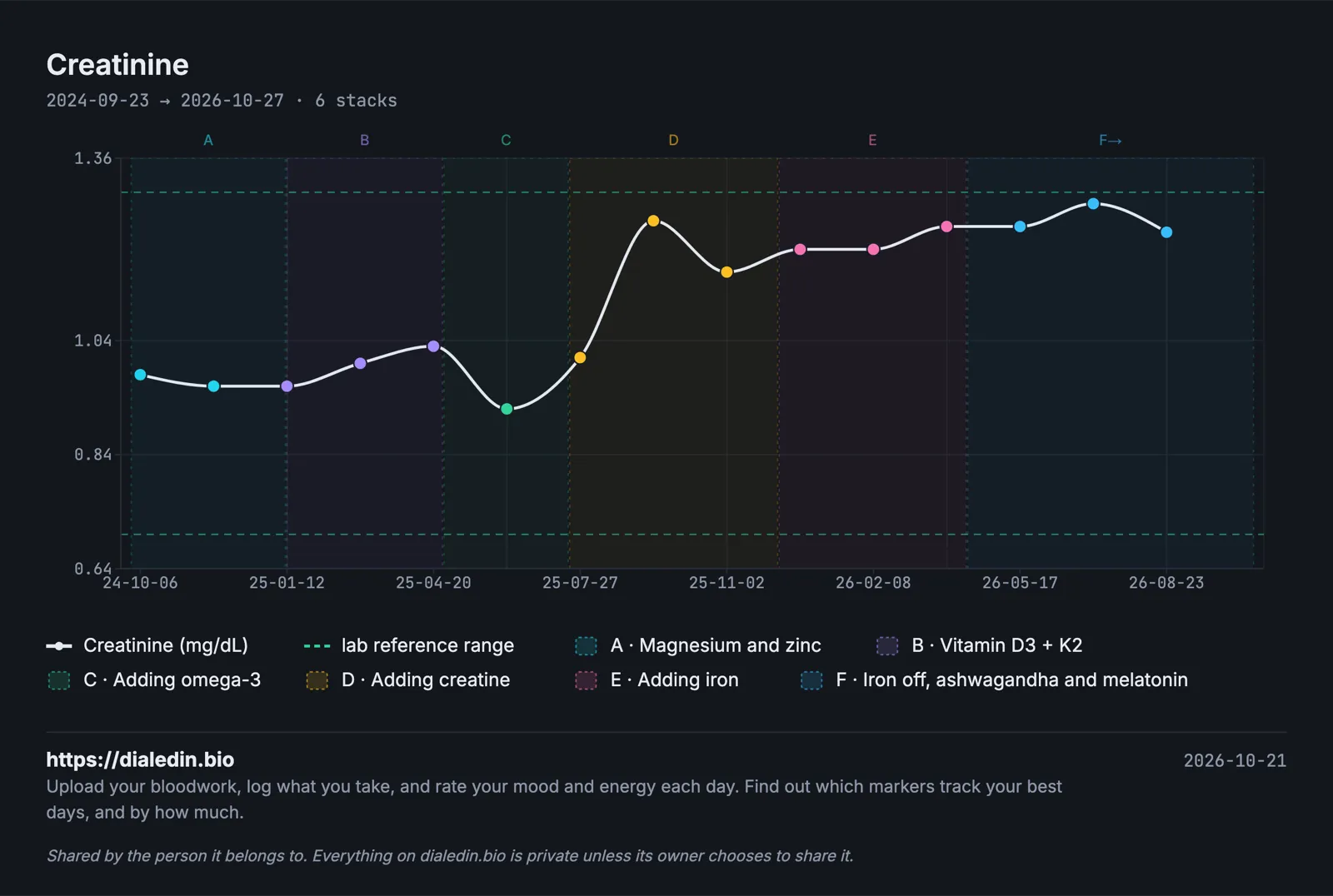
Sample data, not a real person.
The step lines up with the stack where creatine was added, and it stays put through every stack after it. Each result is in range, so no single report would have said much. On a timeline it's obvious what changed, and when.
How to keep kidney results comparable when you take creatine
Tell whoever orders the test that you take creatine
It's the most useful thing you can do. A doctor who knows reads a slightly higher creatinine differently. Many people don't mention supplements because nobody asks.
Get a baseline before you start, if you can
A creatinine and eGFR from before creatine gives you something to compare with. If you already take it, the first result on creatine becomes your reference point. Note that it was taken on creatine.
Write down the date you started or stopped
Creatinine takes a few weeks to settle after a change. A result taken in that window sits between the old level and the new one, and without the date it looks like a drift.
Don't train hard in the day or two before
Heavy lifting or a long run raises creatinine for a while, and so does a big change in training. Our post on ALT and AST after the gym covers the other lines on a panel that a hard session moves.
Skip the big steak the night before
A large meal of cooked meat can raise creatinine for several hours. Eat normally, and keep the evening before each test similar.
Drink normally
Being short of water concentrates the blood. Test in your usual state, the same way each time.
Use the same lab
Creatinine methods differ a little between labs. A small jump after switching labs may be the method.
When does a doctor look further?
That's a decision for your doctor, and it depends on your history, your blood pressure and the other results on the panel. Two things often come up.
The first is a repeat test after a pause. Some doctors ask people to stop creatine for a few weeks and retest, which shows how much of the rise was the supplement.
The second is cystatin C, a different blood marker that the kidneys also filter. Muscle and creatine don't change it, so it can help separate a muscle effect from a kidney one. Our post on eGFR, creatinine and cystatin C explains how the two compare, and the one on BUN and urea covers the other kidney line on most panels.
Protein in the urine is checked separately and isn't affected by creatine. If your doctor wants a fuller picture, that's often the next test.
A record you can keep by hand
| Date | Lab | Creatinine (mg/dL) | eGFR | Creatine? | Trained hard in last 48 h | Notes |
|---|---|---|---|---|---|---|
| 2025-03-03 | City Lab | 1.00 | 99 | no | no | |
| 2025-07-28 | City Lab | 1.02 | 97 | started 2025-07-21 | no | first week on creatine |
| 2025-11-03 | City Lab | 1.21 | 78 | yes | no |
The creatine column is the one that explains the third row. Without it, that row looks like a change in the kidneys.
Where dialedin fits
We built dialedin so a supplement start date and a lab result end up on the same chart.
You upload a lab PDF and it's read into individual markers, which you check before saving. Every report goes onto one timeline, and the same marker under different lab names stays one line. You record what you take and when, so a step like the one above sits right next to the stack that caused it. Optional daily check-ins show how you felt alongside your results, and you can export your history as a PDF to take to your doctor.
It's free while we're in beta. If your creatinine moved and you're not sure why, put your results on one timeline next to what you started taking.
This article is general information, not medical advice, and it can't take your own history into account. Talk to your doctor about your kidney results and any supplements you take.