BUN vs urea: converting and the BUN/creatinine ratio
If you've had blood tests in more than one country, or from more than one lab, you may have seen "BUN 15" on one report and "urea 32" on the next. Put them on one chart and it looks as if the result doubled.
Both lines measure the same substance. Urea is a waste product the liver makes from protein, and the kidneys clear it. BUN, blood urea nitrogen, counts only the nitrogen inside the urea molecule, which is a bit under half of its weight. That's all the difference there is, so the conversion is a fixed factor and the numbers can be put on one chart once they're in the same form.
How to convert BUN to urea
Urea's molar mass is 60.06 g/mol, and the two nitrogen atoms in it weigh 28.02. That ratio, about 2.14, is the whole conversion.
| You have | You want | Do this |
|---|---|---|
| BUN in mg/dL | Urea in mg/dL | Multiply by 2.14 |
| Urea in mg/dL | BUN in mg/dL | Divide by 2.14 |
| BUN in mg/dL | Urea in mmol/L | Multiply by 0.357 |
| Urea in mmol/L | BUN in mg/dL | Multiply by 2.8 |
| Urea in mg/dL | Urea in mmol/L | Divide by 6.006 |
US labs usually report BUN in mg/dL. The UK and much of Europe report urea in mmol/L, and German and Austrian labs often give urea in mg/dL. In mmol/L, BUN and urea are the same number, because both count urea molecules.
What moves BUN
Kidney filtering is only one of the things that set BUN. Protein and water matter almost as much, which is why one BUN result says less than people expect.
Things that tend to raise it:
- A high-protein diet or a large protein meal before the test.
- Not drinking enough, or losing fluid through heat, sweating or illness.
- Bleeding in the stomach or gut, since digested blood is protein.
- Steroid medicines such as prednisone, and other states where the body breaks down muscle.
- Reduced kidney filtering.
Things that tend to lower it:
- A low-protein diet.
- Drinking a lot before the test.
- Liver disease, since the liver makes urea.
- Pregnancy.
What the BUN/creatinine ratio shows
Creatinine is also cleared by the kidneys, but diet and fluid move it much less than BUN. Dividing one by the other gives the BUN/creatinine ratio, which some labs print and others don't.
Doctors use it as a clue to why BUN changed. If both rise together, the kidneys are the usual suspect. If BUN rises much more than creatinine, the cause is often outside the kidneys, such as dehydration, a lot of protein or bleeding. If creatinine rises alone, think muscle, creatine supplements or a medicine. It's a pointer for the doctor, never a diagnosis on its own.
The ratio only works in the US form, with both values in mg/dL. Divide urea in mmol/L by creatinine in µmol/L and you get a different number on a different scale, and the US reference ranges don't apply to it. If you calculate it yourself, convert both first.
This is urea and creatinine from the same person over two years, with the stacks shaded:
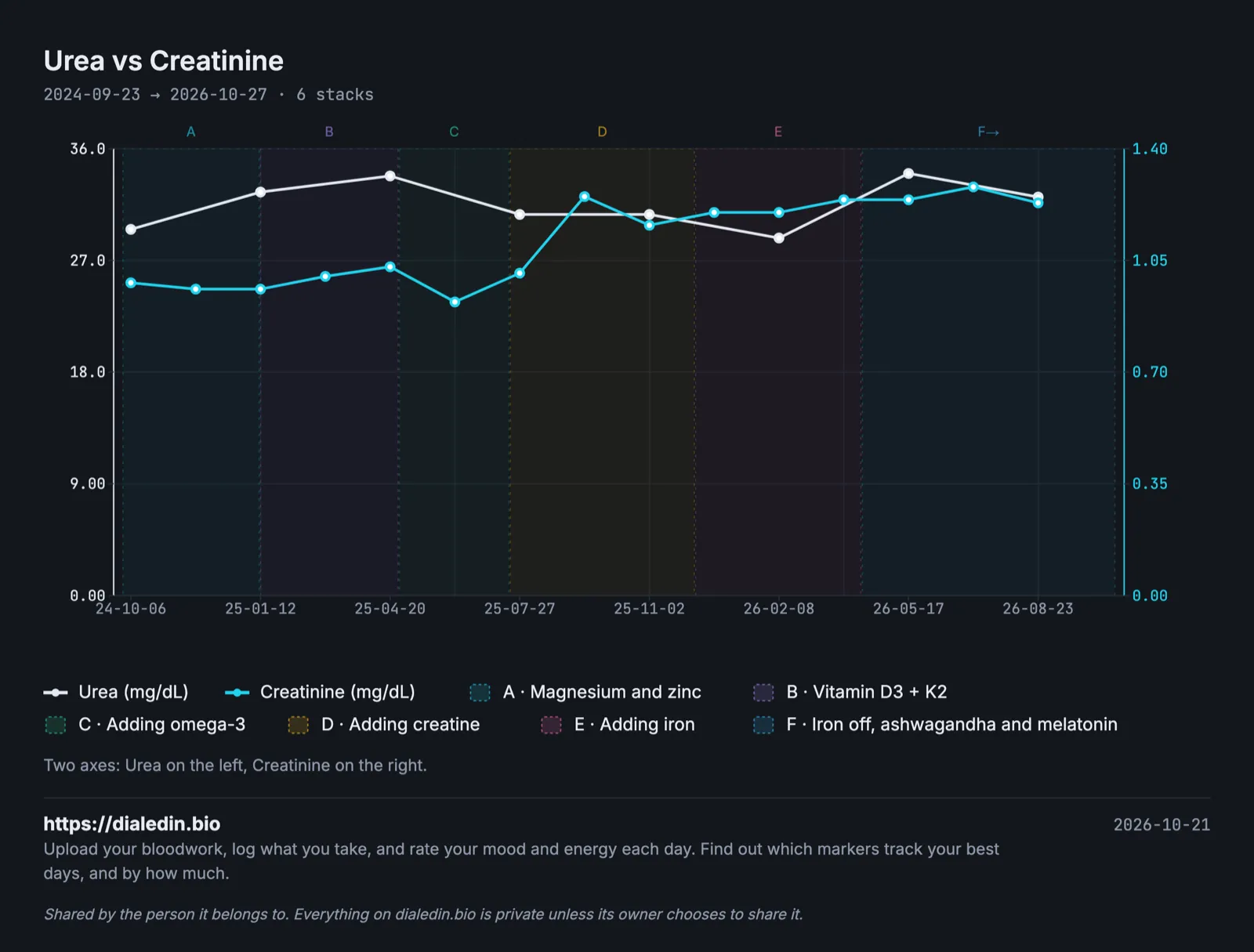
Sample data, not a real person.
Creatinine steps up when creatine starts and urea doesn't, so the ratio between them falls. Kidney trouble would usually push both up. A creatinine rise with a steady urea points at the muscle side, which is what the supplement did. Our post on creatine and creatinine covers that story.
How to keep BUN results comparable
Eat as usual the day before
A big protein meal the evening before can raise BUN the next morning. Keep that evening similar before each test.
Drink normally
A dry morning after a hot day or a hard workout concentrates the blood and raises BUN. Being well hydrated lowers it a little.
Convert before you chart
If one lab gives BUN and another urea, pick one form and convert everything into it. Write the original unit next to each result so you can check it later.
Note illness and new medicines
A stomach bug, a fever or a course of steroids all move BUN for a while. A short note saves a lot of guessing.
Keep the same lab
Methods for BUN and urea are well matched between labs, but reference ranges still differ. Copy the range printed on each report.
How often is BUN checked?
It's part of most routine metabolic panels, so it comes with routine blood work, often once a year. Your doctor may check it more often if you take medicines that affect the kidneys or have a condition that does. Our post on eGFR, creatinine and cystatin C covers the other kidney lines and when they get repeated.
A record you can keep by hand
| Date | Lab | Reported as | Value | BUN (mg/dL) | Creatinine (mg/dL) | BUN/creatinine | Notes |
|---|---|---|---|---|---|---|---|
| 2025-04-21 | City Lab | Urea, mg/dL | 33.8 | 15.8 | 1.03 | 15 | |
| 2025-11-03 | City Lab | Urea, mg/dL | 30.7 | 14.3 | 1.17 | 12 | creatine since July |
| 2026-05-11 | Clinic B | BUN, mg/dL | 15 | 15 | 1.22 | 12 |
The "reported as" column is the one that stops a lab change from looking like a doubling.
Where dialedin fits
We built dialedin because results from different labs rarely arrive in the same form.
You upload a lab PDF and it's read into individual markers, which you check before saving. Every report goes onto one timeline, and the same marker under different lab names stays one line. You record what you take and when, so a supplement start sits next to the results it moved. Optional daily check-ins sit alongside, and you can export your history as a PDF for your doctor.
It's free while we're in beta. If your kidney results come from more than one lab, put them on one timeline and see what actually changed.
This article is general information, not medical advice, and it can't take your own history into account. Talk to your doctor about your kidney results and what they mean for you.