eGFR, creatinine and cystatin C: what each shows
Most people meet eGFR as a single number near the bottom of a routine panel, with a flag next to it if it came out low. It's easy to read it as a direct measurement of the kidneys.
It isn't one. eGFR is a calculation, usually from creatinine plus your age and sex, and creatinine depends on how much muscle you have and what you've eaten and taken. Cystatin C is a second marker that the kidneys filter the same way, but it doesn't come from muscle. When the two disagree, the reason is often outside the kidneys, which is why doctors sometimes order both.
What GFR is, and why it's estimated
GFR, glomerular filtration rate, is how much blood the kidneys filter each minute. Measuring it directly means injecting a tracer and timing how fast it clears, which is slow and not part of routine care. So labs estimate it from something in the blood that the kidneys clear at a known rate.
| Test | What it is | What else moves it |
|---|---|---|
| Creatinine | A waste product of muscle | Muscle mass, creatine supplements, a big meat meal, hard training, some medicines |
| eGFR | GFR estimated from creatinine, age and sex | Everything that moves creatinine |
| Cystatin C | A small protein made at a steady rate by nearly every cell | Thyroid problems, steroid medicines such as prednisone, inflammation, body fat |
| Creatinine clearance | Creatinine in a 24-hour urine collection compared with the blood | A missed or extra hour of collection |
The current US equations come from the CKD-EPI group and were updated in 2021 to drop the race term (Inker et al., 2021). There are versions from creatinine alone, cystatin C alone, and both together. The combined version is usually the most accurate of the three.
When creatinine and cystatin C disagree
Because creatinine comes from muscle and cystatin C doesn't, they drift apart in the same situations:
- A lot of muscle, or creatine supplements. Creatinine runs higher, so the creatinine-based eGFR looks lower than the kidneys are. Our post on creatine and creatinine goes through that one.
- Very little muscle, after a long illness or in older age. Creatinine runs low and eGFR looks better than it is.
- A diet with little or no meat. Creatinine tends to be a bit lower.
- Steroid medicines or an overactive thyroid. These raise cystatin C, so its eGFR reads lower.
The kidney guideline group KDIGO suggests cystatin C when a doctor needs to confirm an eGFR that creatinine alone may get wrong. If the two estimates agree, the answer is more certain. If they don't, the gap is a clue about which one is being pushed around.
This is both lines from the same person over two years, with the stacks shaded:
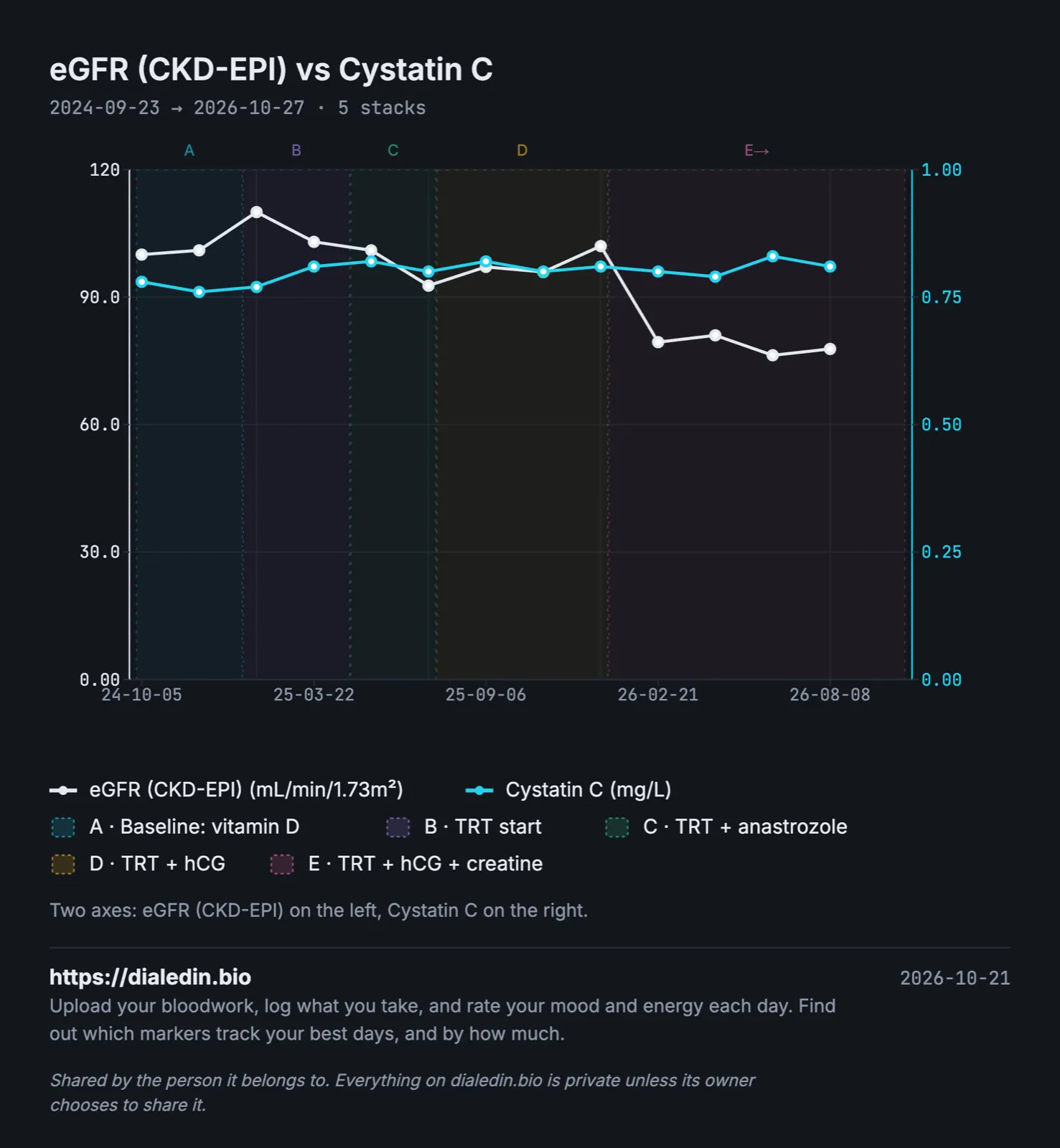
Sample data, not a real person.
The eGFR line falls by about a fifth when creatine starts. Cystatin C doesn't move. On their own, the last four eGFR results look like a change in the kidneys. Next to the cystatin C line and the stack band, they look like creatine.
How to keep kidney results comparable
Keep the conditions the same
Test at a similar time of day, drinking normally, without a hard training session in the two days before and without a big steak the night before. Each of these moves creatinine more than you'd guess.
Note supplements and medicines next to each result
Creatine, steroid medicines, thyroid medicines and the antibiotic trimethoprim all change one of these lines. A note with the date you started makes a step easy to explain.
Use the same lab, and check which equation it uses
Some labs still print eGFR from the older equations. A jump after a lab change may be the formula. The report usually names it in small print.
Compare eGFR only with eGFR from the same marker
An eGFR from cystatin C and one from creatinine are separate estimates. Chart them as two lines, never as one.
Watch the units
Creatinine comes in mg/dL in the US and µmol/L in most other places. 1 mg/dL is about 88.4 µmol/L. Cystatin C is in mg/L almost everywhere.
Get a urine test when your doctor suggests one
The blood tests show how much the kidneys filter. A urine albumin test shows whether protein is leaking, which is a separate question. Doctors often look at both together.
How often should kidney tests be repeated?
That's your doctor's call, and it depends on your blood pressure, blood sugar, medicines and family history. For most healthy adults, creatinine and eGFR come with a routine panel every year or two. People on medicines that affect the kidneys, or with diabetes or high blood pressure, are usually tested more often.
One low eGFR is usually repeated before anything is decided, because so many things move it for a while. A change that lasts across several tests taken the same way is what doctors look at.
Recording it by hand
| Date | Lab | Creatinine (mg/dL) | eGFR (creatinine) | Cystatin C (mg/L) | Equation | Notes |
|---|---|---|---|---|---|---|
| 2025-12-28 | City Lab | 0.98 | 102 | 0.81 | CKD-EPI 2021 | |
| 2026-02-22 | City Lab | 1.20 | 79 | 0.80 | CKD-EPI 2021 | creatine since January |
| 2026-06-14 | City Lab | 1.24 | 76 | 0.83 | CKD-EPI 2021 |
Three columns that look redundant are the ones that settle the question: cystatin C, the equation and the note.
Where dialedin fits
We built dialedin so lines like these sit on one chart, next to what you were taking.
You upload a lab PDF and it's read into individual markers, which you check before saving. Every report goes onto one timeline, and the same marker under different lab names stays one line. You can overlay two markers, like eGFR and cystatin C above, and record what you take and when. Optional daily check-ins sit alongside, and you can export your history as a PDF for your doctor.
It's free while we're in beta. If your eGFR has moved, put it on one timeline with everything else from those reports.
This article is general information, not medical advice, and it can't take your own history into account. Talk to your doctor about your kidney results and which tests you need.