HDL cholesterol on TRT: why it's worth watching
Men on testosterone therapy watch a short list of lines: testosterone, estradiol, hematocrit, PSA. The lipid panel is usually on the same report, and HDL is the line on it that's most likely to move once therapy starts.
Testosterone tends to lower HDL cholesterol. In studies of TRT the drop is often small, larger at higher testosterone levels, and much larger with anabolic steroids, especially oral ones. Estradiol tends to push HDL the other way, so anything that changes estradiol can move HDL too. None of that shows on one report. It shows when you put the tests from before and after starting side by side.
What HDL is
HDL cholesterol is the cholesterol carried in high-density lipoprotein particles. These particles pick up cholesterol from tissues and take it back to the liver, which is the reason HDL got called "good" cholesterol. The story has turned out to be more complicated than that: raising HDL with drugs didn't prevent heart disease in trials. A low HDL is still a common part of the risk picture doctors look at, alongside LDL, triglycerides and blood pressure.
HDL is one of three lines a lipid panel actually measures. Our post on how to read a lipid panel covers the others, and which lines are calculated from it.
What moves HDL on TRT
The things most often discussed:
- Testosterone itself, through its effect on liver enzymes that handle HDL. Higher levels usually mean a bigger effect.
- Estradiol. Estrogen tends to raise HDL, so a large drop in estradiol, for example with an aromatase inhibitor, may lower HDL. Our post on estradiol on a TRT panel explains why estradiol is tested.
- Oral androgens and anabolic steroids, which can lower HDL far more than injected testosterone does.
- Changes that come with starting therapy: training more, losing fat, drinking less or more.
Outside TRT, HDL goes up with regular aerobic exercise and moderate weight loss, and down with smoking, inactivity, weight gain and some medicines, including some progestins and beta blockers.
What it looked like for one man
This is HDL across 13 tests over two years, with the stacks shaded:
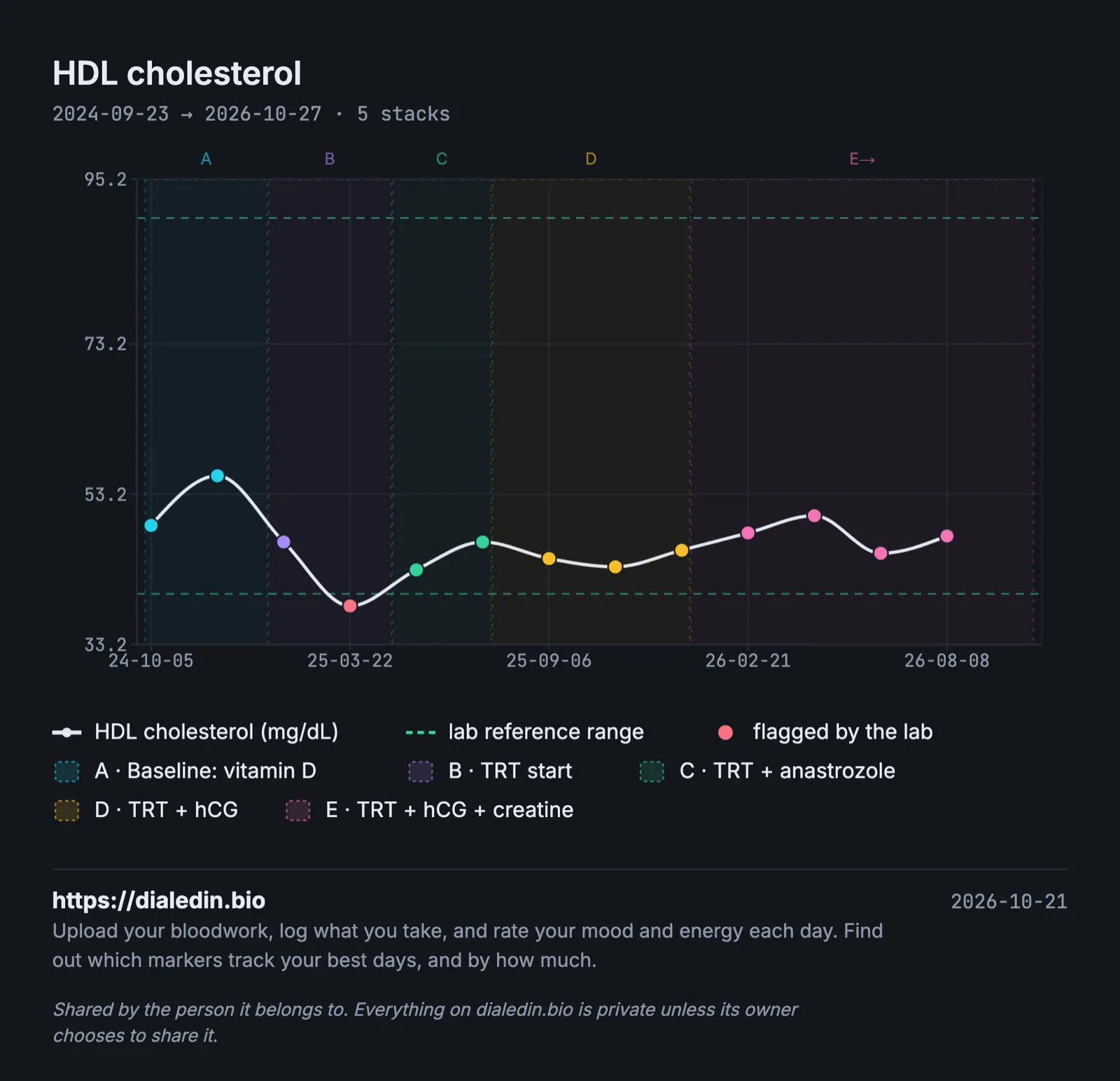
Sample data, not a real person.
The lowest result came in the first months of therapy, and it was the only flagged one. Later results settled a few points below the baseline. Without the two tests from before TRT, there'd be nothing to compare the later ones with.
How to keep HDL comparable on TRT
Get a lipid panel before you start
The baseline is the result you can never get back. If you've already started, the earliest result on therapy becomes the reference, noted as such.
Test at the same point in your injection cycle
HDL doesn't swing much over a few days, but the testosterone and estradiol on the same report do. Keeping one point in the cycle keeps the whole report comparable. Our post on TRT blood test timing explains how to pick it.
Fast or don't, the same way each time
HDL changes little after a meal, but triglycerides do, and a calculated LDL depends on them. Note which it was.
Write down every change to the protocol
New compound, new frequency, an aromatase inhibitor started or stopped. A step in HDL usually lines up with one of these, and the date is what makes it visible.
Note training and weight
Starting TRT often comes with more training and some fat loss, which both nudge HDL up. A short note helps explain why HDL moved less than expected, or more.
Keep the rest of the panel together
Hematocrit and PSA are tested alongside on most TRT panels. Our posts on hematocrit on TRT and PSA on TRT cover those lines.
How often should lipids be checked on TRT?
Your prescriber sets the schedule. A lipid panel before starting and one within the first several months is a common pattern, then with the regular monitoring panels after that. If HDL drops, the usual next step is a talk with your prescriber about the whole picture, and a repeat under the same conditions.
A record you can keep by hand
| Date | Lab | HDL (mg/dL) | Triglycerides (mg/dL) | Total T | Estradiol (pg/mL) | Stack | Days since injection | Notes |
|---|---|---|---|---|---|---|---|---|
| 2024-12-01 | City Lab | 56 | 104 | 3.6 ng/mL | 25 | baseline | ||
| 2025-03-23 | City Lab | 38 | 118 | 9.9 ng/mL | 47 | TRT start | 3 | |
| 2025-12-28 | City Lab | 46 | 110 | 8.4 ng/mL | 34 | TRT + hCG | 3 |
Putting testosterone and estradiol in the same row makes it easier to see what HDL might be following.
Where dialedin fits
We built dialedin because a TRT history means years of panels from more than one clinic.
You upload a lab PDF and it's read into individual markers, which you check before saving. Every report goes onto one timeline, and the same marker under different lab names stays one line. You record each protocol and when it ran, so every result sits inside the stack it came from, as in the chart above. Optional daily check-ins show which levels line up with your better days, and you can export your history as a PDF for your prescriber.
It's free while we're in beta. If you're on TRT, put your lipid panels on one chart next to when each protocol started.
This article is general information, not medical advice, and it can't take your own history into account. Talk to your doctor about your cholesterol results and your testosterone therapy.