PCOS blood tests: testosterone, SHBG and insulin
A lot of people meet PCOS through a blood test request with a long list on it: testosterone, SHBG, LH, FSH, prolactin, TSH, glucose, maybe insulin. The results come back, one or two are flagged, and it's not obvious which ones mattered.
No single blood test diagnoses polycystic ovary syndrome. The diagnosis most clinics use, the Rotterdam criteria, needs two of three things: irregular or absent ovulation, signs of high androgens (on blood tests, or as excess hair growth or acne), and polycystic ovaries on an ultrasound. Blood tests cover one of those three and rule out other causes for the rest. Knowing which test does which job makes the list much easier to read.
Which blood tests are used for PCOS?
| Test | What it's for |
|---|---|
| Total testosterone | The main test for high androgens |
| Free testosterone, or the free androgen index | Shows how much testosterone is unbound, which total alone can hide |
| SHBG | The protein that binds testosterone; often low in PCOS |
| Androstenedione, DHEA-S | Other androgens, sometimes checked when testosterone is normal |
| LH and FSH | Often measured; LH is frequently higher than FSH in PCOS |
| Prolactin, TSH | Rule out other causes of irregular periods |
| 17-OH progesterone | Rules out a form of adrenal hyperplasia that looks similar |
| Glucose, HbA1c, lipids | Metabolic checks, recommended because PCOS raises the risk of diabetes |
An LH-to-FSH ratio used to be quoted as a sign of PCOS. Current international guidelines don't use it for the diagnosis, because many people with PCOS have a normal ratio. Some labs and doctors still print it.
Testosterone in PCOS: why the method matters
Women's testosterone is low compared with men's, often a few tens of ng/dL, and many standard testosterone tests are least accurate at those levels. The 2023 international PCOS guideline recommends measuring it with a method called LC-MS/MS where possible, or calculating free testosterone or the free androgen index from total testosterone and SHBG. Our post on testosterone tests in women explains why.
SHBG matters as much as testosterone here. Low SHBG means more of the testosterone is free, so a total testosterone near the top of the range can still come with a high free value. Insulin lowers SHBG, which is one of the links between PCOS and insulin resistance. Our post on high and low SHBG covers what else moves it.
Insulin resistance and PCOS
Many people with PCOS have some insulin resistance, at any body weight. That's why the metabolic tests are on the list: glucose, HbA1c, sometimes an oral glucose tolerance test, and lipids.
Fasting insulin and HOMA-IR are sometimes added. The international guideline doesn't recommend them for diagnosis or routine care, because the insulin test itself varies a lot between labs and there's no agreed cut-off. Some people track them anyway. If you do, use one lab and always test fasted, since insulin rises within minutes of eating. Our post on insulin resistance tests goes through the options.
What testosterone and SHBG look like over time
This is total testosterone and SHBG from one person across 13 blood tests over two years, with what she was taking shaded:
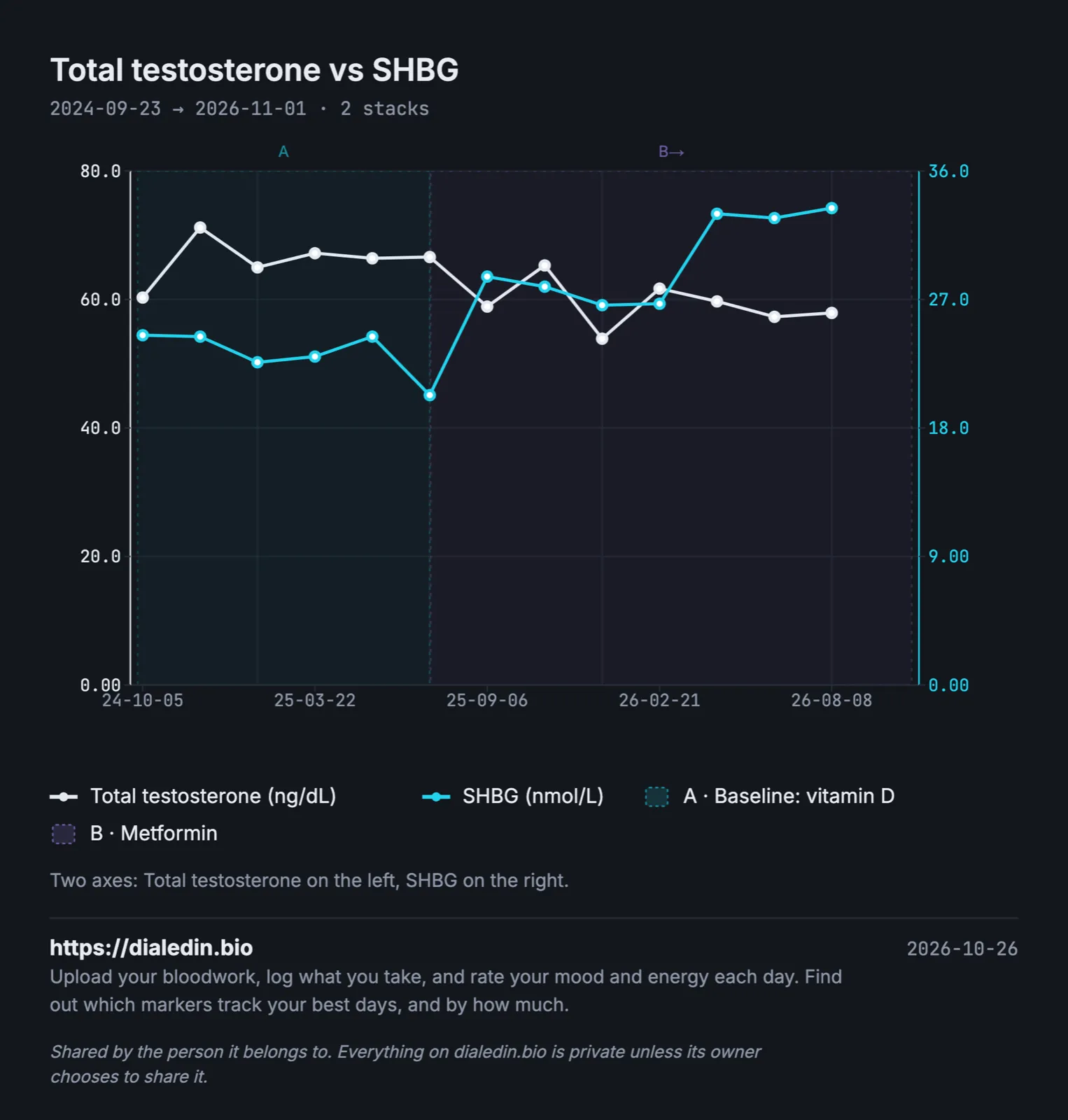
Sample data, not a real person.
The two lines move in opposite directions. In the first band, SHBG drifts down and testosterone stays high. After the change, SHBG rises and testosterone eases. Neither line alone tells you as much as the pair, which is why it's worth getting both on the same draw every time. It also shows how slowly these change: the turn takes most of a year.
How to make PCOS blood tests comparable
Note the cycle day for every test
Testosterone varies a little through the cycle, and LH, FSH and progesterone vary a lot. Many clinics ask for the early follicular phase, days 2 to 5, if you have periods. If your cycles are irregular, write down the day since your last period anyway.
Test off hormonal contraception if your doctor asks
The combined pill raises SHBG and lowers testosterone, which can hide high androgens completely. Guidance usually suggests testing after some months without it. Whether that's right for you is a question for your doctor, but always note whether you were on it.
Use a lab that measures testosterone well at low levels
Ask whether the lab uses LC-MS/MS for testosterone. If you can't choose, at least stay with the same lab so results compare.
Get SHBG with every testosterone test
Without SHBG, you can't work out free testosterone or the free androgen index, and a change in total testosterone can't be read on its own.
Test fasted and in the morning
Glucose, insulin and triglycerides need fasting. Testosterone is also higher in the morning. Our post on fasting before a blood test has the details.
Write down weight and medication changes
Weight changes move SHBG and insulin, and so do several medicines. A one-line note next to each result explains a change months later.
How often are PCOS blood tests repeated?
Once the diagnosis is made, the hormone tests usually aren't repeated often unless something changes or a treatment is being followed. The metabolic checks are different: guidelines suggest checking glucose or HbA1c every one to three years, depending on other risks, and lipids too. Your doctor sets the schedule.
A record you can keep by hand
| Date | Cycle day | Pill? | Total T (ng/dL) | SHBG (nmol/L) | FAI | LH / FSH (mIU/mL) | Glucose (mg/dL) | Notes |
|---|---|---|---|---|---|---|---|---|
| 2024-10-05 | 3 | no | 64 | 26 | 8.5 | 11 / 5.4 | 90 | |
| 2025-04-12 | irregular, 41 | no | 71 | 21 | 11.7 | 13 / 5.6 | 95 | |
| 2026-04-18 | 4 | no | 58 | 33 | 6.1 | 9 / 5.6 | 88 | metformin since July |
The free androgen index here is total testosterone in nmol/L divided by SHBG, times 100. Our free androgen index calculator does the conversion for you.
Where dialedin fits
We built dialedin because results like these come from different labs over years, and comparing them by hand is slow.
You upload a lab PDF and it is read into individual markers, which you check before saving. Every report goes onto one timeline, and the same marker under different lab names stays one line. You can put two markers on one chart, like testosterone and SHBG above, and record what you were taking and when. An optional daily check-in shows which levels line up with your better days, and you can export your history as a PDF for your doctor.
It's free while we're in beta. If your hormone results are spread across clinics and portals, put them on one timeline and see how they've moved.
This article is general information, not medical advice, and it can't take your own history into account. Only a doctor can diagnose PCOS. Talk to yours about which tests you need and what your results mean.