Testosterone tests in women: why the numbers are small
Women get testosterone tested for a few common reasons: irregular periods, acne or hair growth, low libido after menopause, or because it came on a hormone panel. The result is usually a small number like 24 ng/dL, and when the next test says 17, it's hard to know whether anything changed.
Women's testosterone runs at roughly a tenth to a twentieth of men's. That's the range where many routine testosterone tests are least reliable. The Endocrine Society said so in a position statement in 2007 (Rosner et al., 2007), and it's why results in women can differ between labs by more than the change you're looking for. Getting the method right, and keeping it the same, matters more for women's testosterone than for almost any other hormone test.
Where testosterone comes from in women
The ovaries and the adrenal glands each make about half, partly directly and partly from precursors such as DHEA-S and androstenedione that are converted in other tissues. Levels change a little across the menstrual cycle, often highest around ovulation, and fall slowly with age. They don't drop sharply at menopause the way estradiol does, but removal of the ovaries lowers them.
Most testosterone in the blood is bound to SHBG or albumin. The small free part is what acts on tissues. That's why the same total testosterone can mean different things in two women with different SHBG. Our post on high or low SHBG explains what moves it.
Why the method matters
| Method | How it works | At women's levels |
|---|---|---|
| Immunoassay | An antibody binds testosterone | Many give results too high or too scattered at low levels |
| LC-MS/MS | Mass spectrometry separates and weighs the molecule | More accurate at low levels; often recommended for women |
Many labs run immunoassays by default because they're cheap and fast. Some offer LC-MS/MS on request, and some private labs use it as standard. The report often names the method in small print. If two of your results came from different methods, they can't be compared directly.
Total, free and the free androgen index
Three versions turn up on women's reports:
- Total testosterone: bound plus free.
- Free testosterone, either measured directly or calculated from total testosterone, SHBG and albumin. Our post on calculated vs direct free testosterone explains why the direct tests are unreliable.
- The free androgen index: total testosterone divided by SHBG, times 100. It's often used in women, for example when polycystic ovary syndrome is being considered.
Each depends on SHBG, and SHBG moves with the contraceptive pill, oral estrogen, thyroid hormone and weight. A change in SHBG can move free testosterone and the index while total testosterone stays put.
What one person's results look like
This is total testosterone across 13 tests over two years:
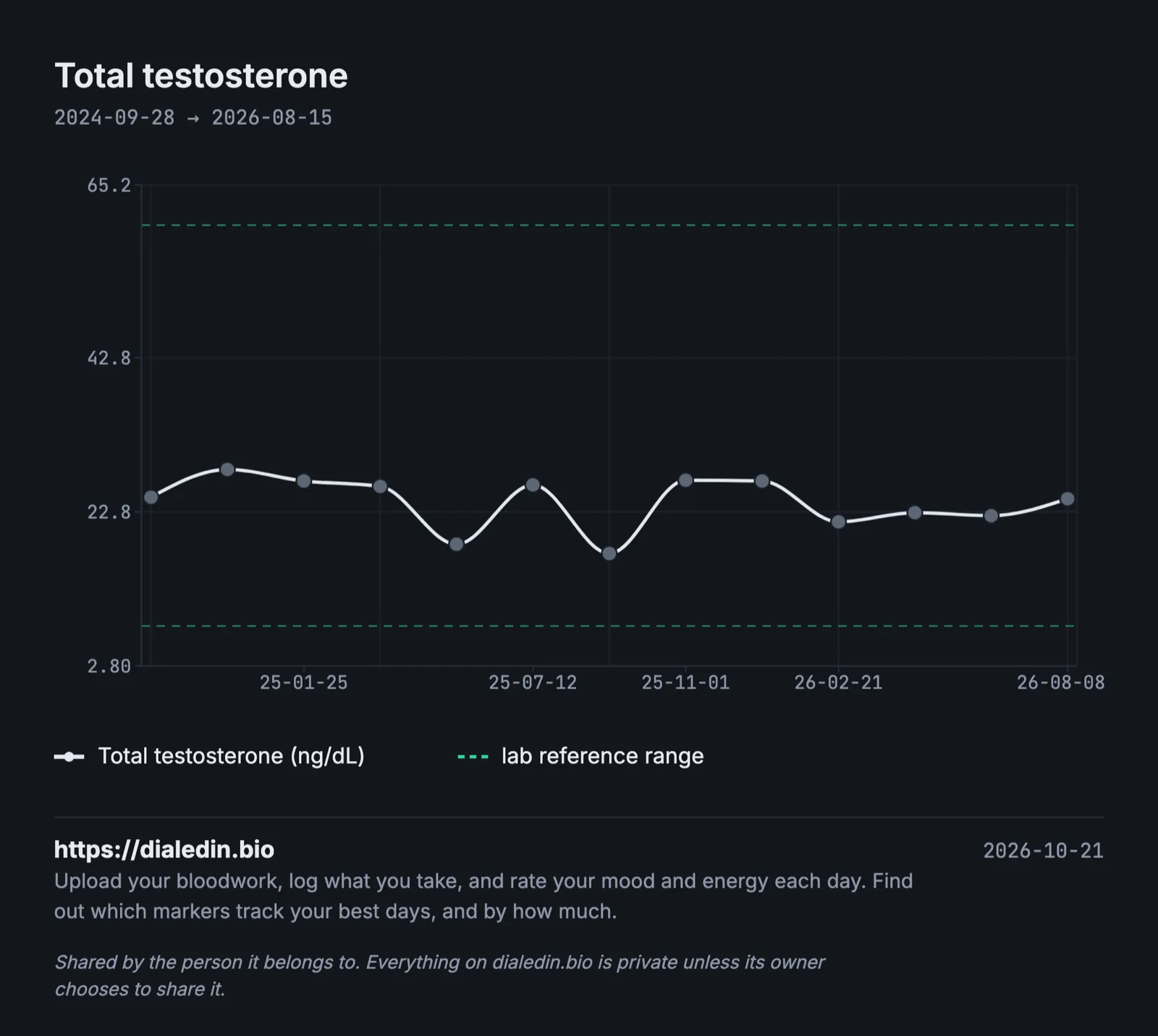
Sample data, not a real person.
The results move by up to ten points between tests with no trend behind it. On this scale that's a lot: a drop from 27 to 17 looks like a third of the level gone. It's mostly the test and the day. A real change shows up as a run of results in one direction, not one low point.
How to make women's testosterone results comparable
Ask for LC-MS/MS if you can
If your doctor or lab can use mass spectrometry, ask for it, and then keep using it. If not, keep the same lab and the same immunoassay.
Test at the same point in your cycle
If you have periods, an early-cycle test (often day 2 to 5) is common and easy to repeat. Write the cycle day next to the result. Our post on progesterone tests covers why cycle day matters so much for the other hormones.
Test in the morning
Testosterone is a little higher in the morning in many people. Same time each test.
Get SHBG on the same draw
Free testosterone and the index can't be worked out without it, and a change in SHBG is often the real story.
Note the pill, HRT and any change to them
Starting or stopping the contraceptive pill, or switching between oral and transdermal estrogen, moves SHBG and therefore free testosterone.
Watch the units
US labs report ng/dL, many others nmol/L. 1 nmol/L is about 28.8 ng/dL. Our post on testosterone units has the conversions.
How often is it worth testing?
That depends on why it was ordered, so your doctor sets it. For many questions one or two results, taken properly, are enough. If you're on testosterone treatment, levels are usually checked a few weeks after starting and then periodically. Either way, keeping the method and timing fixed is what makes a later result comparable.
A record you can keep by hand
| Date | Lab | Method | Cycle day | Total T (ng/dL) | SHBG (nmol/L) | FAI | Notes |
|---|---|---|---|---|---|---|---|
| 2025-03-23 | City Lab | LC-MS/MS | 3 | 26 | 68 | 1.3 | |
| 2025-05-18 | City Lab | LC-MS/MS | 4 | 19 | 70 | 0.9 | |
| 2025-09-07 | City Lab | LC-MS/MS | (on HRT) | 17 | 82 | 0.7 | patch since September |
The method column is the first thing to check when two results disagree.
Where dialedin fits
We built dialedin so small hormone results can be read against your own history.
You upload a lab PDF and it's read into individual markers, which you check before saving. Every report goes onto one timeline, and the same marker under different lab names stays one line. You record what you take and when, such as HRT or the pill. Optional daily check-ins show whether your mood and energy line up with your results, and you can export your history as a PDF for your doctor.
It's free while we're in beta. If your testosterone results jump around, put them on one chart and see whether they follow a trend at all.
This article is general information, not medical advice, and it can't take your own history into account. Talk to your doctor about why testosterone is being tested and what your results mean.