Progesterone blood test: why the cycle day matters
Progesterone results confuse people more than most hormone tests. One comes back at 0.4 and gets flagged low, the next is 9 and looks fine, and the woman they belong to didn't change anything.
What changed was the day of the cycle. Progesterone stays low from the start of a period until ovulation, rises sharply afterwards, peaks about a week later and falls before the next period. Depending on the day, the same healthy person can measure anywhere from almost nothing to well inside the luteal range. A progesterone result without the cycle day attached is close to meaningless.
What progesterone does across a cycle
After ovulation, the follicle that released the egg turns into the corpus luteum, which makes progesterone to prepare the lining of the womb. If there's no pregnancy, it shrinks after about two weeks, progesterone falls and a period starts.
| Phase | Typical days in a 28-day cycle | Progesterone |
|---|---|---|
| Follicular | Day 1 to ovulation | Low |
| Ovulation | Around day 14 | Starting to rise |
| Mid-luteal | About 7 days after ovulation | At its highest |
| Late luteal | The last days before the period | Falling |
Many reports print a separate reference range for each phase. If yours prints only one, it's often the luteal one, and a follicular result will be flagged low for no reason.
The "day 21" test
The classic progesterone test is taken on day 21, because in a 28-day cycle that's about seven days after ovulation. Its main use is to check whether ovulation happened: a raised mid-luteal progesterone means it very likely did.
Day 21 only works for a 28-day cycle. If your cycles are 35 days, ovulation is later and day 21 can fall before it. The more useful rule is about seven days before your next expected period. With irregular cycles, some doctors repeat the test or track ovulation another way first.
Perimenopause, and why results scatter
In perimenopause, cycles get irregular and some of them don't include ovulation. Those cycles make little progesterone. Combine that with tests booked on whatever day the appointment fell, and results jump all over. Our post on tracking hormones through perimenopause covers the other lines that change, and the one on LH and FSH covers the hormones that drive the cycle.
This is progesterone in one woman over two years, before and after starting HRT:
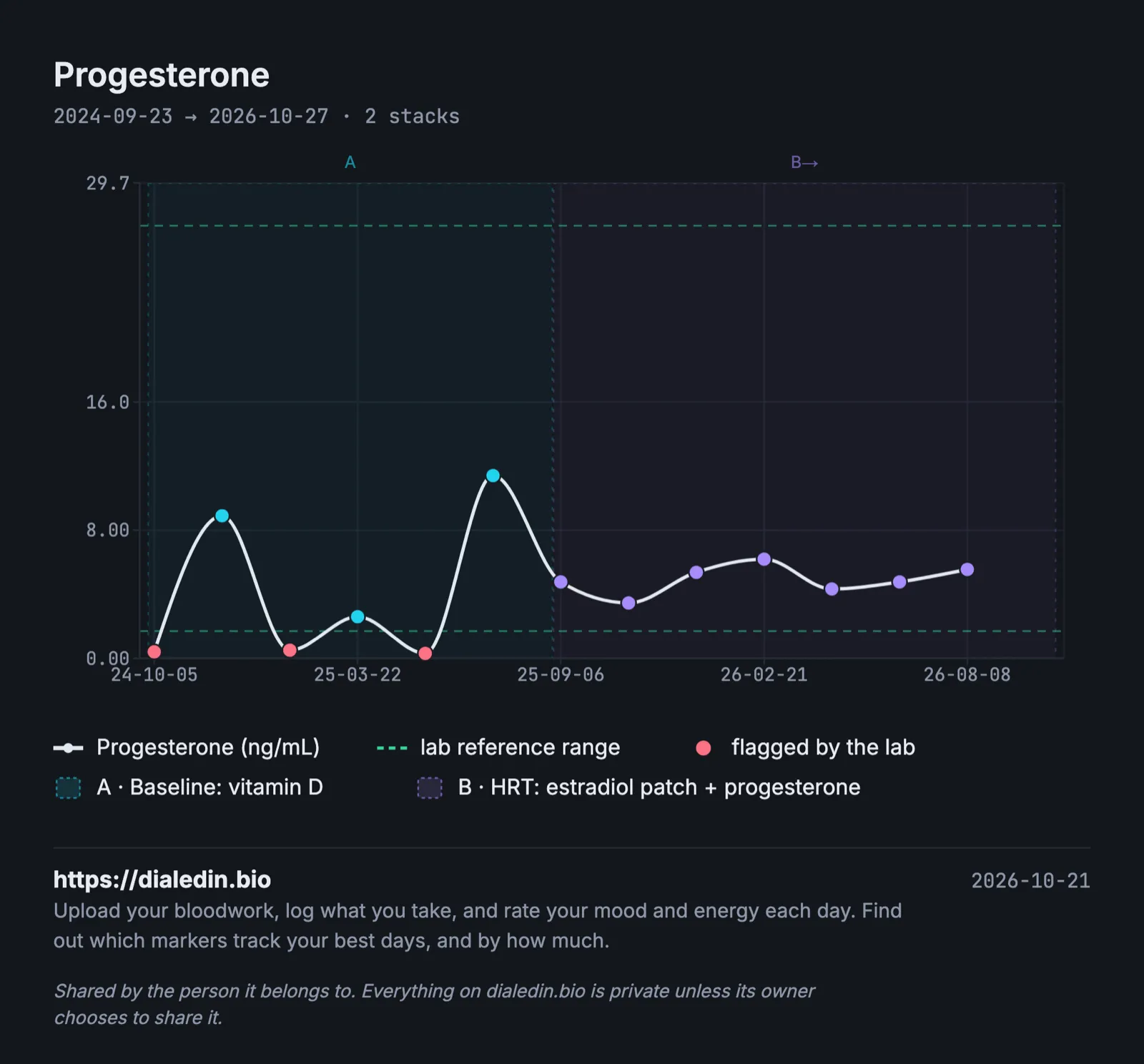
Sample data, not a real person.
The flagged results before HRT were tests taken early in a cycle, and the high ones after ovulation. They don't describe a trend in either direction. On HRT the swings shrink, but the level depends on when the progesterone was taken, as the next section explains.
Progesterone on HRT
On oral micronised progesterone, blood levels rise and fall over hours after each capsule, and much of it is changed in the liver before it reaches the blood. Blood tests aren't usually used to judge whether HRT progesterone is enough; its job of protecting the womb lining is judged in other ways. If a level is measured anyway, the time since the last capsule is what makes it readable.
How to make progesterone results comparable
Write down the first day of your last period
Every progesterone result needs it. Then work out the cycle day of the test and write that too.
For an ovulation check, aim for seven days before your next period
Count back from when you expect it. If your period comes later than expected, the test may have been early; note the actual date.
Book a repeat if the timing was off
A low result on a day that turned out to be before ovulation says nothing about ovulation. Many doctors repeat it in another cycle.
On HRT, note the time since your last capsule
Same for any progesterone you take. Morning and evening schedules give very different numbers.
Note the pill, an IUD and fertility medicines
Hormonal contraception usually stops ovulation, so progesterone stays low. Fertility medicines change it on purpose. They all belong in the notes.
Watch the units
US labs report ng/mL, many others nmol/L. 1 ng/mL is about 3.18 nmol/L.
How often is it tested?
Only when a doctor has a question to answer, such as whether ovulation is happening. Your doctor decides when. One well-timed result says far more than several taken on random days. If you're tracking cycles for a while, test in the same phase each time.
A record you can keep by hand
| Date | Lab | First day of last period | Cycle day | Usual cycle length | Progesterone (ng/mL) | Notes |
|---|---|---|---|---|---|---|
| 2024-10-06 | City Lab | 2024-10-02 | 5 | 26 to 34 days | 0.4 | follicular |
| 2024-12-01 | City Lab | 2024-11-10 | 22 | 26 to 34 days | 8.9 | period came 2024-12-07 |
| 2025-01-26 | City Lab | 2025-01-20 | 7 | 26 to 40 days | 0.5 |
The cycle day column turns three contradicting numbers into a cycle that looks normal.
Where dialedin fits
We built dialedin so hormone results keep the context that explains them.
You upload a lab PDF and it's read into individual markers, which you check before saving. Every report goes onto one timeline, and the same marker under different lab names stays one line. You record what you take and when, such as HRT, so each result sits in the right stretch. Optional daily check-ins sit alongside your results, and you can export your history as a PDF for your doctor or menopause clinic.
It's free while we're in beta. If your progesterone results look random, put them on one timeline with the dates that explain them.
This article is general information, not medical advice, and it can't take your own history into account. Talk to your doctor about when to test progesterone and what your result means.