VLDL cholesterol: what "calculated" means
VLDL cholesterol is the line on a lipid panel that people look up most and understand least. It usually comes with "calc." after its name, sits between LDL and the ratios, and gets flagged now and then for reasons nobody explains.
On most reports VLDL isn't measured at all. The lab takes your triglycerides and divides them by five (in mg/dL), or by 2.2 if it reports in mmol/L. So the VLDL line is your triglyceride line at a fifth of the size, and everything that moves triglycerides moves VLDL by exactly the same share. If you already follow triglycerides, VLDL tells you nothing new.
What VLDL is
VLDL stands for very-low-density lipoprotein. The liver makes these particles to send triglycerides out to the body. As they unload triglycerides, they shrink and turn into smaller particles, and eventually into LDL.
A VLDL particle carries both triglycerides and cholesterol. The VLDL cholesterol line is meant to be the cholesterol part. Measuring it directly takes an ultracentrifuge, so routine labs estimate it instead.
How labs calculate VLDL
The estimate comes from the Friedewald equation, published in 1972 (Friedewald et al., 1972). The authors noticed that in fasting blood, VLDL particles carry roughly one part cholesterol for every five parts triglyceride. So:
| Units | VLDL cholesterol |
|---|---|
| mg/dL | Triglycerides ÷ 5 |
| mmol/L | Triglycerides ÷ 2.2 |
The same equation gives the calculated LDL: total cholesterol minus HDL minus VLDL. So when VLDL goes up, a calculated LDL goes down by the same amount, even though nothing about the LDL particles changed.
The ÷5 rule gets less accurate as triglycerides rise, and most labs stop calculating once triglycerides pass a cut-off printed on the report. Some labs now use newer equations that adjust the factor to your numbers. The report usually names its method in small print.
Why VLDL jumps between tests
Because it's triglycerides in disguise, VLDL jumps for the same reasons triglycerides do:
- Eating before the test, especially fat, sugar or a large meal.
- Alcohol the evening before.
- Weight gain, insulin resistance and poorly controlled blood sugar.
- Some medicines, including oral estrogen, steroid medicines and some for HIV or acne.
- An underactive thyroid.
This is triglycerides and the calculated VLDL from the same reports over two years:
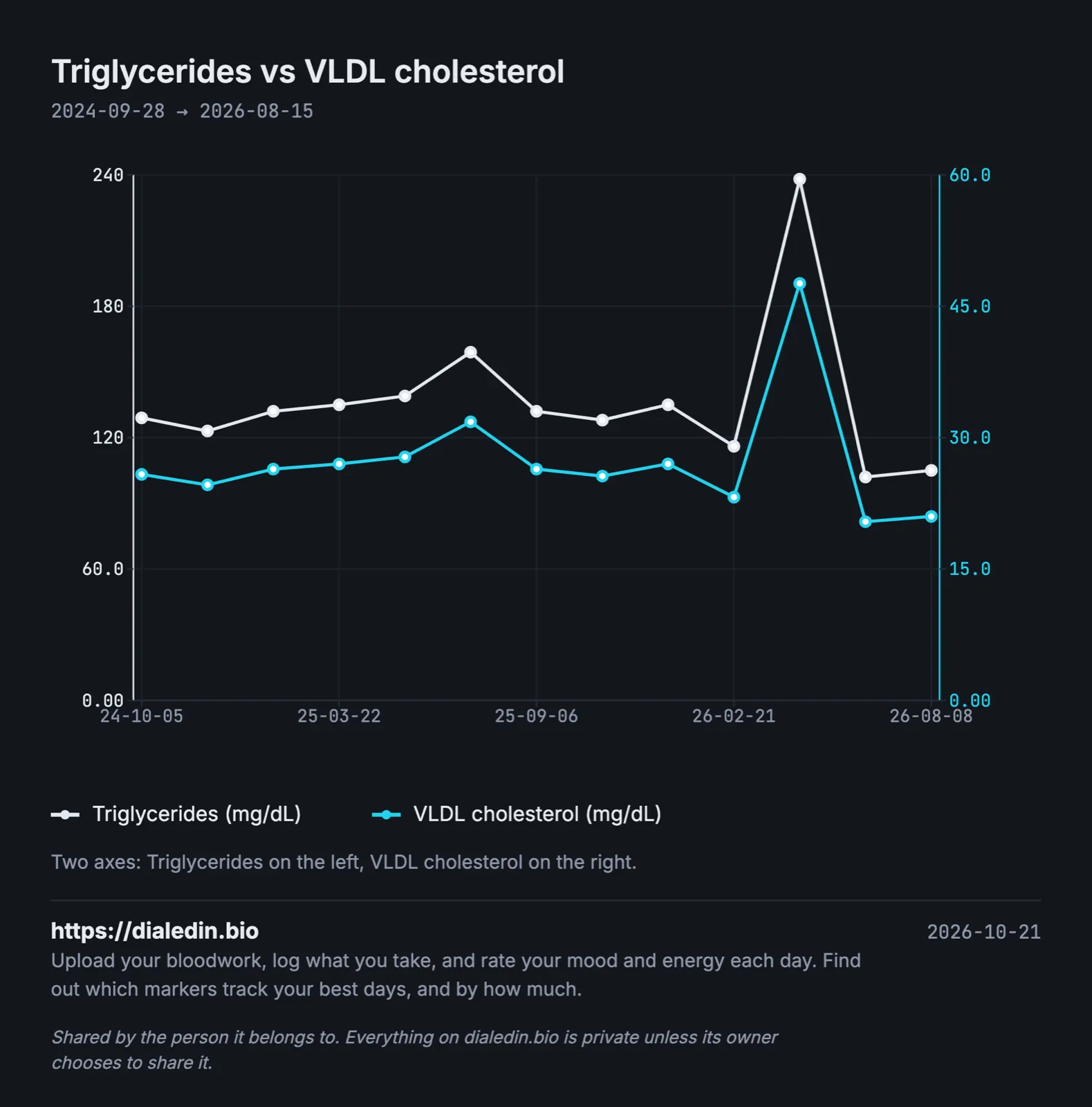
Sample data, not a real person.
The two lines are the same line. The spike is one test taken after breakfast, and the VLDL spike is that number divided by five. Our post on why triglycerides jump covers the triglyceride side.
How to read VLDL on your own reports
Read triglycerides first
If triglycerides moved, VLDL moved by a fifth as much in mg/dL. There's no separate story to look for.
Check whether the sample was fasted
A non-fasting sample raises triglycerides and therefore VLDL, and pushes a calculated LDL down. Write "fasted" or "not fasted" next to every result.
Check the method line
"VLDL, calc." means the ÷5 rule or a newer equation. If a lab ever reports measured VLDL, it isn't comparable with the calculated one. Keep them as separate lines.
Watch the units
In mmol/L the divisor is 2.2, not 5. Mixing reports from a US lab and a European one can make VLDL look like it changed when only the units did.
Look at non-HDL next to it
Non-HDL cholesterol is total cholesterol minus HDL. It includes the cholesterol in VLDL and doesn't depend on the ÷5 estimate, so it's steadier when triglycerides bounce.
Keep the evening before similar
Same kind of dinner, no alcohol, same fasting time. Most of the noise in VLDL comes from the 12 hours before the draw.
How often is VLDL checked?
It comes with every lipid panel, so on the same schedule your doctor sets for cholesterol. It's rarely ordered on its own. Our post on how to read a lipid panel covers when panels are usually repeated and what the other lines mean.
Tracking it by hand
| Date | Lab | Fasted | Triglycerides (mg/dL) | VLDL calc. (mg/dL) | LDL calc. (mg/dL) | Notes |
|---|---|---|---|---|---|---|
| 2026-02-22 | City Lab | yes | 116 | 23 | 88 | |
| 2026-04-19 | City Lab | no | 238 | 48 | 67 | breakfast before the draw |
| 2026-06-14 | City Lab | yes | 102 | 20 | 93 |
The VLDL column can be filled in from the triglycerides column, which is the point. The fasted column explains both.
Where dialedin fits
We built dialedin so the lines on a lipid panel stay connected over time.
You upload a lab PDF and it's read into individual markers, which you check before saving. Every report goes onto one timeline, and the same marker under different lab names stays one line. You can overlay two markers, like triglycerides and VLDL above, and record what you take and when. Optional daily check-ins sit alongside, and you can export your history as a PDF for your doctor.
It's free while we're in beta. If your VLDL keeps getting flagged, put your lipid panels on one chart next to your triglycerides.
This article is general information, not medical advice, and it can't take your own history into account. Talk to your doctor about your cholesterol results and what they mean for you.