Why triglycerides jump from one test to the next
Triglycerides are the line on a lipid panel that surprises people most. One test says 110, the next says 210, and nothing in between felt any different.
Triglycerides are fat in transit. After you eat, fat from the meal enters the blood and triglycerides rise for several hours, then come back down. Alcohol, a late dinner, a hard workout or a bad night all change them too. Of the three things a lipid panel measures, triglycerides vary most from one day to the next even in the same person, so a single result says less than the ones around it.
What triglycerides are
Triglycerides are the main form of fat the body stores and moves around. They come from two places: the food you've just eaten, carried in particles called chylomicrons, and the liver, which packs them into VLDL particles. The blood test measures both at once.
On a lipid panel they matter twice. They're a result in their own right, and they feed the calculated lines: VLDL cholesterol is triglycerides divided by five, and a calculated LDL subtracts that. When triglycerides jump, those lines jump with them.
What moves triglycerides within hours or days
| What | What happens |
|---|---|
| A meal before the test | Rises for several hours, more after a large or fatty meal |
| Alcohol the evening before | Rises, sometimes a lot, for a day or so |
| A big carbohydrate load the day before | Rises the next morning |
| Hard exercise | Can lower them for a day or two |
| An infection or other illness | Often rises |
| A long fast | Changes them in either direction, depending on the person |
What moves them over months
Weight, insulin resistance and blood sugar control have the biggest slow effect. Triglycerides often climb with weight and fall with weight loss. Some medicines raise them, including oral estrogen, steroid medicines and some acne and HIV medicines. An underactive thyroid can raise them. Fish oil in large amounts and several cholesterol medicines lower them.
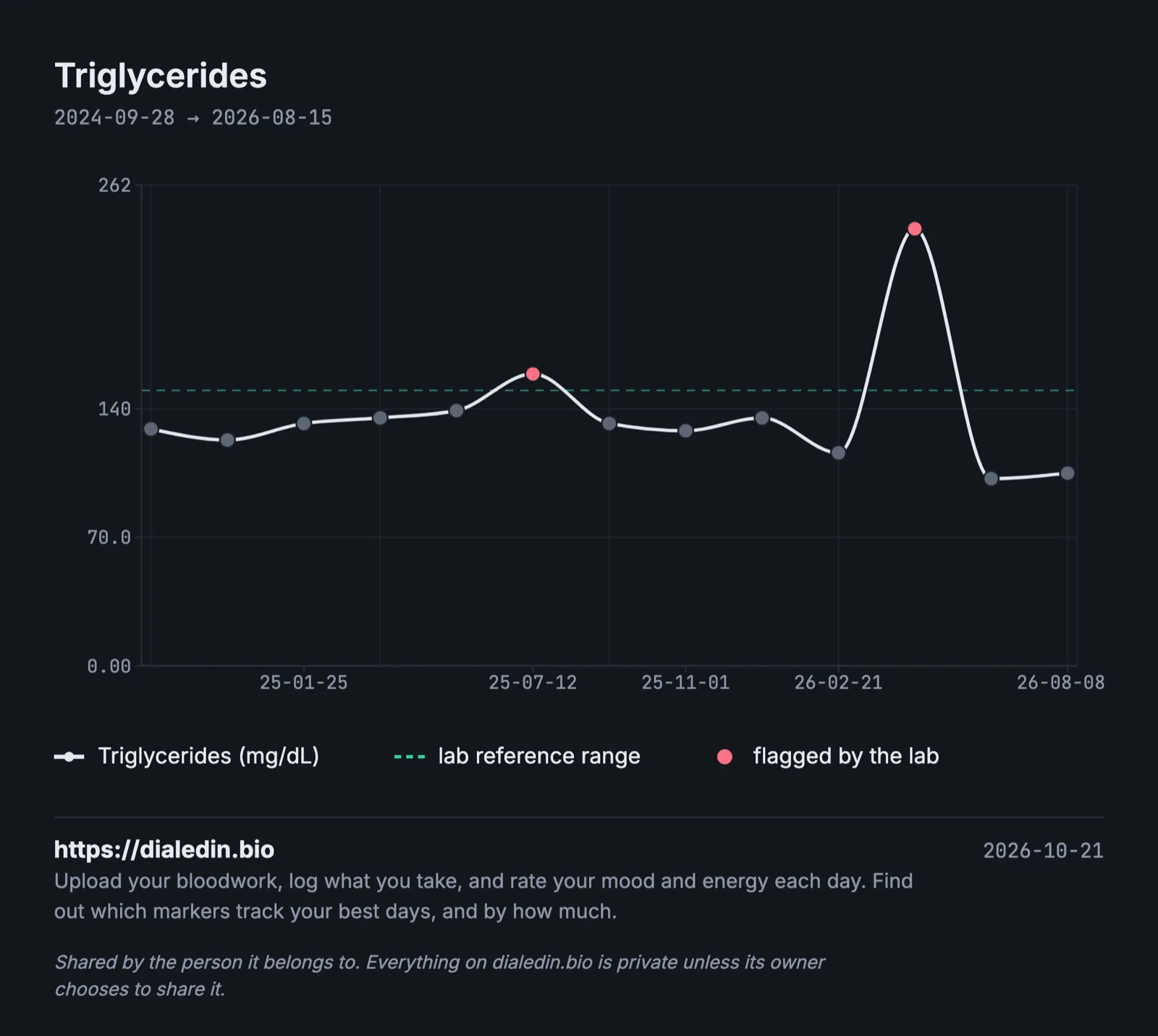
This is triglycerides across 13 tests over two years:
Sample data, not a real person.
The slow climb in the first year is the kind of change a series is good at showing. The spike in 2026 is a single test taken after breakfast. Both crossed the line and got flagged, and they mean very different things. Without a note saying the spike wasn't fasted, it would look like the most important result on the chart.
How to get triglyceride results you can compare
Fast the same way every time
Many labs no longer require fasting for a lipid panel, because the other lines change little after a normal meal (Nordestgaard et al., 2016). Triglycerides do change. Ask whoever orders the test which they prefer, then do the same thing each time and note it. If you fast, the usual instruction is water only for 9 to 12 hours.
Skip alcohol for a day or two before
Alcohol is the most common reason for a surprise result. Even a couple of drinks the evening before can show up.
Keep the evening meal ordinary
A large late dinner or a big dessert lingers into the next morning, even after a fast.
Avoid testing during an illness
A cold or flu can raise triglycerides. Wait until you've recovered, or note it.
Keep training similar in the days before
A long run or a hard session can lower triglycerides for a day or two. It isn't a trick to use; it's noise to keep steady.
Write down medicines and weight changes
A new medicine or a few kilos either way explains a lot. Put the date next to the result.
Watch the units
US labs report mg/dL; most other places use mmol/L. For triglycerides, 1 mmol/L is about 88.57 mg/dL, a different factor from cholesterol's.
How often should triglycerides be checked?
They come with every lipid panel, on whatever schedule your doctor sets. A result that's unexpectedly high is often repeated, fasted, before anything else, because so many harmless things push it up. Our post on how to read a lipid panel has the usual anchors for repeating panels, and the one on the triglyceride to HDL ratio covers a calculation people often add.
A record you can keep by hand
| Date | Lab | Fasted (hours) | Alcohol in last 48 h | Triglycerides (mg/dL) | Notes |
|---|---|---|---|---|---|
| 2025-05-18 | City Lab | 12 | no | 139 | |
| 2025-07-13 | City Lab | 12 | no | 159 | |
| 2026-04-19 | City Lab | 0 | no | 238 | breakfast before the draw |
| 2026-06-14 | City Lab | 12 | no | 102 |
The fasted and alcohol columns take seconds to fill in, and they're what make the triglyceride column readable.
Where dialedin fits
We built dialedin because the notes that explain a triglyceride result usually get lost.
You upload a lab PDF and it's read into individual markers, which you check before saving. Every report goes onto one timeline, and the same marker under different lab names stays one line. You record what you take and when, and optional daily check-ins show how you felt. You can export your history as a PDF for your doctor.
It's free while we're in beta. If your triglycerides look like a seismograph, put them on one chart and see which results belong together.
This article is general information, not medical advice, and it can't take your own history into account. Talk to your doctor about your triglyceride results and what they mean for you.