Non-HDL cholesterol: the number you can work out
Non-HDL cholesterol is a line some labs print and others leave off. People who see it for the first time usually search what it means, find a definition, and still don't know why it's there.
You can work it out from any lipid panel in your head: total cholesterol minus HDL cholesterol. It's everything in the blood that isn't HDL, which means the cholesterol in LDL plus the cholesterol in the triglyceride-rich particles that LDL leaves out. And because it uses two measured lines and no estimates, it stays steady when a non-fasting sample sends triglycerides and the calculated LDL all over the place.
What non-HDL cholesterol includes
Cholesterol travels in several kinds of particles. HDL is one. All the others carry apolipoprotein B and can end up in artery walls:
- LDL, the largest share for most people.
- VLDL, the particles that carry triglycerides out from the liver.
- IDL and remnants, the leftovers as VLDL shrinks into LDL.
- Lipoprotein(a), a variant of LDL that's mostly inherited.
Non-HDL cholesterol counts the cholesterol in all of them. LDL counts only the first. When triglycerides are high, more cholesterol sits in VLDL and remnants, so non-HDL picks up what LDL misses. That's why several guidelines list it alongside LDL, especially for people with high triglycerides or diabetes.
ApoB counts the same particles by number instead of by cholesterol content. Our post on ApoB vs LDL explains the difference. Non-HDL is the free version: it needs no extra test.
How to calculate it
| You have | Non-HDL is |
|---|---|
| Total cholesterol and HDL in mg/dL | Total − HDL, in mg/dL |
| Both in mmol/L | Total − HDL, in mmol/L |
Use two numbers from the same report. If your lab doesn't print it, adding it as a column to your own records costs nothing.
Why it's steadier than LDL
Most labs still calculate LDL with the Friedewald equation: total cholesterol − HDL − triglycerides ÷ 5 (Friedewald et al., 1972). After a meal, triglycerides rise, the ÷5 part grows, and the calculated LDL falls. Nothing happened to your LDL particles. The arithmetic moved.
Non-HDL leaves triglycerides out, and an ordinary meal barely changes total cholesterol or HDL. A 2016 European consensus statement made the same point when it said non-fasting samples are fine for most routine lipid testing (Nordestgaard et al., 2016).
This is non-HDL and calculated LDL from the same reports over two years:
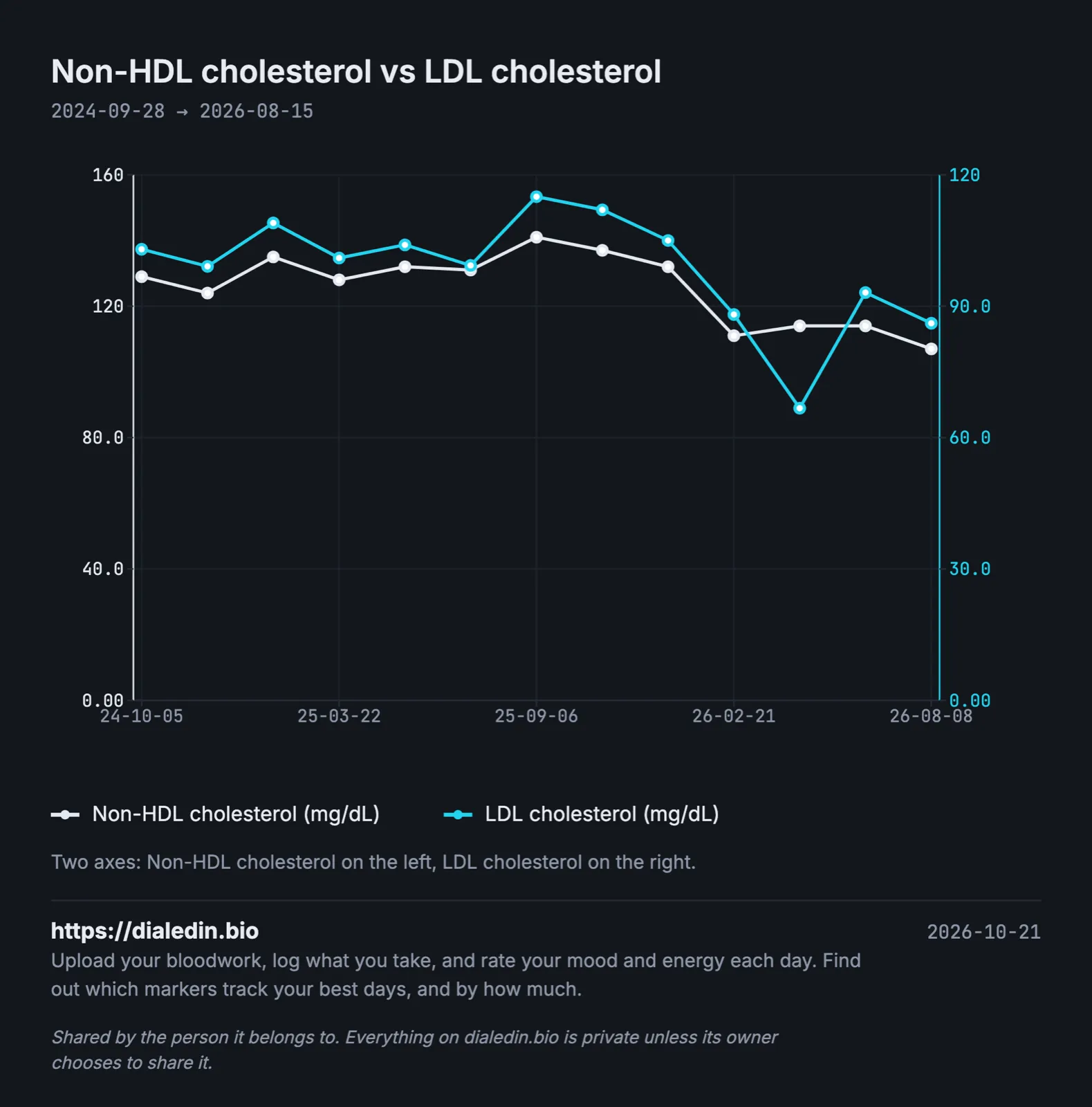
Sample data, not a real person.
The LDL dip is the report taken after breakfast, when triglycerides were 238. Non-HDL on that report is in line with the ones before and after it. Read alone, the LDL result would look like a big improvement. Our post on VLDL cholesterol shows the same report from the triglyceride side.
How to track non-HDL cholesterol
Calculate it for every past report
Old lipid panels all have total and HDL. Going back and adding non-HDL gives you a longer series straight away.
Keep total and HDL from the same lab
Both are measured, but methods and calibrations differ a little between labs. A step after a lab change may be the lab.
Note fasting anyway
Non-HDL hardly cares, but the triglycerides and the calculated LDL on the same report do. A note keeps the rest of the panel readable.
Don't test during or just after an illness
Infection and surgery lower total cholesterol and HDL for weeks, which moves non-HDL.
Write down medicines and their start dates
Statins, other cholesterol medicines, thyroid medicine and hormone therapy all change it. A start date next to the result shows what changed it.
Watch the units
In mmol/L, non-HDL is a much smaller number. 1 mmol/L of cholesterol is about 38.67 mg/dL.
How often is it checked?
It comes with your lipid panel, on whatever schedule your doctor sets for that. Our post on how to read a lipid panel has the usual anchors. If your doctor follows LDL, ask whether they look at non-HDL too, especially if your triglycerides run high.
A record you can keep by hand
| Date | Lab | Fasted | Total (mg/dL) | HDL (mg/dL) | Non-HDL (mg/dL) | Triglycerides | LDL calc. | Notes |
|---|---|---|---|---|---|---|---|---|
| 2026-02-22 | City Lab | yes | 162 | 51 | 111 | 116 | 88 | |
| 2026-04-19 | City Lab | no | 165 | 51 | 114 | 238 | 67 | breakfast before |
| 2026-06-14 | City Lab | yes | 164 | 51 | 113 | 102 | 93 |
Read down the non-HDL column and nothing much happened. Read down the LDL column and something did. The non-HDL column is closer to the truth.
Where dialedin fits
We built dialedin because a lipid trend means following several lines across many reports.
You upload a lab PDF and it's read into individual markers, which you check before saving. Every report goes onto one timeline, and the same marker under different lab names stays one line. You can overlay two markers, like non-HDL and LDL above, and record what you take and when. Optional daily check-ins sit alongside, and you can export your history as a PDF for your doctor.
It's free while we're in beta. If your LDL keeps jumping, put your lipid panels on one chart and look at non-HDL next to it.
This article is general information, not medical advice, and it can't take your own history into account. Talk to your doctor about your cholesterol results and what they mean for you.