Is there a blood test for perimenopause?
Many women in their forties go to a doctor with hot flushes, poor sleep or periods that have gone irregular, and ask for "the hormone test". Some get an FSH test, some are told they don't need one, and some get a normal result and leave wondering whether it's all in their head.
For most women over 45 there's no blood test that confirms perimenopause, and the main guidelines say not to rely on one. Hormones swing so much in perimenopause that a single result can look premenopausal one month and postmenopausal the next. The UK's NICE guideline (NG23) says perimenopause in women over 45 is diagnosed from symptoms, without blood tests. Blood tests still have a place, mostly in younger women and for ruling out other causes.
Why one FSH result says so little
FSH is the signal from the pituitary that tells the ovaries to grow follicles. As the ovaries respond less in perimenopause, FSH tends to rise. But it doesn't rise in a straight line. Some cycles still ovulate normally and FSH drops back, others don't and it climbs. Estradiol swings the other way, sometimes higher than it ever was in your thirties.
So a normal FSH doesn't rule perimenopause out, and a high one on a single day doesn't confirm it either. Our post on LH and FSH blood tests explains what they do in more detail.
This is FSH from one woman across 13 blood tests over two years:
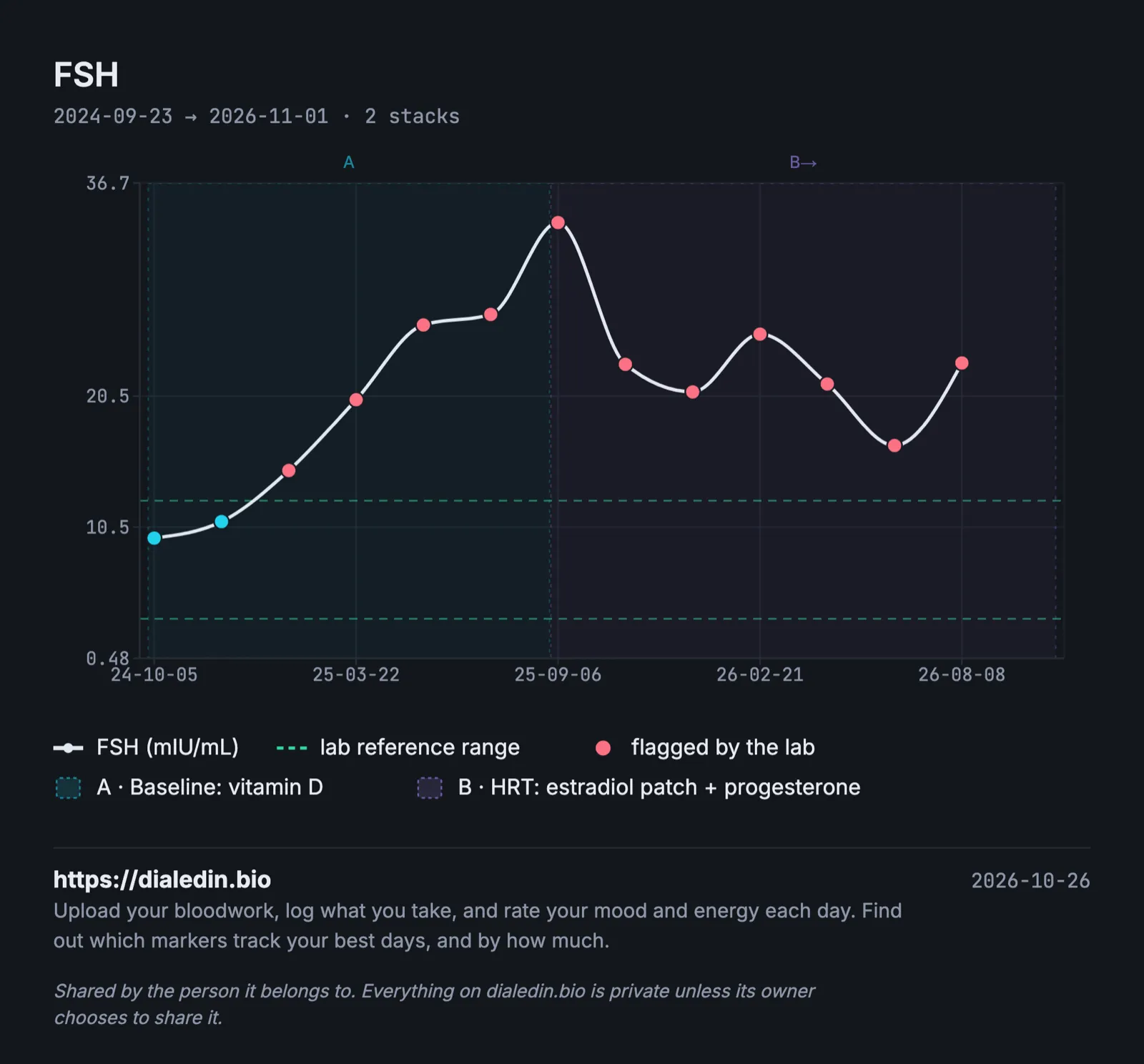
Sample data, not a real person.
Her first two results were inside the range. If she had been tested only then, the report would have looked ordinary while her symptoms were already starting. Even on HRT, FSH keeps moving from one test to the next, which is one reason it isn't used to adjust HRT.
When is FSH used?
FSH has its place in a few situations. These follow NICE NG23; other countries' guidance is similar.
| Situation | FSH test? |
|---|---|
| Over 45 with typical symptoms | Usually not needed; diagnosis from symptoms |
| Age 40 to 45 with symptoms | Sometimes considered |
| Under 40 with symptoms | Recommended, usually twice, a few weeks apart, to check for premature ovarian insufficiency |
| On the combined pill or high-strength progestogen | Not reliable, since they change FSH |
If you're under 40 and your periods have stopped or become irregular, that's worth raising with your doctor soon. Premature ovarian insufficiency is diagnosed partly on FSH and has its own care.
What other blood tests are used for
Perimenopause symptoms overlap with several other conditions, and blood tests are good at ruling those out.
TSH checks the thyroid. An underactive or overactive thyroid can cause tiredness, low mood, heat intolerance and period changes. Our post on tracking thyroid blood tests covers that side.
Ferritin and a blood count look for low iron, which is common with heavy periods and causes tiredness of its own.
Prolactin can disturb periods when high.
A pregnancy test is often done when periods change, since perimenopause doesn't stop ovulation completely.
Glucose or HbA1c and lipids are often checked at the same age for general health, and both tend to change around menopause.
How to make your results useful if you are tested
Write down the cycle day for every test
FSH, LH, estradiol and progesterone all move through the cycle. A result means much more when you know whether it was day 3 or day 23. Many doctors ask for the first few days of a period.
Note anything hormonal you take
The pill, a hormonal coil, HRT and some fertility treatments all change these results. Write down what you were on, and since when.
Use the same lab
Hormone tests differ between labs, and so do their ranges. A switch can look like a change.
Keep a symptom diary alongside
Because the diagnosis is made from symptoms, a record of them is often more useful to your doctor than any single blood test. Note hot flushes, night sweats, sleep, mood and period dates. Our post on tracking hormones through perimenopause has a routine for that.
Repeat a surprising result before reading much into it
A single high or low hormone result in perimenopause is often just the day it was taken. If a result would change a decision, ask whether it's worth repeating.
Should you get tested anyway?
That's a conversation with your doctor, and the answer depends on your age and what else is going on. For women over 45, the main guidelines don't recommend hormone tests to confirm perimenopause. For younger women, or when symptoms don't fit, tests help. On HRT, estradiol is sometimes measured to check absorption; our post on estradiol on HRT covers the timing.
What helps in every case is keeping copies of whatever tests you do have. A run of results, even a few years apart, says more than any single one.
A record you can keep by hand
| Date | Cycle day | Hormonal? | FSH (mIU/mL) | Estradiol (pg/mL) | TSH (mIU/L) | Ferritin (ng/mL) | Notes |
|---|---|---|---|---|---|---|---|
| 2024-10-05 | 3 | no | 9.8 | 118 | 2.1 | 64 | sleep worse since summer |
| 2025-05-17 | 2 | no | 26 | 52 | periods 6-10 weeks apart | ||
| 2025-11-01 | n/a | HRT patch since Sept | 22 | 96 | 2.0 | 55 | flushes much fewer |
Keep the "hormonal?" column even when the answer is no. It's the first thing anyone reading the results will want to know.
Where dialedin fits
We built dialedin because perimenopause results and symptoms make sense together, and they usually live apart.
You upload a lab PDF and it is read into individual markers, which you check before saving. Every report goes onto one timeline, and the same marker under different lab names stays one line. You can record what you were taking and when, like the HRT band above, and log a short daily check-in on sleep, mood and symptoms to see which levels line up with your better days. You can export your history as a PDF to take to your doctor.
It's free while we're in beta. If your results and notes are scattered, put them on one timeline and see them side by side.
This article is general information, not medical advice, and it can't take your own history into account. Talk to your doctor about your symptoms and whether any tests would help.