Normal testosterone levels: why lab ranges differ
Search "normal testosterone levels" and you get a dozen different answers. One chart says 300 to 1,000 ng/dL, a lab report says 264 to 916, another says 8.6 to 29 nmol/L, and a forum post has a table by age that matches none of them. People reasonably wonder which one is right.
They can all be right, for what they were built from. A "normal" range is a description of a group of people measured with one method, and different labs measured different groups with different machines. What the range can't tell you is where your own level usually sits. For that you need your own results over time.
Where the normal range on your report comes from
Most reference ranges are built the same way. A lab, or the maker of its test, measures a large group of people it considers healthy and reports the interval that holds the middle 95% of them. Some labs use a group they measured themselves, some use the manufacturer's numbers, and some use a range published in a study.
That has three consequences. About 1 in 20 healthy people land outside any such range by definition. The range depends on who was in the group: age, health, weight and even the time of day the samples were taken. And it depends on the method, since testosterone tests from different manufacturers don't give identical numbers.
In 2017 a study by Travison and colleagues in the Journal of Clinical Endocrinology and Metabolism tried to fix part of this. It pooled four large studies, calibrated every result against a reference method run by the CDC, and proposed 264 to 916 ng/dL for healthy non-obese men aged 19 to 39. That's why that range shows up on many US reports now. Other labs still use their own.
Our glossary page for total testosterone lists sourced ranges side by side, each with where it came from.
Do testosterone levels change with age?
Yes, slowly. In men, total testosterone usually falls gradually from middle age, and free testosterone falls faster, because SHBG tends to rise with age and holds more of it. The average change is small from one year to the next, and the spread between men of the same age is much bigger than the drift with age.
That spread is why tables of "normal testosterone by age" disagree so much. Each one comes from a different group, and each age band still covers a wide range.
Some labs print age-specific ranges. Many print one adult range for everyone. Neither tells you whether your number is unusual for you.
Normal testosterone levels in women
Women's testosterone is measured on a different scale: roughly a tenth to a twentieth of men's, often a few tens of ng/dL. Ranges for women vary even more between labs, partly because many tests are less accurate at such low levels. Our post on testosterone tests in women explains why the method matters so much there.
What one person's levels look like against the range
This is total testosterone from one woman across 13 blood tests over two years:
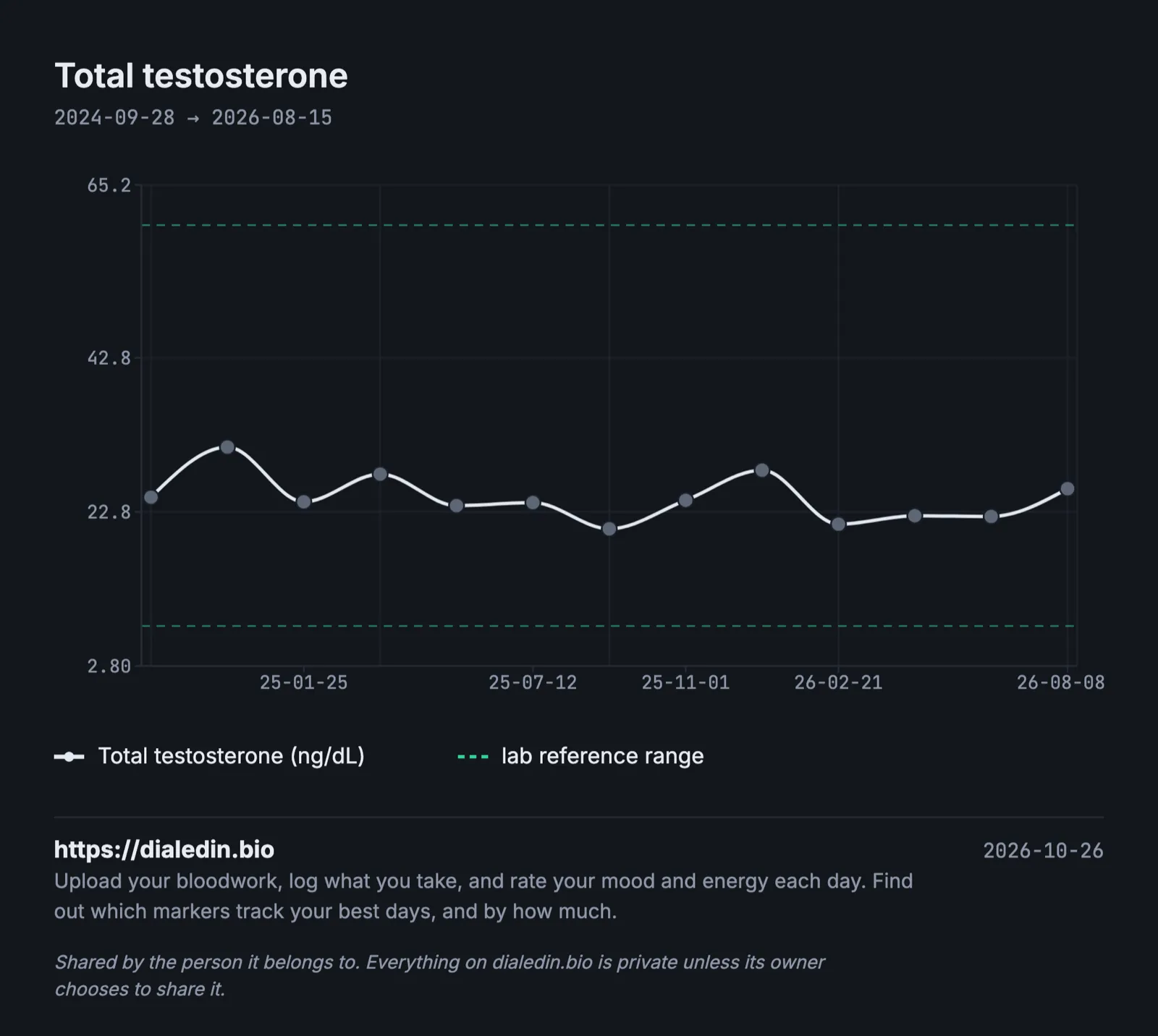
Sample data, not a real person.
The range runs from 8 to 60. Her results stay within about 10 units of each other for two years. A result of 50 would be "normal" by the report, and still well away from anything she has had before. The same idea holds for men's results: the band on the report is wide, and a person's own results usually move around inside a much narrower part of it.
How to tell what's normal for you
Get a few results under the same conditions
One result is a sample of one morning. Two or three, taken the same way, show your usual level and how much it moves. Our post on the testosterone blood test covers how to prepare.
Test in the morning, every time
Testosterone is highest soon after waking. An afternoon result sits lower, so comparing it with a morning one shows a drop that isn't there.
Keep the same lab
A range from one lab doesn't apply to a result from another. If you switch, write "new lab" next to the first result from it.
Write the range down with the result
The range printed on the report is part of the result. If the lab changes method, the range usually changes too, and that's how you'll notice.
Get SHBG on the same draw
Two people with the same total testosterone can have very different free testosterone if their SHBG differs. Our post on SHBG explains why.
Watch the units
ng/dL, nmol/L and ng/mL are all in use. 400 ng/dL, 13.9 nmol/L and 4.0 ng/mL are the same result. Our post on testosterone units has conversion tables.
How often should testosterone be checked?
There's no general schedule for someone who isn't being treated. A sensible pattern is a couple of tests to establish your usual level while you feel well, then a repeat when something changes, such as new symptoms or a new medicine. On treatment, your doctor sets a schedule. In both cases, keep the conditions the same so each result can be compared with the last.
A record you can keep by hand
| Date | Lab | Time | Total T | Unit | Lab's range | SHBG (nmol/L) | Notes |
|---|---|---|---|---|---|---|---|
| 2025-02-14 | City Lab | 08:10 | 512 | ng/dL | 264-916 | 34 | |
| 2025-08-09 | City Lab | 08:20 | 478 | ng/dL | 264-916 | 36 | |
| 2026-02-07 | Other Lab | 08:15 | 15.9 | nmol/L | 8.6-29.0 | 35 | new lab; about 459 ng/dL |
Keep the lab's range in its own column. When the range changes, so has the method, and the step in your numbers may be the lab, not you.
Where dialedin fits
We built dialedin so "normal for you" is something you can see on a chart.
You upload a lab PDF and it is read into individual markers, which you check before saving. Every report goes onto one timeline with the lab's range drawn behind it, and the same marker under different lab names stays one line. You can record what you were taking and when, and add an optional daily check-in to see which levels line up with your better days. You can export your history as a PDF for your doctor.
It's free while we're in beta. If you have a few testosterone results already, put them on one timeline and see where yours usually sits.
This article is general information, not medical advice, and it can't take your own history into account. Talk to your doctor about what your testosterone results mean for you.