T3 uptake and the free T4 index (T7), explained
Some thyroid reports, especially from US labs, carry three lines most people have never heard of: total T4, T3 uptake and free T4 index, sometimes written T7 or FTI. Then someone with a low T3 uptake searches what it means for their T3, and finds nothing that makes sense.
T3 uptake doesn't measure the T3 in your blood at all. It's an indirect test of how many empty binding sites there are on the proteins that carry thyroid hormone. Its only job is to correct total T4 for those proteins, which is what the free T4 index does. Together, the three lines are an older way of estimating free T4, from before labs could measure it directly. Many labs now measure free T4 instead, but the older trio is still ordered.
Why total T4 needs correcting
Almost all T4 in the blood is attached to carrier proteins, mostly one called thyroxine-binding globulin (TBG). Only a tiny fraction is free, and the free part is what the body uses.
Total T4 counts both. So anything that changes the carrier proteins changes total T4, even when the thyroid and the free hormone are completely normal. Pregnancy, estrogen-containing pills and HRT tablets raise TBG and push total T4 up. Some medicines and serious illness lower it.
What T3 uptake measures
In the T3 uptake test, the lab adds a known amount of labelled T3 to your sample, along with a material that soaks up whatever T3 the proteins don't hold. Then it measures how much ended up in the material.
If your proteins have lots of empty binding sites, they hold on to more of the added T3 and less goes into the material: T3 uptake reads low. If they have few empty sites, more goes to the material: T3 uptake reads high.
So T3 uptake moves the opposite way to TBG. That's the opposite of what most people expect from the name.
| Situation | TBG | Total T4 | T3 uptake | Free T4 index |
|---|---|---|---|---|
| Pregnancy, estrogen tablets | Up | Up | Down | Roughly unchanged |
| Low binding proteins (some medicines, illness) | Down | Down | Up | Roughly unchanged |
| Overactive thyroid | Normal | Up | Up | Up |
| Underactive thyroid | Normal | Down | Down | Down |
The useful pattern: when total T4 and T3 uptake move in opposite directions, it's usually the proteins. When they move the same way, it's usually the thyroid.
How the free T4 index (T7) is calculated
The free T4 index multiplies total T4 by T3 uptake:
Free T4 index = total T4 × T3 uptake (%) ÷ 100
For example, a total T4 of 8.0 µg/dL with a T3 uptake of 30% gives a free T4 index of 2.4. If pregnancy raised total T4 to 10.0 and lowered T3 uptake to 24%, the index would still be 2.4. That's the point of it: the protein change cancels out.
Some labs report T3 uptake as a percentage and some as a ratio against a reference serum, and some call the result the "thyroid hormone binding ratio". The arithmetic is the same idea, but the numbers aren't interchangeable between the two styles.
Free T4 index vs free T4
The index is an estimate. It works well in most people and less well when binding is very unusual, such as in some inherited binding-protein differences and in severe illness. A direct free T4 test measures the free hormone itself, and most labs now prefer it.
Both still sit next to TSH, which is usually the first test to look at. Our post on the thyroid panel covers how the lines relate.
If your reports switch from one to the other, don't put them on the same line. A free T4 index of 2.4 and a free T4 of 1.2 ng/dL are different numbers in different units, even when they describe the same thyroid.
What a free T4 line looks like over time
This is free T4 from one person across 13 tests over two years, with her treatment shaded:
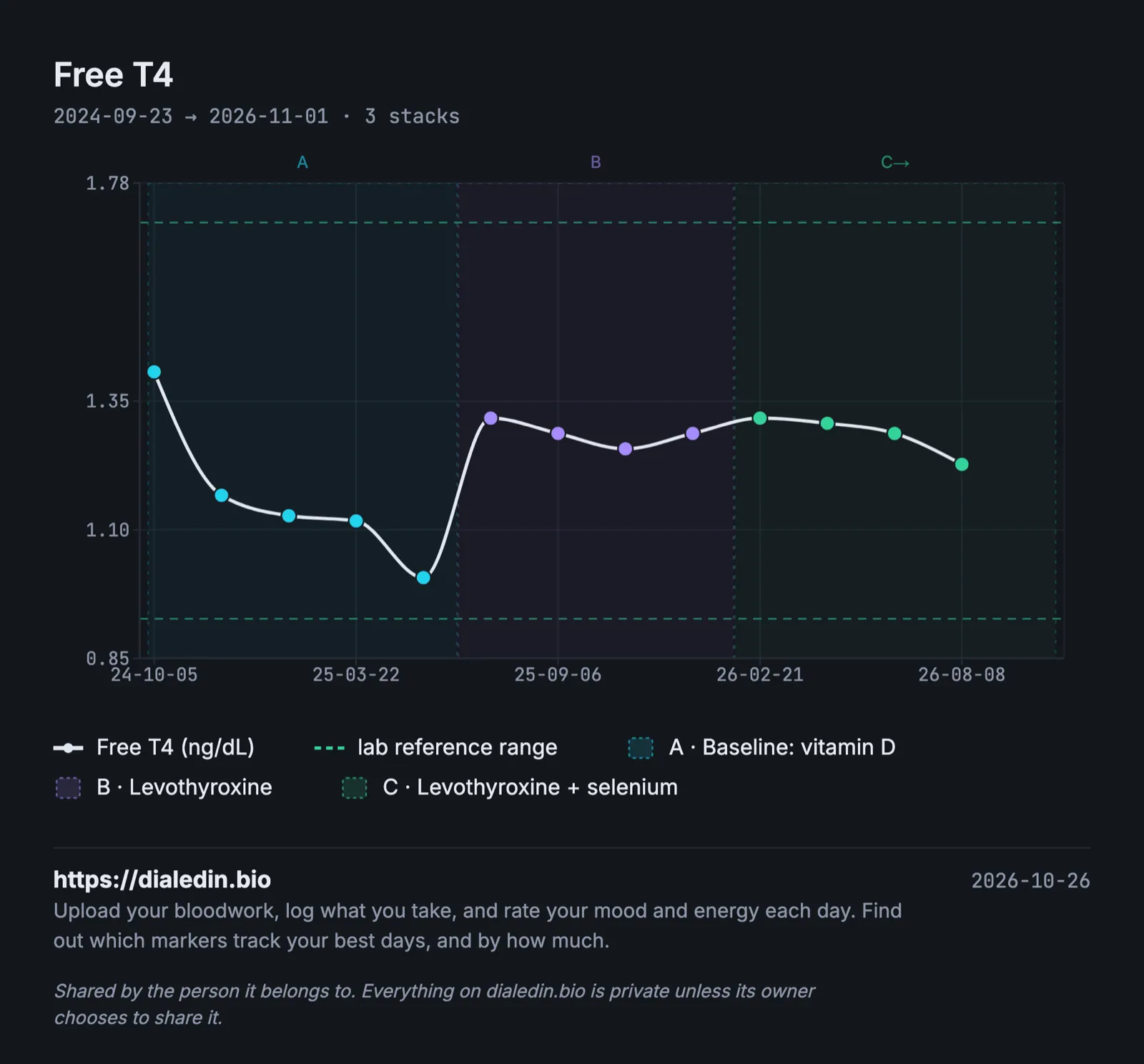
Sample data, not a real person.
Free T4 slid through the bottom half of the range for months before treatment, and every result was "normal". A run of free T4 index results would show the same shape, on a different scale. The point is to keep one of them, measured the same way, so the line is continuous.
How to track T3 uptake, T7 and free T4
Keep each test as its own line
Total T4, T3 uptake, free T4 index and free T4 are four different results. A spreadsheet or app that merges any of them into one line produces a meaningless chart.
Note pregnancy, the pill and HRT
These change total T4 and T3 uptake a lot. A one-line note explains a big move in both that leaves the index unchanged.
Use the same lab
T3 uptake methods and their reporting styles differ. One lab's percentage isn't another's ratio.
Test at the same time of day, the same way
TSH has a daily rhythm. If you take thyroid medication, take it the same way before each test. Our post on levothyroxine and blood tests covers the timing.
Stop biotin first, if your doctor agrees
Biotin in large amounts can make several thyroid tests read wrongly. Our post on biotin and blood tests explains which ones and why.
Calculate the ratio yourself if you want it
If you track free T4 and free T3, our free T3 to free T4 ratio calculator works it out from a report.
How often are these tests done?
As often as the thyroid panel they're part of. For most people that's set by their doctor: once to check, more often after starting or changing medication, then once a year or so when stable. Whether you get free T4 or the older trio depends on what your doctor orders and what the lab offers.
A record you can keep by hand
| Date | Lab | TSH (mIU/L) | Total T4 (µg/dL) | T3 uptake (%) | Free T4 index | Notes |
|---|---|---|---|---|---|---|
| 2025-03-15 | City Lab | 2.4 | 8.0 | 30 | 2.4 | |
| 2025-09-20 | City Lab | 2.6 | 10.1 | 24 | 2.4 | started the pill in June |
| 2026-03-14 | City Lab | 2.5 | 10.3 | 23 | 2.4 |
The total T4 and T3 uptake columns moved a lot. The index didn't. Without the note, the first two columns would look like a thyroid change.
Where dialedin fits
We built dialedin so each thyroid line keeps its own history, whatever the lab called it.
You upload a lab PDF and it is read into individual markers, which you check before saving. Every report goes onto one timeline, and the same marker under different lab names stays one line, while different tests stay separate. You can record what you were taking and when, and add an optional daily check-in to see which levels line up with your better days. You can export your history as a PDF to take to your doctor.
It's free while we're in beta. If your thyroid results are spread across reports, put them on one timeline and see the trend.
This article is general information, not medical advice, and it can't take your own history into account. Talk to your doctor about what your thyroid results mean for you.