DHT blood test: what it measures and why it varies
People usually come to a DHT test from one of three places: hair loss, TRT, or a prostate question. They order it, or ask for it, expecting the number to explain what's happening in the scalp or the prostate. Often it doesn't, and they're left unsure what it was for.
Most DHT is made and used inside tissues such as skin, hair follicles and the prostate, and only part of it reaches the blood. So the blood level is a rough reflection of what's happening in those tissues, not a direct reading of it. It's still useful in a few specific situations, mostly for seeing how a treatment changed it, compared with your own earlier results.
What DHT is
Dihydrotestosterone (DHT) is an androgen made from testosterone by an enzyme called 5-alpha reductase. It binds the androgen receptor more strongly than testosterone does, which is why it matters in tissues that have the enzyme: the prostate, skin, hair follicles and the genitals during development.
In the blood, DHT is present at roughly a tenth of testosterone's level in men, and much less in women. Like testosterone, most of it is bound to SHBG and albumin.
When a DHT test is used
A DHT test is ordered for specific questions, usually one of these:
- During TRT, mostly with gels and creams, to see how much testosterone is being converted.
- On finasteride or dutasteride, which block 5-alpha reductase and lower DHT a lot, to see the change.
- In women with signs of high androgens, sometimes alongside testosterone, DHEA-S and androstenedione.
- In children and teenagers with unusual development, in specialist care.
It isn't a test for hair loss on its own. Hair loss in men and women depends largely on how sensitive the follicles are to DHT, which a blood test can't measure. Two people with the same blood DHT can have very different hair.
How TRT changes DHT
Testosterone treatment raises DHT, because there's more testosterone to convert. How much depends partly on the route. Skin is rich in 5-alpha reductase, so gels and creams tend to raise DHT more relative to testosterone than injections do.
This is DHT from one man on TRT, tested every other blood draw over two years:
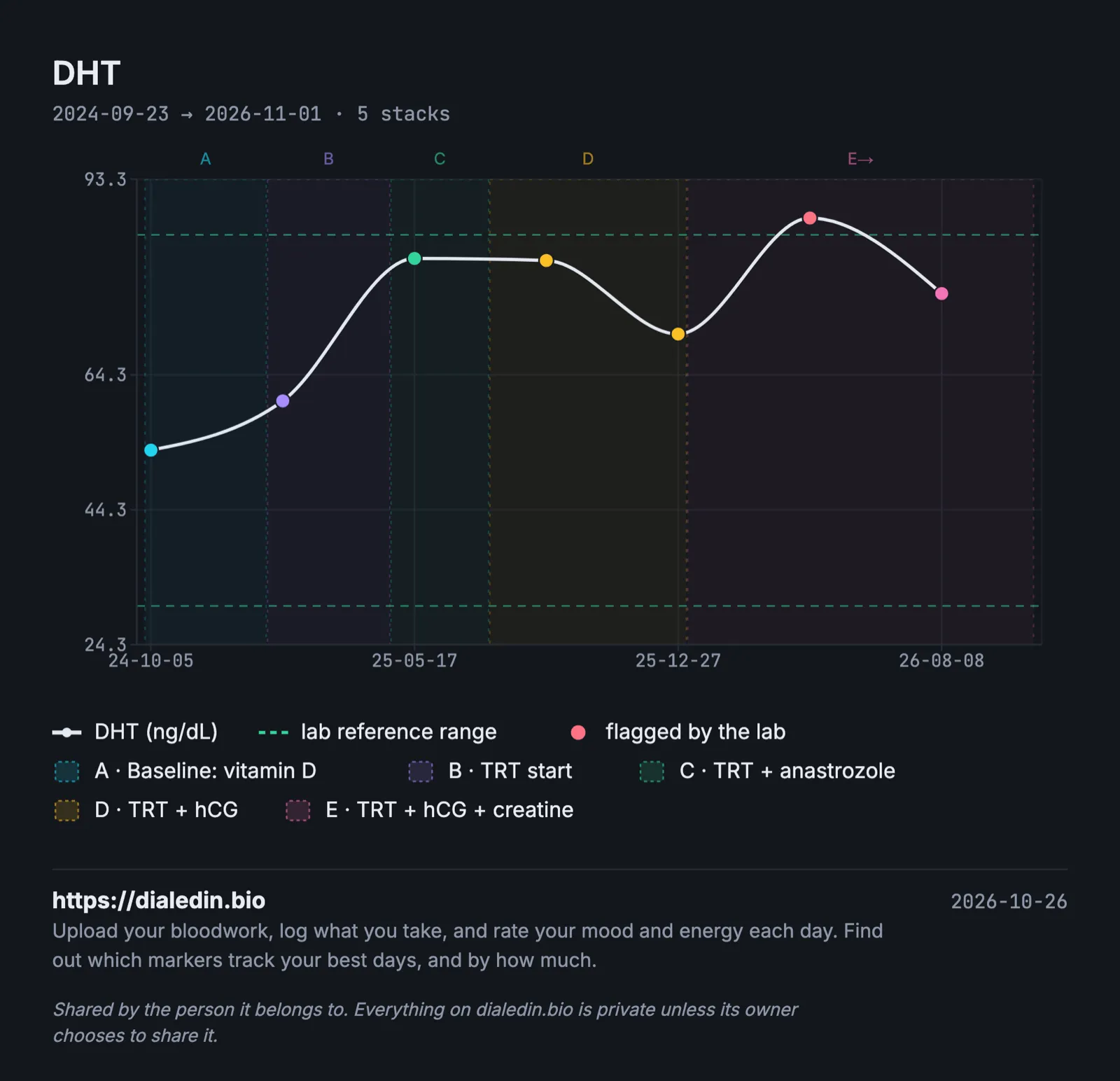
Sample data, not a real person.
DHT followed testosterone up after treatment started and then stayed in the upper part of the range, with one result just over it. On its own, that one flagged result says little. Next to the earlier ones, you can see it's part of a level that has been high in the range for a year, which is the more useful thing to discuss with a doctor.
If you track DHT next to estradiol, our DHT to estradiol ratio calculator works out the ratio from one report.
Why the method matters
DHT is hard to measure. It's structurally very close to testosterone and present at a much lower level, so older immunoassay tests can confuse the two. The more reliable method is LC-MS/MS, which many specialist labs use for DHT.
That makes the lab especially important. A DHT result from an immunoassay and one from LC-MS/MS can differ by more than the change you're trying to see. Results only compare within one lab and one method.
How to make DHT results comparable
Use the same lab and ask about the method
If you can choose, pick a lab that uses LC-MS/MS for DHT, and stay with it. Write the method next to each result if the report names it.
Test at the same point in your treatment
On TRT, DHT moves with testosterone through the injection or gel cycle. Test at the same point each time, the way our post on TRT blood test timing describes.
Keep gel away from the arm used for the draw
Testosterone gel on the skin near the draw site can contaminate the sample and raise both testosterone and DHT. Apply it somewhere else on test day, or ask the lab.
Test in the morning
DHT follows testosterone's daily rhythm to a degree. A morning test, like the testosterone one, keeps results comparable.
Note finasteride, dutasteride and any change
These lower DHT a lot within weeks. Write down when one started or stopped. Several hair-loss and prostate products sold as supplements claim to affect DHT too; note those as well.
Get testosterone and SHBG on the same draw
DHT on its own is hard to read. With total testosterone and SHBG from the same sample, you can see whether DHT moved with testosterone or apart from it.
Watch the units
DHT is reported in ng/dL, pg/mL or nmol/L. 1 ng/dL is 10 pg/mL, and nmol/L = ng/dL ÷ 29.04.
How often is DHT tested?
There's no standard schedule. It's tested when there's a question, often once before a change and once or twice after. If you're on TRT and your doctor checks it, testing at the same point in your cycle each time matters more than how often.
A record you can keep by hand
| Date | Lab | Method | Time | Total T (ng/dL) | DHT (ng/dL) | SHBG (nmol/L) | Notes |
|---|---|---|---|---|---|---|---|
| 2024-10-05 | City Lab | LC-MS/MS | 08:10 | 490 | 52 | 38 | before TRT |
| 2025-06-14 | City Lab | LC-MS/MS | 08:05 | 910 | 82 | 33 | on TRT, mid-cycle |
| 2026-04-18 | City Lab | LC-MS/MS | 08:20 | 950 | 88 | 32 | flagged high |
The method column is the one people skip, and it's the one that explains a sudden step after changing labs.
Where dialedin fits
We built dialedin so a result like that flagged DHT is read next to the ones before it.
You upload a lab PDF and it is read into individual markers, which you check before saving. Every report goes onto one timeline, and the same marker under different lab names stays one line. You can record what you were taking and when, like the shaded stacks above, and add an optional daily check-in to see which levels line up with your better days. You can export your history as a PDF for your doctor.
It's free while we're in beta. If your hormone results are spread across reports, put them on one timeline and see how they've changed.
This article is general information, not medical advice, and it can't take your own history into account. Talk to your doctor about what your DHT result means for you.