DHEA-S blood test: why it falls with age
DHEA-S shows up on hormone panels for men and women, and people usually read it the way they read every other line: in range or not. That misses the most important thing about it.
DHEA-S changes more with age than almost any other hormone on a routine panel. It rises through puberty, peaks in the twenties, then falls slowly for the rest of life, so a typical 70-year-old has a fraction of what they had at 25. Labs handle this by printing a reference range for your age band and sex. A result only makes sense against the right band, and a slow fall across years of tests is expected.
What DHEA-S is
DHEA, dehydroepiandrosterone, is a hormone made mainly by the adrenal glands. The body attaches a sulphate group to most of it, making DHEA-S. Both can be turned into testosterone and estrogens in other tissues, which is part of why they're tested.
| DHEA | DHEA-S | |
|---|---|---|
| Where it comes from | Adrenals, some from the ovaries and testes | Almost entirely the adrenals |
| How much it moves in a day | A lot, with a morning peak | Very little |
| How often it's tested | Less often | The usual test |
Because DHEA-S comes from the adrenals and barely changes across a day, it's the more useful one to follow. If a report says "DHEA" without the S, check which test was actually run; people often mean DHEA-S.
Why DHEA-S is tested
Doctors order it for a few reasons:
- In women with acne, excess hair growth or irregular periods, as one of the androgen tests.
- When the adrenal glands are being looked at, for making too much or too little.
- On wellness and hormone panels, where people follow it over time.
Taking DHEA as a supplement raises DHEA-S, and some people test it for that reason. Those supplements are sold in many countries without a prescription, and whether to take them is a conversation for your doctor.
Why the reference range depends on your age
A lab's DHEA-S range for a 25-year-old woman can have an upper limit several times higher than the one for a 65-year-old. The same result can be high for one person and low for another. So:
- Check that the range on your report matches your age and sex. A report that prints one adult range for everybody is less useful for this test.
- Expect a slow fall across years. A drop of a few percent a year is age, not news.
- Compare yourself with your own earlier results first, then with the range.
If the lab doesn't know your age or sex, it can't pick the right range. That's one of the few cases where those boxes on the request form really matter.
What one person's results look like
This is DHEA-S across eight tests over two years in a man in his thirties:
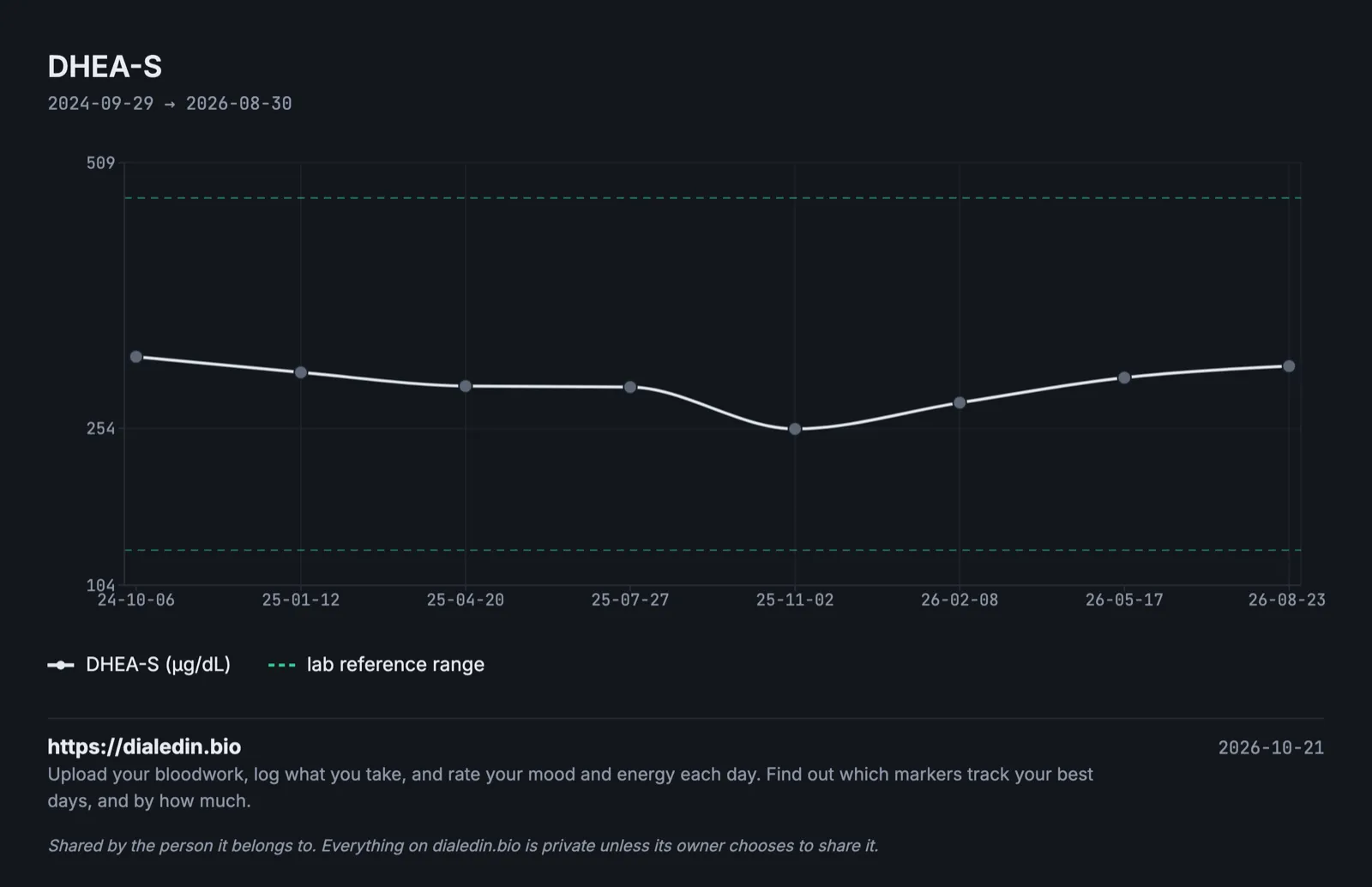
Sample data, not a real person.
The line moves slowly and smoothly, which is what DHEA-S usually does when tests are taken the same way. The lowest result is about a fifth below the first and still near the middle of the range. Two years is too short to see the age-related fall clearly. Ten years of results would show it.
How to make DHEA-S results comparable
Use the same lab
DHEA-S methods differ between labs, and so do the age bands. Copy the range from each report.
Make sure your age and sex are on the request
So the lab prints the right range. Check it on the report.
Test at a similar time of day
DHEA-S moves less than most hormones, but the other hormones on the same panel, like cortisol and testosterone, don't. A morning draw keeps the whole report comparable. Our post on cortisol tests explains why time of day matters for that one.
Note any DHEA supplement and its start date
Supplements raise DHEA-S, sometimes a lot. A result taken on DHEA isn't comparable with one taken off it.
Note other hormones you take
Testosterone, HRT, the pill and steroid medicines can all change DHEA-S or how it's read. Steroid medicines in particular can suppress it.
Stop biotin first, if your doctor agrees
Biotin in large amounts interferes with many hormone tests. A few days' break is the usual advice.
Watch the units
US labs report µg/dL, many others µmol/L. 1 µg/dL is about 0.0271 µmol/L, so 300 µg/dL is about 8.1 µmol/L.
How often is it worth testing?
When it's part of an investigation, your doctor decides. For tracking, once a year or with your regular hormone panel is plenty, because it changes slowly. The value is in the long series. Our post on why regular bloodwork matters covers that idea more broadly.
A record you can keep by hand
| Date | Lab | Age | DHEA-S (µg/dL) | Lab's range for age and sex | Time of draw | Notes |
|---|---|---|---|---|---|---|
| 2024-10-07 | City Lab | 36 | 323 | 138 to 475 | 08:15 | |
| 2025-11-03 | City Lab | 37 | 254 | 138 to 475 | 08:20 | |
| 2026-08-23 | City Lab | 38 | 315 | 138 to 475 | 08:10 |
The range column will change as the age band does. Copying it each time keeps old results readable.
Where dialedin fits
We built dialedin because DHEA-S only says much over many years, and years of reports are hard to keep together.
You upload a lab PDF and it's read into individual markers, which you check before saving. Every report goes onto one timeline with the lab's range drawn in, and the same marker under different lab names stays one line. You record what you take and when, such as a DHEA supplement. Optional daily check-ins sit alongside, and you can export your history as a PDF for your doctor.
It's free while we're in beta. If you've had DHEA-S tested before, put it on one chart and start the long series now.
This article is general information, not medical advice, and it can't take your own history into account. Talk to your doctor about your DHEA-S result and any supplements you take.