Cortisol blood test: why the time of day matters
Cortisol is the hormone people associate with stress, so a cortisol result tends to get read as a stress score. A high one means you're stressed, a low one means you're burnt out. Neither reading holds up.
The biggest thing in a cortisol result is the time on the clock. Cortisol follows a daily rhythm: it climbs in the early morning, peaks within an hour or so of waking, falls through the day and reaches its lowest around midnight. A blood test at 8am and one at 4pm can differ by half or more in the same person on the same day. The time of the draw has to be part of the result, and two results are only comparable if they were taken at a similar time.
What cortisol does, and what the blood test measures
Cortisol is made by the adrenal glands, under the control of ACTH from the pituitary. It helps regulate blood sugar, blood pressure, the immune response and the response to physical stress. The morning peak is part of what gets you going after waking.
A blood test measures total cortisol, most of which is bound to a carrier protein. Anything that changes that protein changes the result. The contraceptive pill and oral estrogen raise it, so cortisol on the pill often reads higher with no change in the free hormone.
When cortisol is tested
Doctors order cortisol mainly to look for two things: the body making too little (adrenal insufficiency) or too much (Cushing's syndrome). A morning blood test is usually the first step for the first question. For the second, doctors tend to use tests that don't depend on one morning: late-night saliva cortisol, a 24-hour urine collection (urinary free cortisol) or a suppression test with dexamethasone. Those decisions belong to your doctor, and a single blood cortisol rarely settles anything.
Cortisol also turns up on wellness panels, where people track it over time. That works only if every test is taken the same way.
What moves cortisol on the day
| What | Effect |
|---|---|
| Time since waking | The biggest effect: highest in the first hour, falling after |
| Night shifts or a very late night | The rhythm shifts, so "morning" means something else |
| Stress around the draw: rushing, a hard needle | Can raise it |
| Illness, injury, surgery | Raises it, sometimes a lot |
| Hard exercise | Raises it for a while |
| The pill, oral estrogen, pregnancy | Raise total cortisol through the carrier protein |
| Steroid medicines, including creams and inhalers | Can lower the body's own cortisol; some cross-react with the test |
Prednisolone in particular can be read as cortisol by some lab methods. Hydrocortisone is cortisol. Tell the lab and the doctor about any steroid you use, in any form.
What a steady routine looks like
This is morning cortisol across eight tests over two years, all drawn between 8 and 9am:
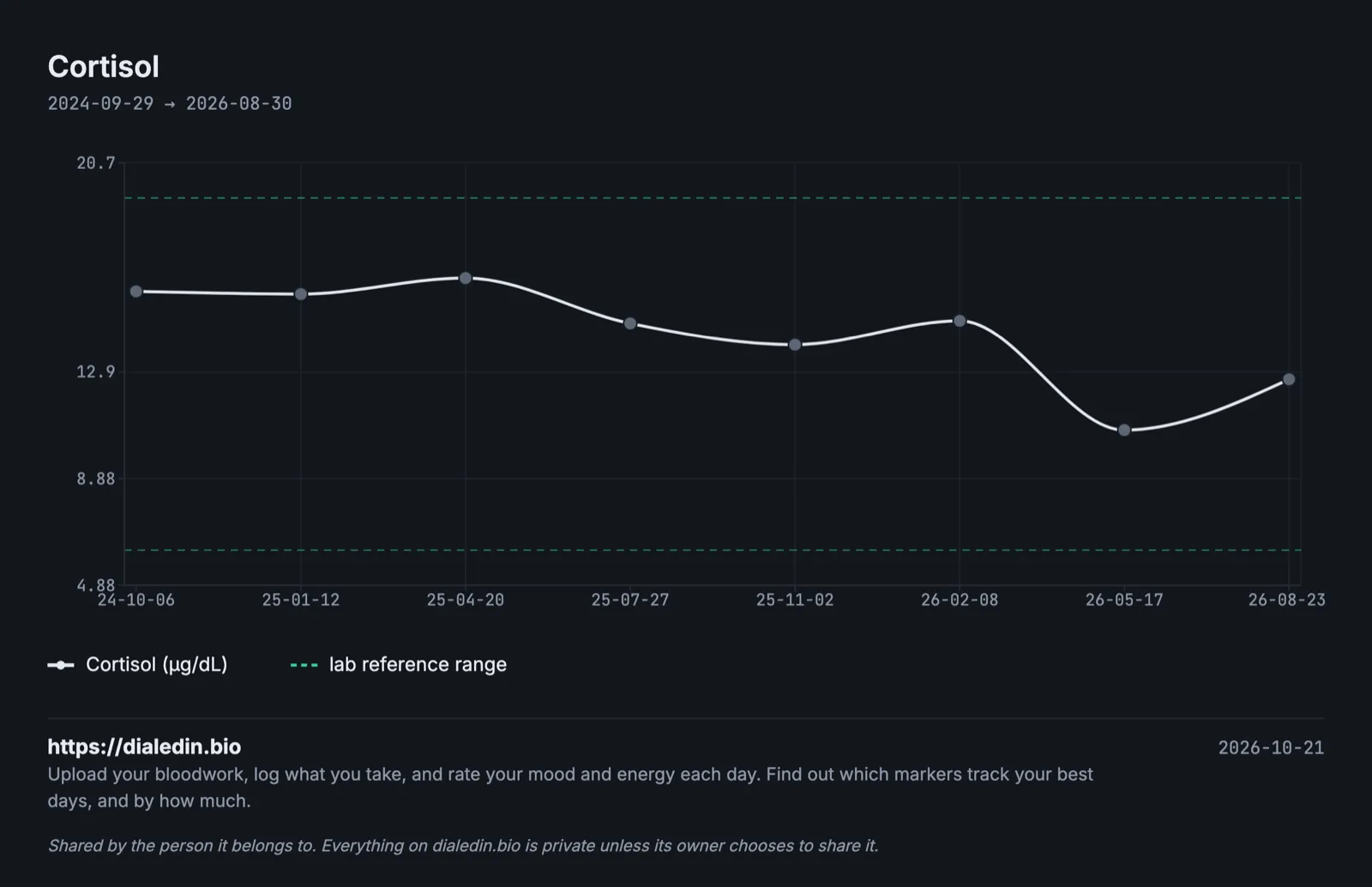
Sample data, not a real person.
Because the time of day was kept the same, the first six results sit in a narrow band and the drop in the last two stands out. If some of those tests had been drawn in the afternoon, they'd have dropped just as much, and the chart couldn't tell the two apart.
How to make cortisol results comparable
Book the same time every time
Most morning cortisol tests are drawn between about 7 and 9am. Pick one slot and keep it. Write the exact time on your record.
Keep your wake-up time similar
What matters is time since waking. A test at 8am after waking at 7 isn't the same as one at 8am after waking at 5.
Arrive calm
Leave time to sit for a few minutes before the draw. Rushing in late doesn't help.
Don't train hard that morning
Hard exercise raises cortisol for a while. Move training to after the test.
List every steroid you use
Tablets, injections, creams, inhalers, nasal sprays and joint injections in the past months. Some lower your own cortisol for weeks, and some show up in the test.
Note the pill, HRT and pregnancy
They raise total cortisol without a change in the free hormone.
Watch the units
US labs report µg/dL, many others nmol/L. 1 µg/dL is about 27.6 nmol/L.
How often is it worth testing?
When your doctor is investigating a question, they'll set the schedule and probably the test type. For tracking on a wellness panel, cortisol fits naturally with a regular panel, once or twice a year. One rule matters more than frequency: same time of day, every time. Our post on why prolactin results bounce around covers another hormone where the conditions of the draw decide a lot of the result.
A record you can keep by hand
| Date | Lab | Woke at | Time of draw | Cortisol (µg/dL) | Steroids used | Notes |
|---|---|---|---|---|---|---|
| 2025-07-28 | City Lab | 06:45 | 08:20 | 14.7 | none | |
| 2025-11-03 | City Lab | 06:50 | 08:15 | 13.9 | none | |
| 2026-05-11 | City Lab | 06:40 | 08:25 | 10.5 | none |
"Woke at" is the column that lets two morning results be compared.
Where dialedin fits
We built dialedin so the conditions around a result stay attached to it.
You upload a lab PDF and it's read into individual markers, which you check before saving. Every report goes onto one timeline, and the same marker under different lab names stays one line. You record what you take and when. Sleep data from your phone sits on the same timeline, so a short night before a test is easy to spot, and optional daily check-ins show how you felt. You can export your history as a PDF for your doctor.
It's free while we're in beta. If you've had cortisol tested more than once, put the results on one chart and check they were taken at the same time.
This article is general information, not medical advice, and it can't take your own history into account. Talk to your doctor about why cortisol is being tested and how to prepare.