CRP vs hs-CRP: the same protein, two tests
People who see CRP on one report and hs-CRP on another usually assume they're two different markers, or that one is a better version of the other. Then they compare the numbers and get confused.
They measure the same protein. C-reactive protein is made by the liver when there's inflammation in the body, and it can rise a thousandfold during a serious infection. A standard CRP test is built to measure those big rises. The high-sensitivity test, hs-CRP, is built to measure the low levels found in healthy people precisely, because small differences there have been linked to heart disease risk. Same molecule, different range, different question.
What each test is for
| CRP | hs-CRP | |
|---|---|---|
| Measures well | Medium to very high levels | Very low to moderate levels |
| Used for | Infections, flare-ups of inflammatory conditions, recovery after surgery | Part of heart disease risk assessment in people who are well |
| Typical question | "Is there active inflammation, and is it going down?" | "Is there low-grade inflammation when nothing is wrong?" |
| Units | mg/L, sometimes mg/dL | mg/L |
Below its lower limit, a standard CRP report often just says "<5" or "<3". hs-CRP gives an actual number there, such as 0.9 or 1.6.
Some reports print CRP in mg/dL, a factor of ten different. A CRP of 0.5 mg/dL is 5 mg/L. Check before comparing.
Why hs-CRP jumps
hs-CRP is meant to measure quiet, low-level inflammation, but it can't tell that apart from anything else that makes the liver produce CRP. These can raise it sharply for days to weeks:
- A cold, flu or any other infection, even a mild one.
- A cut, dental work, a sprain or surgery.
- A hard workout or a long race.
- A flare of an inflammatory condition, such as arthritis or gum disease.
Slower influences move the baseline: body fat, smoking, poor sleep, some hormone treatments (oral estrogen raises it), and blood sugar control.
Because of these spikes, a joint statement from the American Heart Association and the CDC suggested measuring hs-CRP twice, about two weeks apart, when it's used for heart risk, and repeating a very high result once any infection has settled (Pearson et al., 2003).
What a cold looks like on a chart
This is hs-CRP across 13 tests over two years:
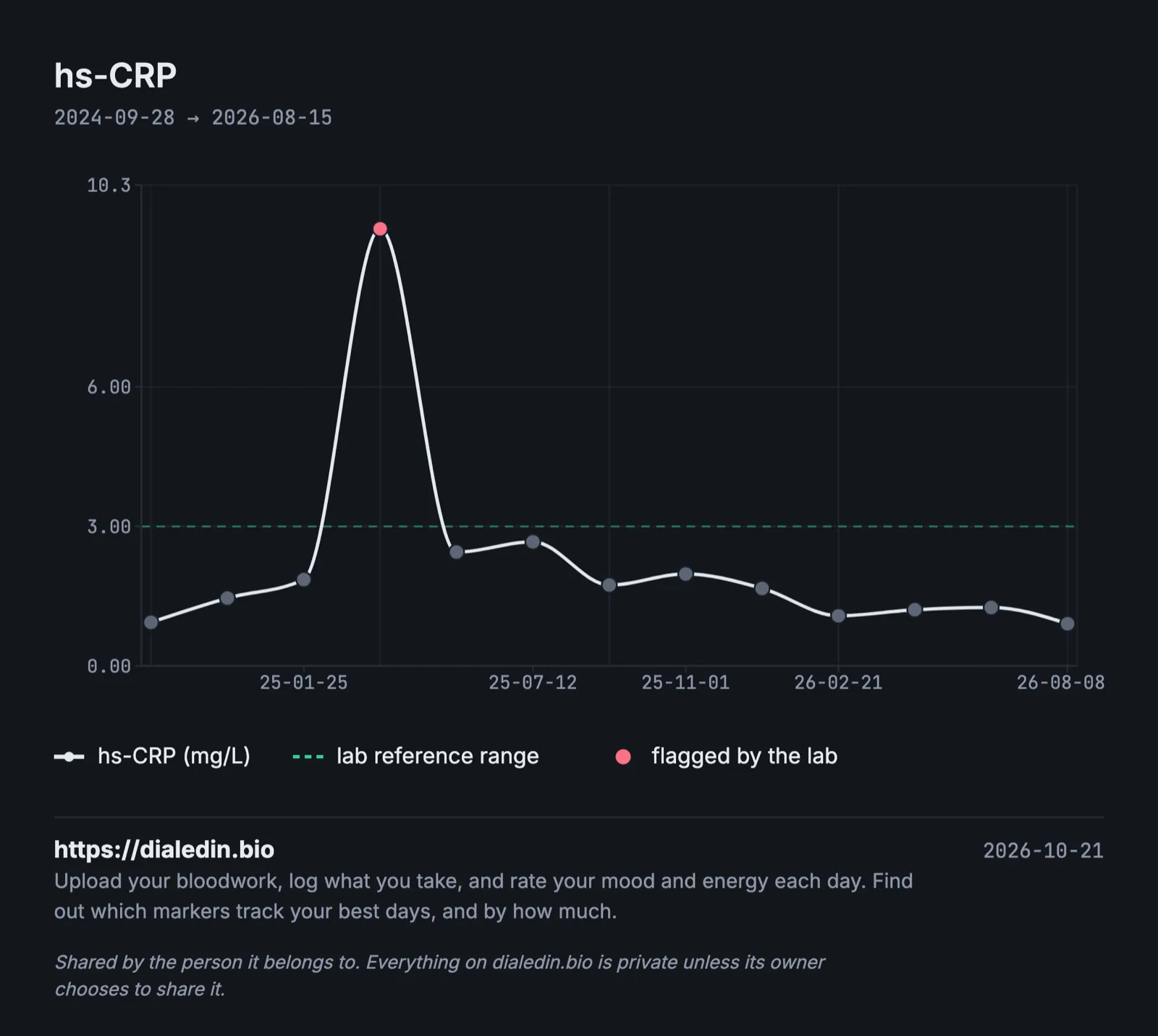
Sample data, not a real person.
The March result was drawn the week after a cold. It's five times the results either side and says nothing about long-term inflammation. Under it, a slower story runs: a gentle rise over the first year and a fall in the second. You can only see the slow story if the spike is labelled for what it is.
How to get hs-CRP results you can compare
Don't test while you're ill, or for a couple of weeks after
If you've had a cold, an infection or a fever recently, move the test. If you can't, note it next to the result.
Avoid hard exercise in the two days before
A long run or a heavy session raises CRP for a day or more.
Note injuries, dental work and flare-ups
Anything that inflamed a part of your body in the past couple of weeks belongs in the notes.
Ask for the same test each time
If you want to follow low-level inflammation, ask for hs-CRP specifically, not CRP. A standard CRP that reads "<5" can't be compared with an hs-CRP of 1.2.
Check the units on every report
mg/L and mg/dL differ by ten. Convert before you chart.
Keep the same lab
hs-CRP methods are fairly well matched, but small differences matter when the numbers are around 1.
Note anything that moves the baseline
Starting oral estrogen, quitting smoking, losing weight, changing a medicine. A date next to the result shows what changed.
How often is it worth testing?
For heart risk, your doctor decides whether hs-CRP adds anything to what they already know, and it's often measured once or twice. A standard CRP is ordered to look for inflammation, and repeated to watch it come down. For tracking on your own panels, testing hs-CRP with your regular panel is enough. Keeping illness away from test day is what makes the series useful. Our post on ferritin and iron explains why CRP is often ordered with ferritin, and the one on ApoB vs LDL covers another test used in heart risk.
A record you can keep by hand
| Date | Lab | Test | Result | Unit | Ill in last 2 weeks | Hard exercise in last 48 h | Notes |
|---|---|---|---|---|---|---|---|
| 2025-01-26 | City Lab | hs-CRP | 1.9 | mg/L | no | no | |
| 2025-03-23 | City Lab | hs-CRP | 9.4 | mg/L | cold, last week | no | |
| 2025-05-18 | City Lab | hs-CRP | 2.5 | mg/L | no | no |
The "ill" column is what keeps the 9.4 from being read as a change.
Where dialedin fits
We built dialedin so a one-off result can be seen against everything around it.
You upload a lab PDF and it's read into individual markers, which you check before saving. Every report goes onto one timeline, and the same marker under different lab names stays one line. You record what you take and when, and optional daily check-ins show how you felt, so a week of feeling ill sits right next to the spike it caused. You can export your history as a PDF for your doctor.
It's free while we're in beta. If you've had CRP or hs-CRP tested more than once, put the results on one chart and see which ones belong to the trend.
This article is general information, not medical advice, and it can't take your own history into account. Talk to your doctor about your CRP results and what they mean for you.