Platelet count and MPV: what the numbers show
The platelet lines sit near the bottom of a full blood count, and most people only notice them when one is flagged. Then they search for "MPV" or "plateletcrit" and find pages written for lab students.
The fact that changes how you read them: a low platelet count on one report is quite often a property of the sample, not of your blood. Platelets can clump together in the standard tube, and the analyser counts a clump as one cell or misses it. Labs know this well and repeat the count in a different tube when they suspect it. And healthy people tend to have either more, smaller platelets or fewer, larger ones, so the count and MPV are best read together.
What the platelet lines on a blood count mean
Platelets are small cell fragments that start blood clotting. Depending on the analyser, your report can print up to four lines about them:
| Line | What it describes | Usual unit |
|---|---|---|
| Platelet count (PLT) | How many platelets are in a volume of blood | ×10³/µL or ×10⁹/L (the same number) |
| MPV, mean platelet volume | Average size of a platelet | fL (femtolitres) |
| PDW, platelet distribution width | How much the platelets vary in size | fL or % |
| Plateletcrit (PCT) | Share of the blood's volume taken up by platelets | % |
The count is the line doctors look at first. MPV is printed by most labs. PDW and plateletcrit only appear on some analysers, which is why many people have never seen them. Plateletcrit is calculated from the other two: roughly the count multiplied by MPV. Your lab's reference ranges are the ones that apply, and the glossary pages list each line with the sources we could cite.
Why the count and MPV move in opposite directions
Across healthy people, a higher platelet count tends to come with a lower MPV, and a lower count with a higher MPV. The total volume of platelets stays roughly similar, made up either of more small ones or fewer large ones. That is why an MPV slightly outside the range on a report where the count is at the other end of its range is usually unremarkable.
MPV also reflects how young the platelets are. Newly made platelets are larger, so when the bone marrow is making them faster, for example after platelets have been used up, MPV tends to rise.
What moves the platelet count
These are the common reasons a platelet count changes. None is a diagnosis, and a count that stays out of range or keeps moving one way is worth raising with your doctor.
The count rises with inflammation and infection (platelets are one of the things the body makes more of when it is fighting something), with iron deficiency, after losing blood, and briefly after hard exercise. It can stay a bit high for weeks after an illness while things settle.
It falls during some viral infections, with regular heavy drinking, with some medicines, and in late pregnancy. It is also lower for a while in a sample where the platelets clumped.
Women tend to have slightly higher counts than men, and counts drift down a little with age.
When a low platelet count is the tube
The standard tube for a blood count contains an anticoagulant called EDTA. In a small share of people, EDTA makes the platelets stick to each other in the tube. The analyser then counts too few, and the report says the platelet count is low. Lab staff call this pseudothrombocytopenia ("false low platelets").
It has nothing to do with how your blood behaves in your body. The usual check is to look at a blood smear for clumps, or to repeat the count in a different type of tube (citrate). If your history shows a low platelet count that keeps coming back normal on a repeat, mention this to your doctor. Once it is known, a note on your file saves a lot of repeat tests.
Sample age matters too. In EDTA, platelets swell over the hours after the draw, so MPV reads higher in a sample that waited before it was run.
A steady platelet count looks like this
For most healthy people the count sits in a narrow band of their own, much narrower than the lab's range. This is thirteen tests over two years:
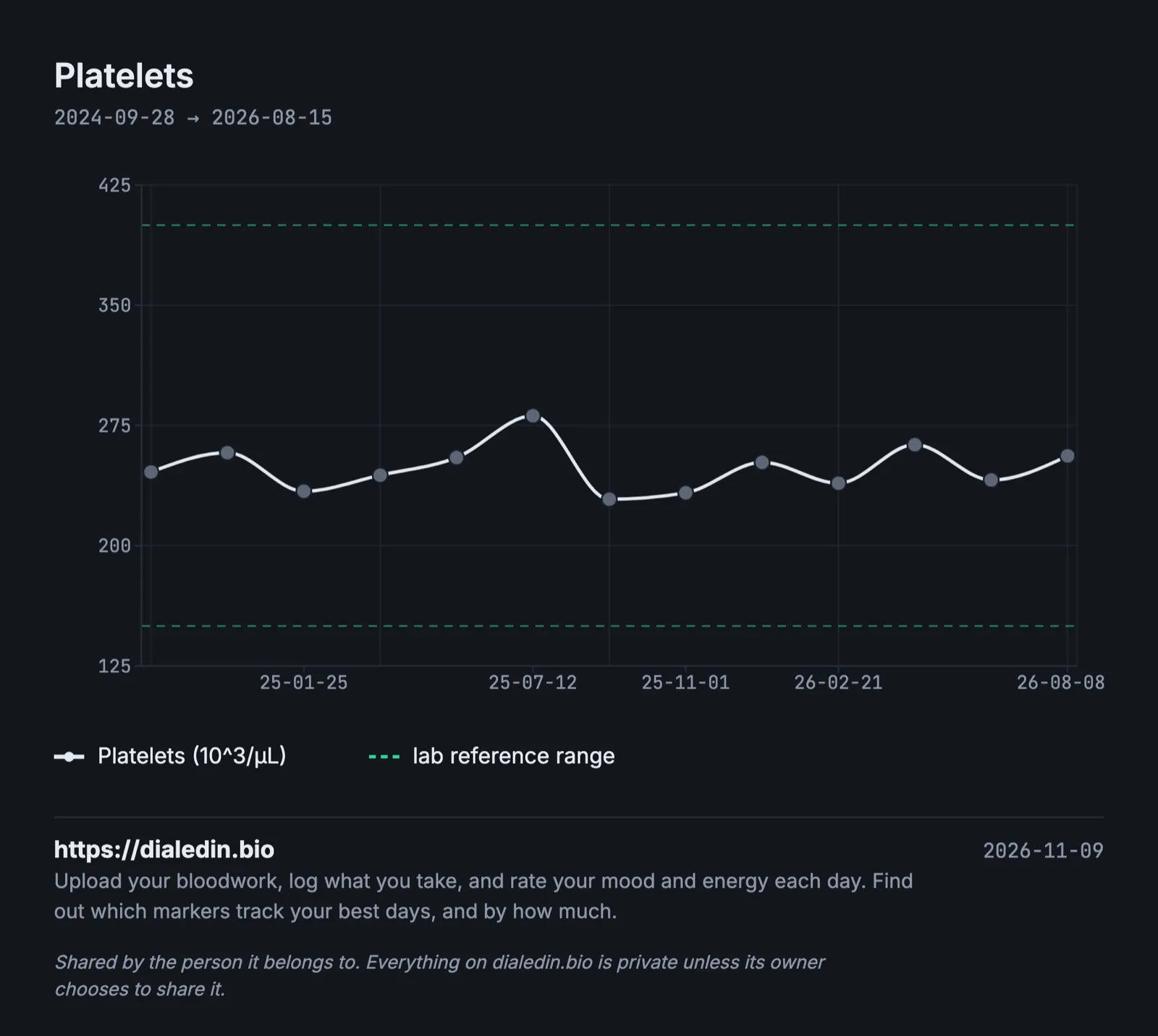
Sample data, not a real person.
The lab's range runs from 150 to 400. This person's own results stay between about 230 and 280. Against that history, a result of 180 would stand out even though no lab would flag it, and a single low result followed by a normal repeat would read as what it probably was.
How to compare platelet results between tests
Get the sample run quickly
MPV rises the longer the sample waits, and clumping gets worse with time. A draw in the lab itself is usually run sooner than one couriered from a clinic. If your draws happen in different places, write down where.
Use the same lab
MPV in particular depends on the analyser. Two makers can report noticeably different MPVs for the same blood, and their reference ranges reflect that. Compare MPV only within one lab. The count travels better between labs, but still expect a small step.
Don't test in the middle of an infection
An infection can push the count up or down, depending on the type. Unless the test is about the illness, move it, or note it next to the result.
Skip hard exercise the day before
A hard session releases platelets that were held in the spleen, and the count rises for a while afterwards. Keep the day before a test similar each time.
Note medicines, alcohol and supplements
Some medicines lower the count, and regular heavy drinking does too. Iron treatment can bring a raised count back down as iron stores recover. A line in your notes saves guessing later.
Write down a "clumped" comment
If the report says the platelets were clumped, or that the count was repeated in citrate, keep that comment with the result. It is the most useful single note for anyone reading your history later.
How often are platelets checked?
Platelets come with every full blood count, so they are checked whenever you have one. How often that should be depends on your health and any treatment, and is a question for you and your doctor.
When a count is flagged, the usual next step is a repeat, often in a different tube or after an illness has passed. Most single flags settle. A result from a time you felt well is the one to compare against, and a series of three or more from the same lab is what shows whether anything is moving.
Keeping a record by hand
One row per test, the count and MPV next to each other, and a notes column:
| Date | Lab | Platelets (×10³/µL) | MPV (fL) | Where drawn | Notes |
|---|---|---|---|---|---|
| 2025-02-10 | City Lab | 246 | 10.1 | lab | |
| 2025-06-02 | City Lab | 142 | 10.4 | GP clinic | report says "platelet clumps seen" |
| 2025-06-09 | City Lab | 251 | 10.0 | lab | repeat in citrate tube |
In this made-up example the flagged result has its explanation sitting right next to it.
Where dialedin fits
We built dialedin to keep exactly this kind of history without copying numbers by hand.
You upload a lab PDF and it is read into individual markers, which you check before saving. Every report goes onto one timeline, so your own band for the platelet count is visible at a glance, like the chart above. Different lab names for the same marker stay one line. You can add what you were taking and when, and before an appointment export everything as a PDF. The other blood count lines have their own posts: red cell indices and the white cell differential.
It is free while we are in beta. If your blood counts are scattered across PDFs, put them on one timeline and see where your own range sits.
This article is general information, not medical advice, and it can't take your own history into account. Talk to your doctor about what your platelet results mean for you.