Lipoprotein(a): the cholesterol test you take once
Lipoprotein(a), usually written Lp(a) and said "L-P little a", isn't on a standard cholesterol panel. Most people only meet it when a doctor orders it after a family history comes up, or when they add it to a private panel because they read about it somewhere.
It behaves differently from every other line on a lipid report. LDL, HDL and triglycerides move with diet, weight, exercise and medicines, which is why people retest them. Lp(a) is mostly set by the genes you inherited and reaches its adult level in early childhood. For most people it stays roughly where it is for life. That's why the European Atherosclerosis Society suggests every adult have it measured at least once (Kronenberg et al., 2022), and why one good result can be worth keeping for decades.
What lipoprotein(a) is
Lipoprotein(a) is a particle that looks a lot like LDL: a ball of cholesterol and fat wrapped around one apolipoprotein B molecule. What makes it different is an extra protein, apolipoprotein(a), attached to the outside. The size of that extra protein varies from person to person, which turns out to matter for the units (more on that below).
Because each Lp(a) particle carries ApoB, it's counted in an ApoB result. Its cholesterol is also counted inside most LDL cholesterol results. Our post on ApoB vs LDL explains how those two relate.
Why one test is often enough
A few things follow from Lp(a) being mostly inherited.
- Everyday changes in diet and exercise barely move it, so a retest after a new diet usually shows the same number.
- Your level is likely to be similar to your parents' and siblings'. Some guidelines suggest testing close relatives of people with a high result.
- A result from ten years ago is usually still informative, as long as you know which unit it was in.
There are exceptions. Kidney disease, an underactive thyroid and menopause can all raise Lp(a), and inflammation can nudge it up for a while. If one of those applies, your doctor may want a repeat. Otherwise, one careful measurement goes a long way.
This is Lp(a) measured four times over two years, next to triglycerides from the same person:
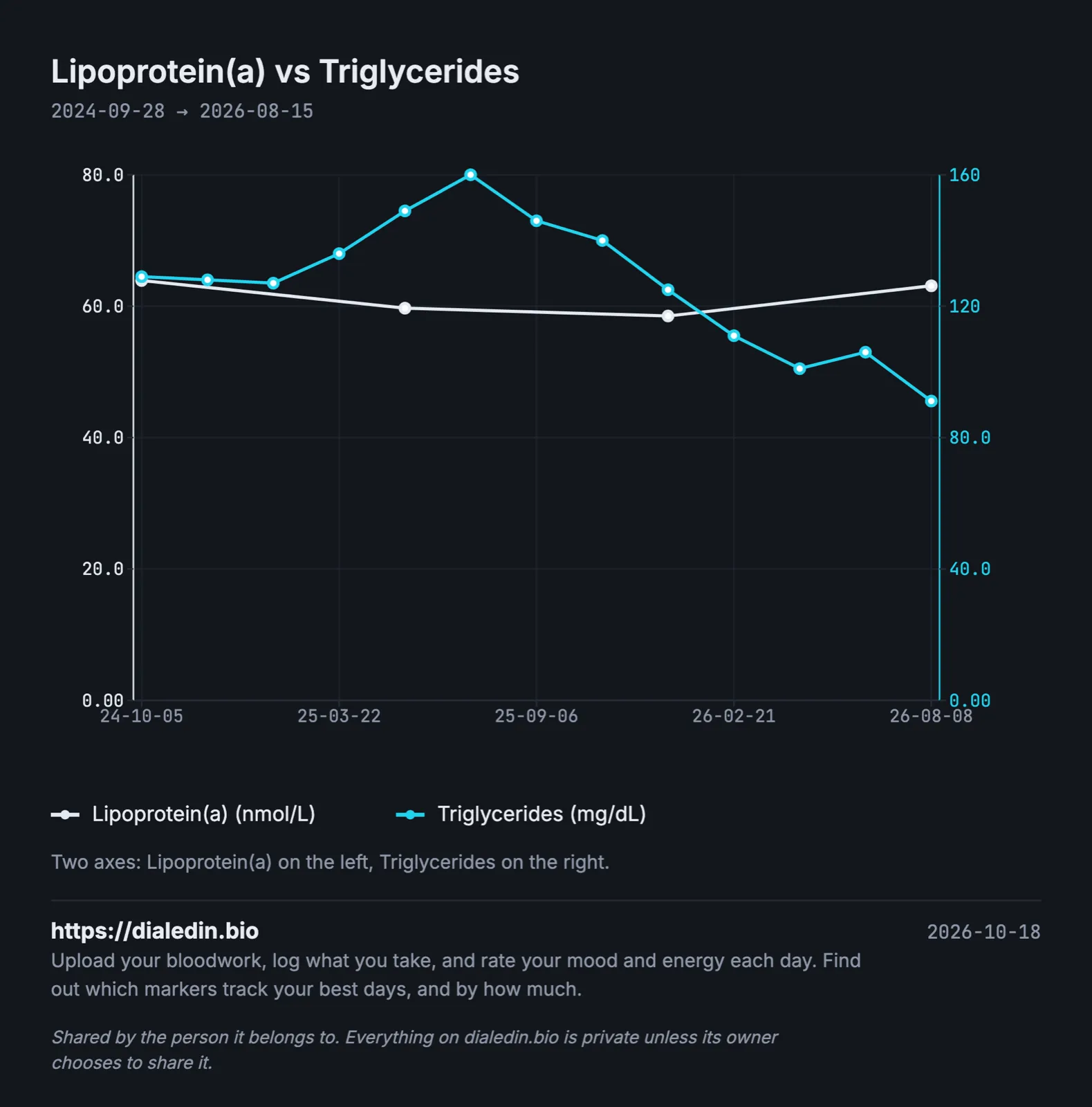
Sample data, not a real person.
Triglycerides rose and fell by more than half over the same two years. Lp(a) stayed put. Most of the small wobble in the Lp(a) line is the test's own variation.
The unit trap: nmol/L vs mg/dL
Lp(a) is reported in two units, and unlike most markers, they can't be reliably converted.
nmol/L counts particles. mg/dL weighs them. Because the extra protein on each particle comes in many sizes, the weight of one particle varies from person to person. Converting between the two needs a factor that depends on particle size, so the single conversion factors you find online are rough approximations that can be well off for you.
What to do about it:
- Note the unit on every result. A number without its unit is close to useless for Lp(a).
- If you have results in both units, keep them as two separate series, and don't convert one into the other.
- Many labs and guidelines now prefer nmol/L, because it counts particles. If you have the choice, ask for that.
How to get a useful Lp(a) result
Ask for it, because it usually isn't included
Lp(a) isn't part of a standard lipid panel in most places. Ask your doctor whether it makes sense for you, especially if close relatives had heart disease early. Many private labs offer it as a separate test.
Write down the lab, the unit and the method
Methods differ in how well they handle different particle sizes. Since you may only test once or twice in your life, the details of that one result matter more than usual. Keep the original report.
Don't test during an illness
Inflammation can raise Lp(a) for a while. Test when you're well, and note anything that was going on.
Keep it with your other lipid results
Lp(a) is easier to read next to LDL, ApoB, HDL and triglycerides from the same period, and next to your family history. One row in your records is enough.
Tell close family if it's high
Because it's inherited, your result says something about your parents, siblings and children. Whether they get tested is their decision with their own doctor, but they can't make it if they don't know.
Retest only when something has changed
A new kidney or thyroid diagnosis, menopause, or a new treatment aimed at Lp(a) are reasons your doctor might want another result. Otherwise, a second test mainly confirms the first.
What the result means for you
That depends on the rest of your picture: your other lipids, blood pressure, blood sugar, smoking and family history. Lp(a) is one input your doctor weighs among those. A high result on its own isn't a diagnosis, and a low one doesn't cancel out other risks. Bring the result, its unit and your family history to the conversation.
Recording it by hand
Since you won't have many results, a small table is plenty. The columns that matter most are the unit and the conditions.
| Date | Lab | Lp(a) | Unit | Method (if printed) | LDL-C (mg/dL) | ApoB (mg/dL) | Notes |
|---|---|---|---|---|---|---|---|
| 2018-04-11 | Hospital lab | 28 | mg/dL | 121 | old result, mg/dL | ||
| 2025-02-03 | City Lab | 62 | nmol/L | immunoassay | 116 | 98 | well, fasted |
The two results are in different units, so they stay in separate series. The 2018 one is still useful as a record, and it's a reason to ask about the method.
Where dialedin fits
We built dialedin to keep results like these from getting lost, including the one you only take once.
You upload a lab PDF and it is read into individual markers, which you check before saving. Every report goes on one timeline, the same marker under different lab names stays one line, and each result keeps the unit the lab printed. Your Lp(a) sits on the same chart as the lipids that do move, and you can mark what you were taking and when. Before an appointment you can export your whole history as a PDF.
It's free while we're in beta. If your Lp(a) result is buried in an old PDF, put it on the same timeline as everything else so it's there when you need it.
This article is general information, not medical advice, and it can't take your own history into account. Talk to your doctor about whether you should have Lp(a) tested and what your result means for you.