Estrone (E1): the other estrogen on your report
Most hormone panels report estradiol and stop there. Then one day a lab adds a line called estrone, or E1, sometimes next to a "total estrogens" result, and it's higher than the estradiol number beside it. People reasonably ask whether that's a problem.
Often it's expected. Estrone is a weaker estrogen made largely from other hormones in fat tissue, and after menopause it's the main estrogen in the blood. Its level also depends a lot on how HRT is taken: estradiol tablets turn into estrone in the gut and liver, so women on oral estradiol usually have far more estrone than women on a patch. One estrone number means little without knowing that.
What estrone is
The body makes three main estrogens:
| Estrogen | Short name | Where it matters most |
|---|---|---|
| Estradiol | E2 | The strongest; the main estrogen from puberty to menopause |
| Estrone | E1 | Weaker; the main estrogen after menopause |
| Estriol | E3 | Mainly made in pregnancy |
Estrone and estradiol turn into each other all the time, in the liver and in many other tissues. Estrone is also made directly from androstenedione, an androgen from the adrenal glands and ovaries, by the enzyme aromatase. Aromatase is especially active in fat tissue.
Estrone after menopause
Before menopause, the ovaries make most of the estradiol and the ratio of estradiol to estrone is high. After menopause the ovaries make very little, and most remaining estrogen is estrone made in fat tissue from adrenal androgens. The ratio flips.
That's why body weight affects estrone levels more than estradiol after menopause: more fat tissue, more aromatase, more estrone.
Estrone on HRT: tablets vs patches and gels
How estradiol is taken changes the estrone result more than almost anything else.
Estradiol tablets pass through the gut and liver first, where a large part is converted to estrone. Women on oral estradiol commonly have estrone well above their estradiol.
Patches, gels and sprays put estradiol straight into the bloodstream through the skin. The ratio of estrone to estradiol stays closer to what it was before menopause.
Neither ratio is "right". They're what each route does. But it means an estrone result has to be read with the route written next to it, and a change of route shows up as a big step in estrone. Our post on estradiol on HRT covers the timing of the draw for each form.
Estrone in men
Men make estrone too, mostly by aromatase in fat tissue from androstenedione and testosterone. On TRT it often rises along with estradiol. Estrone is rarely part of a routine men's panel, though. When estrogen is checked in men it's almost always estradiol, which our post on estradiol in men on TRT explains.
What estrone and estradiol look like together
This is estradiol and estrone from one woman across two years of tests, before and after starting HRT with a patch:
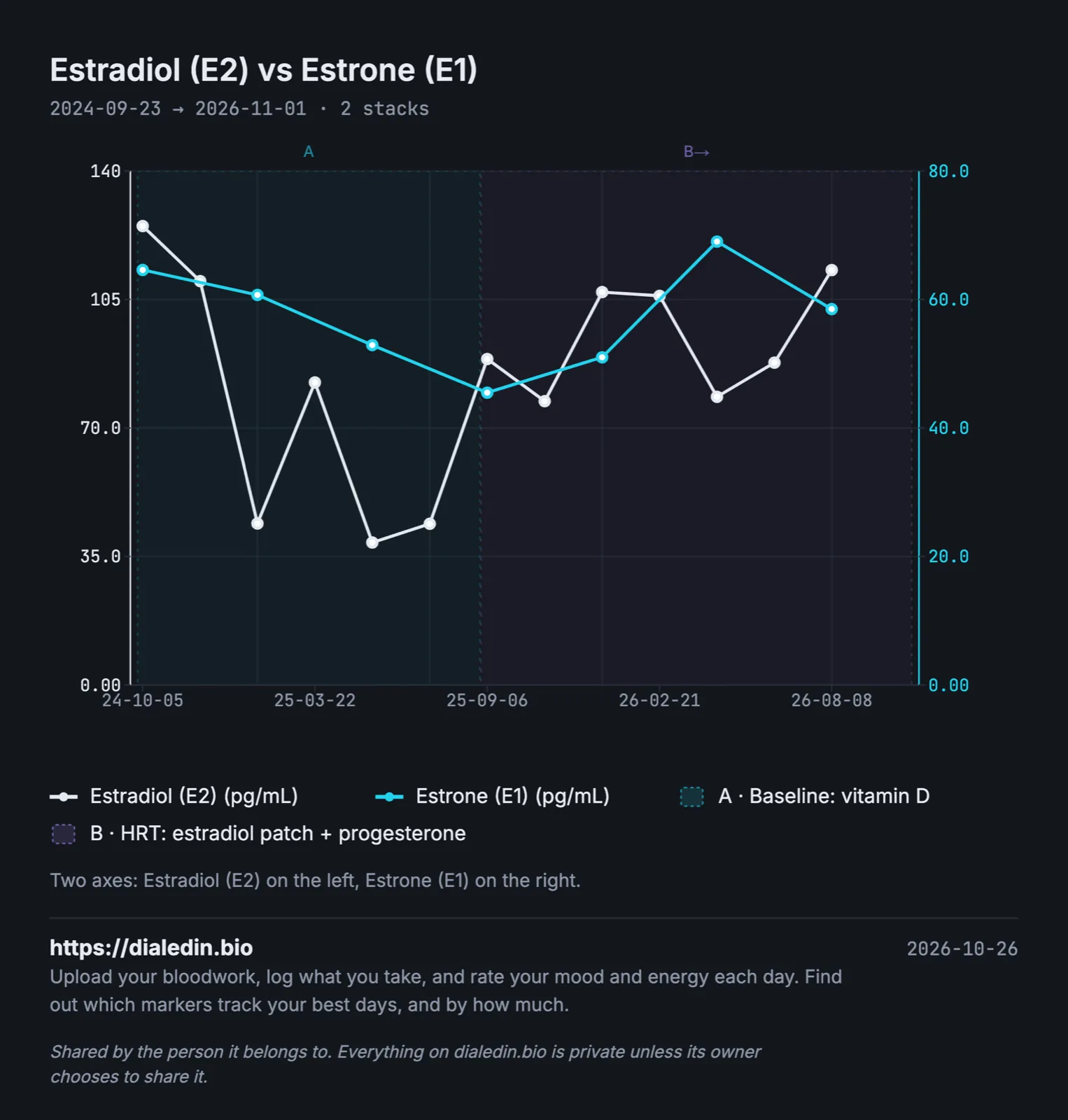
Sample data, not a real person.
Before HRT, estradiol jumps around with whatever her ovaries did that month. Estrone, made mostly outside the ovaries, moves much less. On the patch both settle, and estrone stays below estradiol, as it usually does with a skin route. On tablets, the estrone line would sit higher.
How to make estrone results comparable
Write down the HRT route and the timing
Tablet, patch, gel or spray, and how long since the last one. For estrone, the route matters even more than the timing.
Use a lab that measures it by LC-MS/MS
Estrone is present at low levels and is best measured by a method called LC-MS/MS, which many specialist labs use for it. Some estradiol tests can also pick up a little of other estrogens. Staying with one lab and one method keeps results comparable.
Get estradiol on the same draw
Estrone on its own is hard to read. With estradiol from the same sample you can see the balance between them, which is what changes with route and weight.
Note weight changes
After menopause especially, a large change in body weight can move estrone. A one-line note explains it later.
Check the units
Estrone is reported in pg/mL or pmol/L. To convert, pmol/L = pg/mL × 3.699. Estradiol's factor is slightly different, 3.671, because the molecules weigh slightly different amounts. Our post on testosterone units covers the other lines on a hormone panel.
Don't add the estrogens together yourself
"Total estrogens" tests exist but measure different things at different labs. Adding E1 and E2 from separate tests doesn't give the same number. Track them as separate lines.
How often is estrone tested?
Not often. It isn't part of routine HRT monitoring in most guidelines, which mostly go by symptoms and, sometimes, estradiol. It's ordered in specific situations: questions about how HRT is being absorbed, some fertility and gender-affirming care, and some research and specialist settings. If yours is being tested, ask why. The reason tells you which other results to read it with.
A record you can keep by hand
| Date | Lab | Route | Hours since last | Estradiol (pg/mL) | Estrone (pg/mL) | Notes |
|---|---|---|---|---|---|---|
| 2025-06-14 | City Lab | none | 42 | 52 | cycle day 3 | |
| 2025-11-01 | City Lab | patch | 48 | 96 | 51 | patch on the other hip |
| 2026-04-18 | City Lab | patch | 36 | 104 | 69 |
If you ever switch between tablets and a patch, start a new note in the route column. It will explain the biggest change in the estrone line.
Where dialedin fits
We built dialedin so results like these stay next to what you were taking at the time.
You upload a lab PDF and it is read into individual markers, which you check before saving. Every report goes onto one timeline, and the same marker under different lab names, including names in other languages, stays one line. You can put two markers on one chart, like estrone and estradiol above, and record what you were taking and when. An optional daily check-in shows which levels line up with your better days, and you can export your history as a PDF for your doctor.
It's free while we're in beta. If your hormone results are spread across reports, put them on one timeline and see how they relate.
This article is general information, not medical advice, and it can't take your own history into account. Talk to your doctor about what your estrogen results mean for you.