Vitamin D blood test: units, timing and trends
Vitamin D is one of the tests people order for themselves most often, and one of the easiest to misread. A result of 75 can be low or comfortably in range depending on the units, and a result from February can't be compared with one from August as if nothing else changed.
The test measures 25-hydroxyvitamin D, the form the body stores, and it changes slowly. It takes weeks to respond to sunlight or a supplement and months to settle at a new level. Most of the confusion between two results comes from three things: the units, the season and the lab method. Fix those and a vitamin D series becomes one of the clearest lines on a chart.
What the test measures
Vitamin D from sunlight or food is turned by the liver into 25-hydroxyvitamin D, often written 25-OH-D or 25(OH)D. It stays in the blood for weeks, so it's a good record of what you've had recently. That's the standard vitamin D test.
The kidneys then turn a small amount into 1,25-dihydroxyvitamin D, the active hormone. It's tightly controlled, short-lived and often normal or even high when stores are low. It isn't the test for vitamin D status, and ordering it by mistake is common.
Units: ng/mL and nmol/L
| Unit | Where | Conversion |
|---|---|---|
| ng/mL | US and some others | × 2.5 to get nmol/L |
| nmol/L | UK, Europe, Australia, Canada | ÷ 2.5 to get ng/mL |
The exact factor is 2.496. A result of 30 ng/mL is 75 nmol/L. Mixing the two on one chart makes it look as if vitamin D jumped or crashed by more than half when only the lab changed.
Different organisations also use different cut-offs for "enough", so two labs can flag the same result differently. Read your result against your lab's printed range, and ask your doctor which target they go by.
What moves vitamin D
- Season. In places far from the equator, levels are usually highest in late summer and lowest in late winter or early spring.
- Sun exposure, skin tone, sunscreen and time spent indoors.
- Body fat: vitamin D is stored in fat, and levels tend to be lower with more of it.
- Supplements and fortified food. A new supplement takes about two to three months to reach a steady level.
- Some medicines and gut conditions that affect fat absorption.
What a supplement looks like on a chart
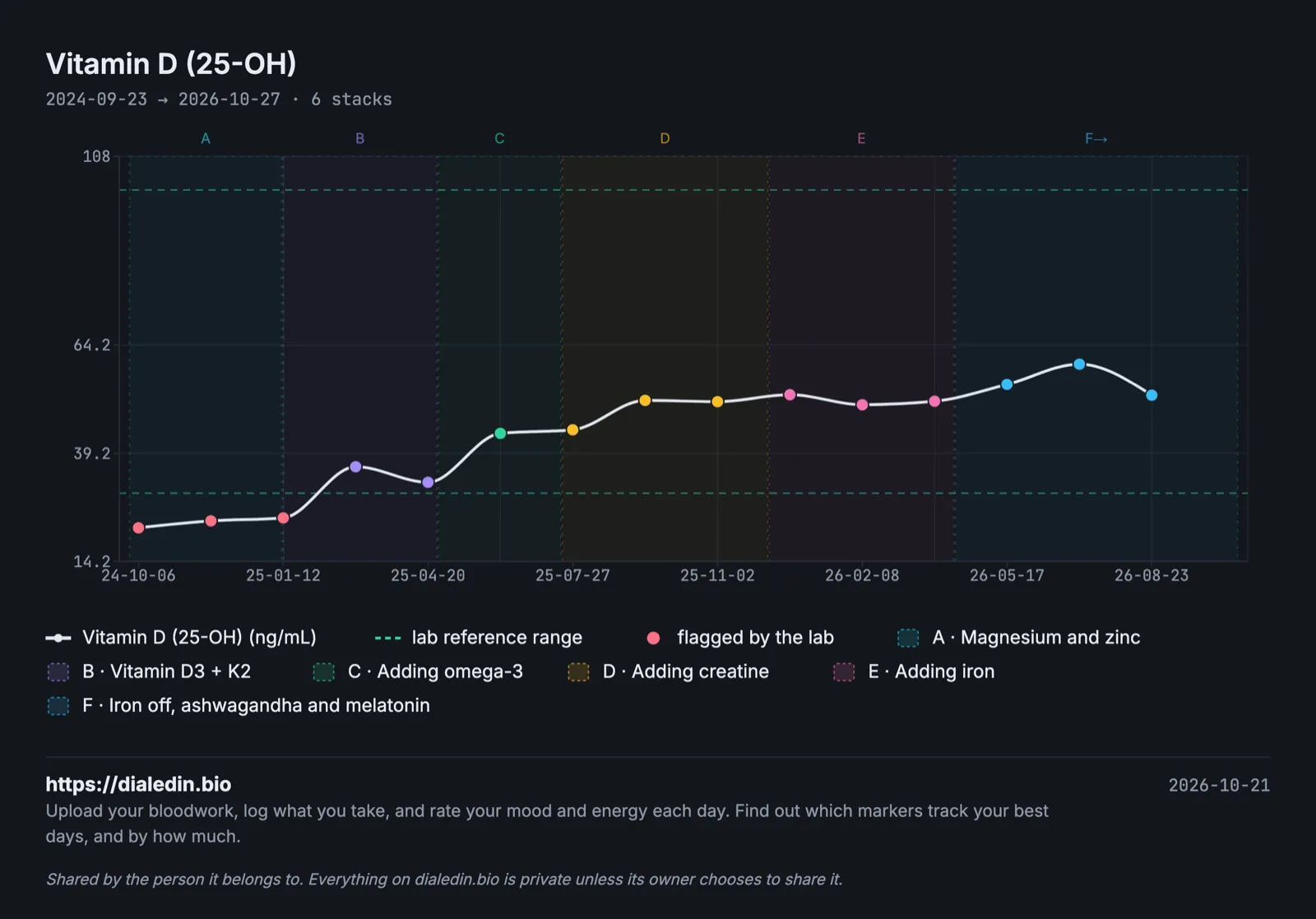
This is vitamin D across 15 tests over two years, with the supplement stacks shaded:
Sample data, not a real person.
The climb doesn't happen in one step. The first result after starting is a bit higher, the next few keep rising, and the level settles months later. A test taken a few weeks after starting would have understated where it ended up. The summer bumps on top of the plateau are the season.
How to make vitamin D results comparable
Use one unit in your records
Convert everything to ng/mL or nmol/L and label the column. Keep the original next to it for checking.
Note the month
A winter result and a summer result differ even with no change in habits. When you compare, compare the same season, or at least know which season each one was.
Wait about three months after a change
After starting, stopping or changing a supplement, levels take weeks to months to settle. A test sooner shows a level that's still moving.
Stay with one lab and method
Labs use immunoassays or LC-MS/MS, and they don't always agree. Some immunoassays also measure vitamin D2, the plant form, less well than D3. Note the method if the report names it.
Stop biotin first, if your doctor agrees
Biotin in large amounts interferes with many immunoassays, including some for vitamin D. A few days' break is the usual advice.
Write down supplements and their start dates
Include multivitamins, fortified drinks and fish oil with vitamin D in it. Without a date, the climb in the chart above has no explanation.
How often should vitamin D be tested?
The Endocrine Society's 2024 guideline suggests against routine vitamin D testing for most healthy adults (Demay et al., 2024), so many doctors only test for a reason: a condition that affects absorption, bone problems, or checking a supplement they've suggested. If you are tested, a common pattern is a result before starting something and another about three months later. Your doctor decides. Testing more often than every few months adds little, because the level can't move much faster.
A record you can keep by hand
| Date | Lab | Month | 25-OH vitamin D | Unit | In ng/mL | Supplement | Notes |
|---|---|---|---|---|---|---|---|
| 2025-01-13 | City Lab | January | 24.3 | ng/mL | 24.3 | none | |
| 2025-03-03 | City Lab | March | 36.1 | ng/mL | 36.1 | D3 since 2025-01-13 | |
| 2025-11-03 | Clinic B | November | 128 | nmol/L | 51.3 | D3 | different lab |
The last row is the reason for the "in ng/mL" column. Read raw, 128 looks like it more than tripled.
Where dialedin fits
We built dialedin so a supplement and the result it moved sit on one chart.
You upload a lab PDF and it's read into individual markers, which you check before saving. Every report goes onto one timeline, and the same marker under different lab names stays one line. You record what you take and when, so a climb like the one above lines up with the stack that caused it. Optional daily check-ins show how you felt, and you can export your history as a PDF for your doctor.
It's free while we're in beta. If your vitamin D results are spread across labs and units, put them on one timeline and see the real trend.
This article is general information, not medical advice, and it can't take your own history into account. Talk to your doctor about whether vitamin D testing or a supplement makes sense for you.