Bilirubin blood test: total, direct and fasting
Bilirubin is the line on a liver panel that gets flagged more than any other in people who otherwise feel fine. You see an H next to "bilirubin, total", search it, and land on pages about jaundice and liver disease.
Bilirubin is also one of the easiest results to push up without anything being wrong. In many people it rises after a missed meal, a day of fasting, a bad cold or a hard few days of training. A common inherited trait, Gilbert's syndrome, makes that effect larger, and many people only find out they have it from exactly this kind of flag. The split between direct and indirect bilirubin on the same report is often what tells the two kinds of rise apart.
What bilirubin is
Red blood cells live about four months. When old ones are broken down, the haemoglobin inside them is turned into bilirubin, a yellow pigment. That bilirubin travels in the blood to the liver, which changes it chemically so it can leave in bile.
So there are two forms in the blood:
| Form | Also called | What it is |
|---|---|---|
| Indirect | Unconjugated | Bilirubin on its way to the liver, not yet processed |
| Direct | Conjugated (roughly) | Bilirubin the liver has already processed |
| Total | The two added together |
Most labs measure total and direct bilirubin and work out indirect as the difference. Some only measure the total unless asked. The names "direct" and "indirect" come from how the old lab method reacted with each form, and they stuck.
Total vs direct bilirubin: why the split matters
The two forms rise for different reasons, so which one is up says a lot about where to look.
When mainly the indirect part rises, the extra is bilirubin that hasn't reached the liver's processing step yet. That happens when more red cells are broken down than usual, or when the liver's processing step is a bit slow, as in Gilbert's syndrome. The direct part stays normal.
When the direct part rises, bilirubin has been processed but isn't leaving in bile as it should. That points towards the liver itself or the bile ducts, and is something to raise with your doctor without waiting for the next routine test.
That's why the direct line is worth looking at whenever the total is flagged. A raised total with a normal direct result reads very differently from a raised total where the direct part is up too.
Gilbert's syndrome and fasting
Gilbert's syndrome is a common inherited difference in the enzyme the liver uses to process bilirubin. The NHS describes it as harmless and not needing treatment. People with it usually have a total bilirubin near the top of the range or a bit over, mostly indirect, with normal liver enzymes.
What makes it confusing is how much the number swings. Fasting, a missed meal, illness, dehydration, stress, poor sleep and hard exercise can all push it up for a day or two. One test can be flagged and the next perfectly normal. In this made-up person, three of thirteen results are over the range:
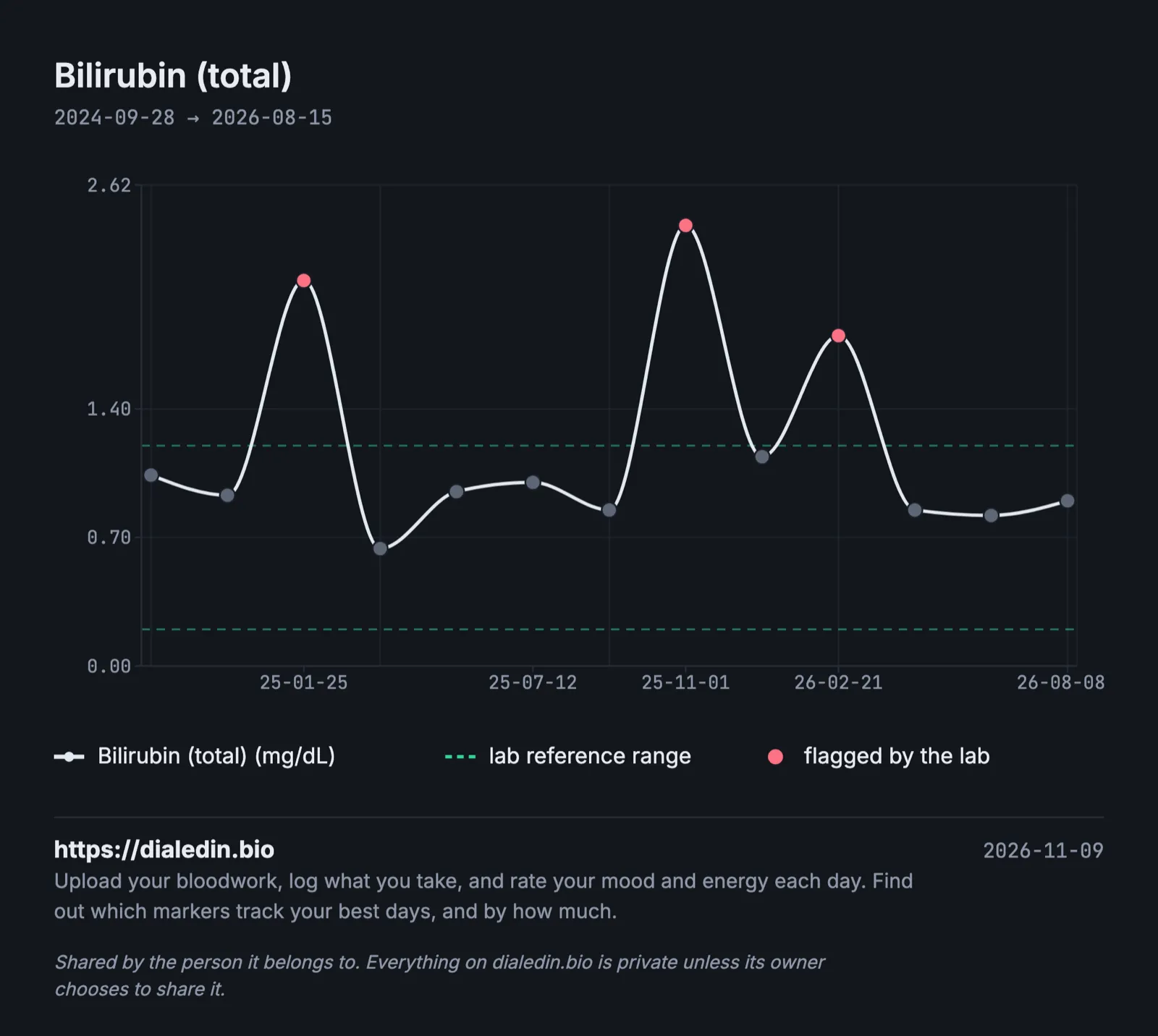
Sample data, not a real person.
The three flagged draws were taken after a missed dinner, the week after a cold, and after a long fast. On every one, direct bilirubin and the liver enzymes were normal. One flagged result on its own could mean many things. With the history and the notes beside it, the pattern is much easier for a doctor to read.
Whether a pattern like this is Gilbert's is a diagnosis, and that is your doctor's call. It is often made from repeat tests like these together with normal liver enzymes and a normal blood count.
What else moves bilirubin
These are the common reasons outside Gilbert's. None is a diagnosis.
More red cells being broken down raises the indirect part. That can come from a red cell condition, from a large bruise healing, or from very hard endurance training.
Some medicines raise bilirubin, either by competing with the liver's processing or by affecting bile flow.
A liver or bile duct problem tends to raise the direct part, usually together with changes in ALT, AST, ALP or GGT. Our post on ALT and AST after the gym covers how training moves the enzymes on the same panel.
How to make bilirubin results comparable
Most of the swing in bilirubin between two reports comes from the days before the test. These habits keep it down.
Eat normally the day before
Skipping dinner, or a day of fasting, can raise bilirubin by the next morning, particularly with Gilbert's. If your test asks for an overnight fast, that's fine. Make it a normal overnight fast after a normal dinner, and keep it the same each time. Our post on fasting before a blood test covers which tests need it.
Don't test during or just after an illness
A cold or a stomach bug can raise bilirubin for several days. Move the test if it isn't about the illness, or write it down.
Drink normally
Dehydration concentrates the blood and raises bilirubin a little, on top of what it does to other lines.
Skip hard training for a day or two
Long or very hard sessions break down more red cells and can raise ALT and AST too. A rest day before a test keeps the whole liver panel cleaner.
Use the same lab and check the units
Bilirubin is reported in mg/dL in the US and in µmol/L in most other places. 1 mg/dL is about 17.1 µmol/L. Mix the two in one list and a normal result looks seventeen times too high.
Write down what came before the draw
One line is enough: "missed dinner", "had flu last week", "ran a half marathon Sunday". For bilirubin, these notes explain most of the flags.
How often should bilirubin be checked?
Bilirubin is part of the standard liver panel, so it is usually checked whenever that panel is. How often depends on your health and any treatment, and is for you and your doctor to decide.
When it is flagged on its own, the usual next step is a repeat under normal conditions, with direct bilirubin included. If you already know you run high when you fast, say so at the appointment, and bring the earlier results. A raised direct bilirubin, yellowing of the skin or eyes, dark urine or pale stools are reasons to speak to a doctor promptly, not at the next routine test.
Tracking bilirubin by hand
A small table with the direct part and a notes column does most of the work:
| Date | Total (mg/dL) | Direct (mg/dL) | ALT (U/L) | Ate normally the day before? | Notes |
|---|---|---|---|---|---|
| 2025-01-25 | 2.1 | 0.17 | 22 | no | skipped dinner |
| 2025-03-22 | 0.6 | 0.18 | 17 | yes | |
| 2025-11-01 | 2.4 | 0.16 | 20 | yes | cold the week before |
After a few rows, the flagged results and their reasons sit side by side.
Where dialedin fits
We built dialedin because the note that explains a result is usually lost by the time anyone looks at it again.
You upload a lab PDF and it is read into individual markers, which you check before saving. Every report goes onto one timeline, so total and direct bilirubin and the liver enzymes each become a line you can chart, like the one above. You can record what you were taking and when, and add notes about the days before a draw. Before an appointment you can export your history as a PDF.
It is free while we are in beta. If you have a bilirubin flag and a few old reports, put them on one chart and bring the whole picture to your doctor.
This article is general information, not medical advice, and it can't take your own history into account. Talk to your doctor about what your bilirubin results mean for you.